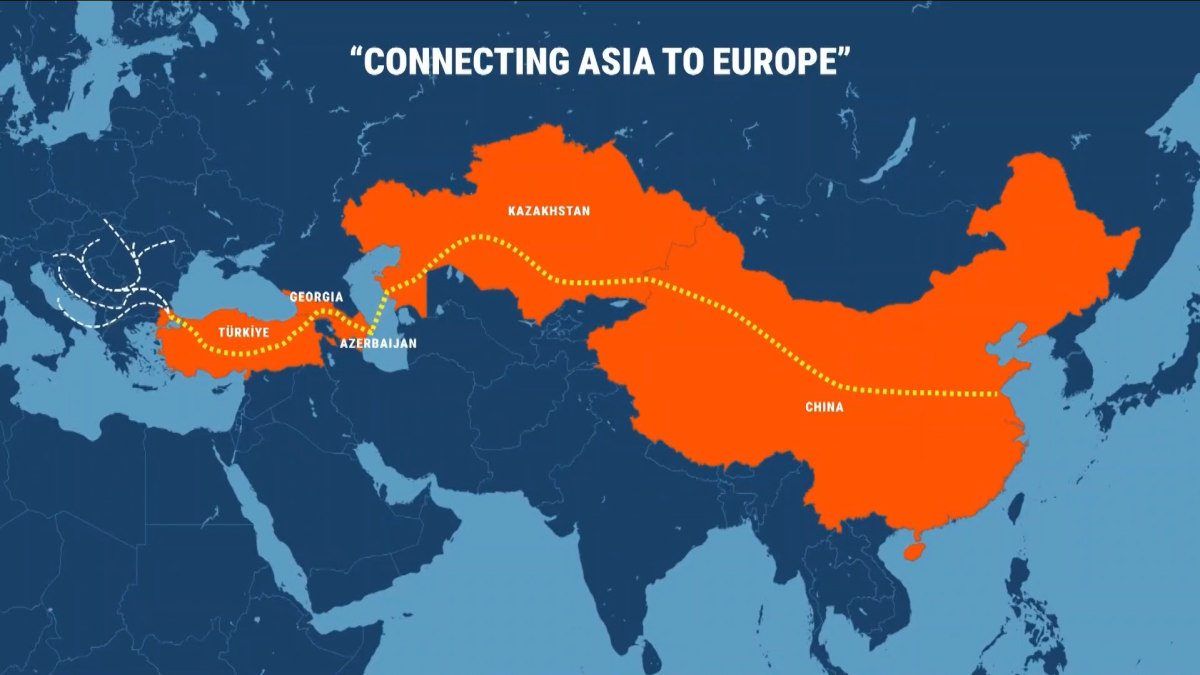
The South Caucasus is increasingly being viewed not only through the lens of past conflicts but also as a strategic bridge linking Europe, the Caspian region and Central Asia. One analyst says this presents an opportunity for a new Euro-Atlantic approach focused on long-term regional cooperation.
From peacebuilding to region-building
Political analyst Ahmad Alili argues that lasting stability in the South Caucasus cannot depend solely on peace agreements or external mediation. Instead, he says, it requires stronger institutions, shared economic interests and practical links between countries that have often been treated separately.
"The recent developments that took place in the South Caucasus require a new strategy for the transatlantic community to engage with the South Caucasus and Central Asia. We believe this shift should be from peacebuilding to region-building," Alili said.
He explained that peacebuilding often focuses on addressing the immediate symptoms of conflict, whereas region-building aims to create the conditions for deeper integration.
"By region-building, we mean developing institutions and creating conditions in which the region can be integrated. These countries should be approached as one unified, comprehensive region, with mechanisms that allow them to engage with each other as peers and build common defence, economic and other forms of cooperation," he added.
A wider strategic space
Alili also argues that the South Caucasus and Central Asia should be understood as part of a broader strategic space, where transport routes, energy corridors and access to international markets are creating increasing interdependence.
"There is a certain phase in their historical development when they need each other, because without the South Caucasus, Central Asia cannot reach European and international markets. Their sovereignty will be restricted if they do not have alternative access to world markets," he said.
At the same time, he stressed that Azerbaijan, Georgia and Armenia should be integrated within a single regional framework while also strengthening cooperation with Central Asian states.
"Working together within the South Caucasus can increase their visibility and importance in the transatlantic community. As a result, we can have a comprehensive region that may be called the greater Caspian region," Alili noted.
The greater Caspian region
Alili suggested that a more integrated "greater Caspian region" could become a source of new ideas, innovation and sustainable growth.
"This greater Caspian region can be a source of new ideas, innovative development and technologies. It can help the countries in the region become more sustainable in terms of development, conflict resolution and many other aspects," he said.
Connectivity at the centre of regional strategy
The discussion reflects a wider debate over the future of connectivity across Eurasia, as transport, energy and trade routes through the South Caucasus gain renewed strategic importance.
For Alili, the region's next chapter depends not only on maintaining peace but also on building the institutions, partnerships and practical mechanisms needed to sustain long-term cooperation.
As global attention increasingly turns towards alternative trade corridors and energy routes, the South Caucasus is being seen as a key link between Europe, the Caspian basin and Central Asia.











What is your opinion on this topic?
Leave the first comment