U.S. President Donald Trump says his so-called 'Board of Peace' on Gaza "might" replace the United Nations, but said the body should "continue."
When asked directly if he wanted his Board of Peace to replace the UN, he replied: “Well it might," before adding: "You got to let the UN continue.”
His comments came amid concerns that his proposed Board of Peace could undermine existing international institutions.
“The UN just hasn’t been very helpful. I am a big fan of the UN potential but it has never lived up to its potential,” Trump said during a briefing.
The White House has named several board members, including U.S. Secretary of State Marco Rubio, Trump’s special envoy Steve Witkoff, former British Prime Minister Tony Blair, and Trump’s son-in-law Jared Kushner. Israel is among several states to accept Trump's invitation to be on the Board.
Donald Trump is expected to announce the Board of Peace Charter in Switzerland later today. Several of the founding member states are expected to attend. A senior White House official said around 35 countries have committed in total, but only 20 have been publicly named.
A UN Security Council resolution, which was adopted in mid-November, authorised the Board of Peace and cooperating countries to establish an international stabilisation force in Gaza, where a fragile ceasefire began in October under a Trump-backed plan accepted by Israel and Hamas.
Trump later said the board could be expanded to address conflicts globally.
Azerbaijan agrees to join Trump's 'Board of Peace'
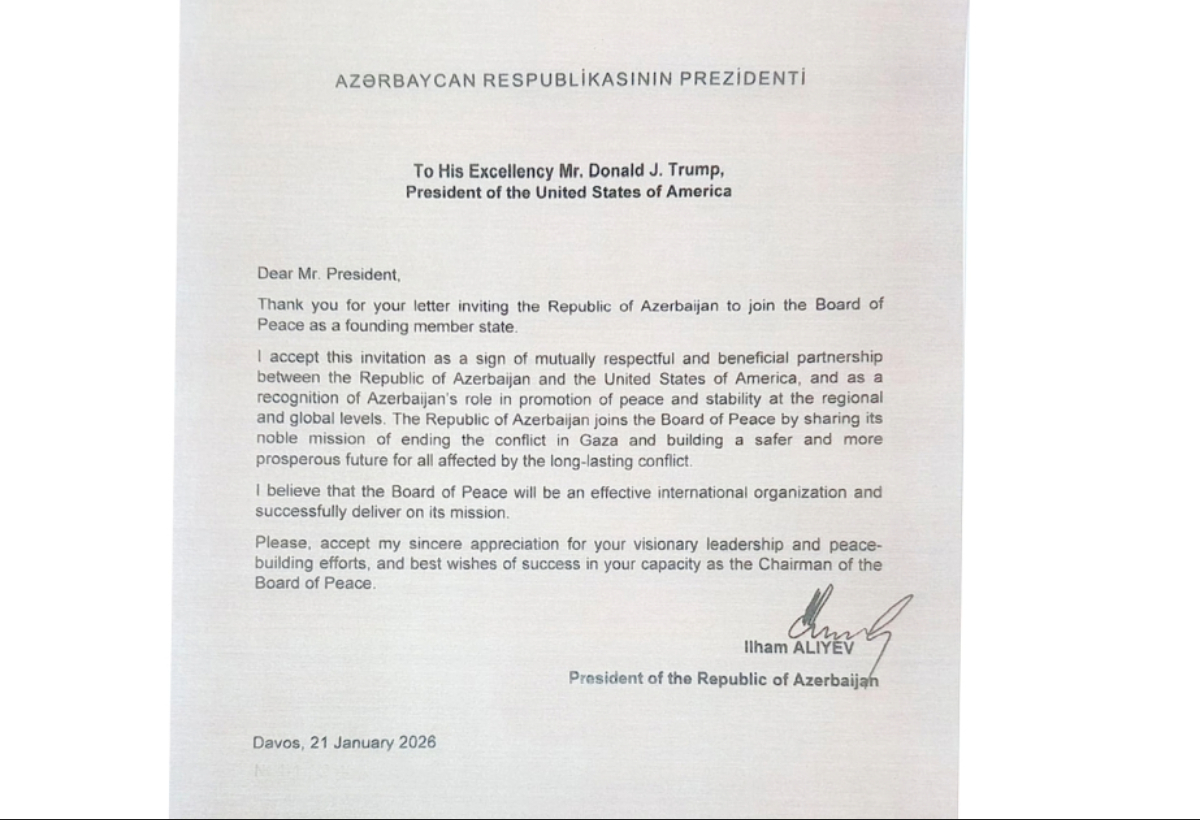
Azerbaijan said on Wednesday that it had accepted an invitation from U.S. President Donald Trump to join his 'Board of Peace' for Gaza.
In a statement on joining the 'Board of Peace,' the President of Azerbaijan Ilham Aliyev described the move “as a recognition of Azerbaijan’s role in promotion of peace and stability at the regional and global levels.”
Several countries have responded to invitations to join a proposed peace initiative announced by U.S. President Donald Trump.
The 'Board of Peace' was initially propelled by the aim to end the conflict in Gaza, but Trump has said it could resolve conflicts globally.
Armenian Prime Minister Nikol Pashinyan joined it on Tuesday, his spokesperson said.
Egypt’s foreign ministry said in a statement that it had also agreed to join.
Israel’s Prime Minister Benjamin Netanyahu on Wednesday accepted President Donald Trump’s invitation to join the so-called ‘board of peace’, saying the body could later be expanded to address conflicts elsewhere, Netanyahu’s office posted on X.
Kazakhstan’s President Kassym-Jomart Tokayev said his country would also join after accepting an invitation, with his spokesperson noting Tokayev’s intention to contribute to stability in the Middle East.
Italian Prime Minister Giorgia Meloni said Italy was ‘ready to do our part’, without specifying whether her remarks referred specifically to Gaza or broader peace efforts.
Canada has agreed in principle to take part, Prime Minister Mark Carney said, adding that details are still under discussion.
Hungary has accepted the invitation, with Prime Minister Viktor Orbán calling it ‘honourable’ in a post on X.
Separately, Saudi Arabia, Türkiye, Egypt, Jordan, Indonesia, Pakistan and Qatar have also accepted invitations to join the board, their foreign ministers said in a joint statement on Wednesday.
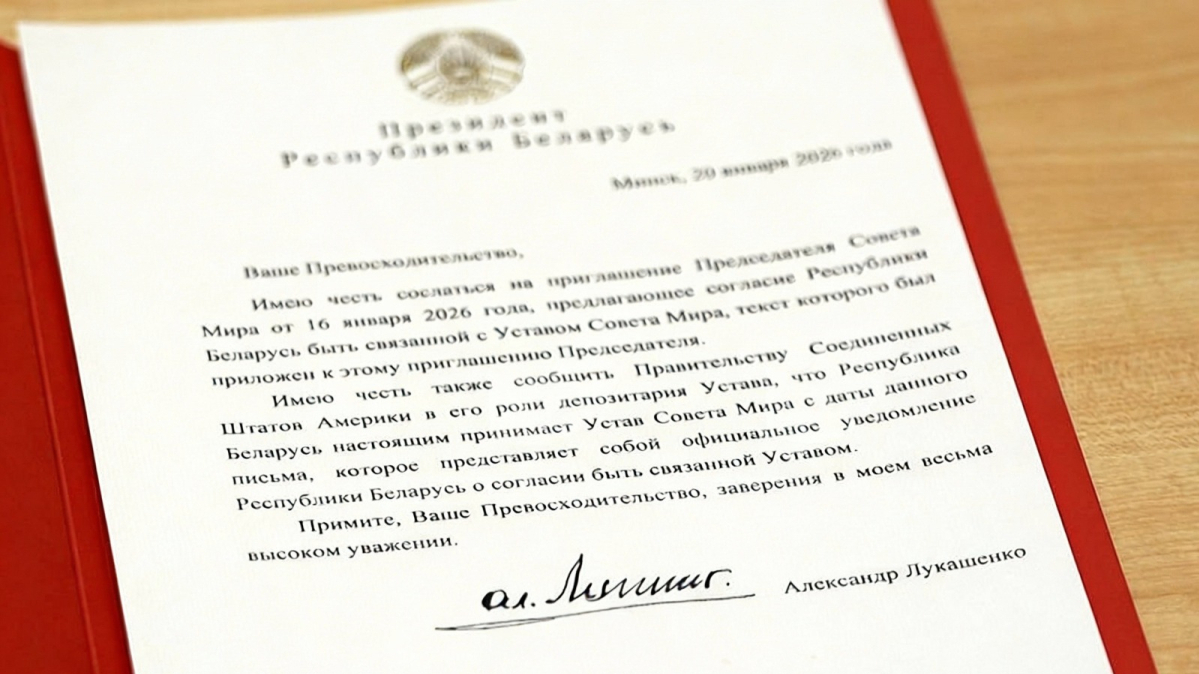
Belarusian President Alexander Lukashenko signed an agreement on Tuesday to also participate, the latest step in a rapprochement with Washington.
Officials said invitations were also extended to leaders of France, Germany, Australia, Canada, the European Commission and several key Middle East powers.
France, however, said it would not join. President Emmanuel Macron’s office said the proposed body could exceed its stated focus on Gaza and raise concerns regarding the principles and structure of the United Nations.
Trump later threatened to impose 200% tariffs on French wines and champagnes, in what appeared to be an effort to pressure France into joining the initiative.
Analyst view: Why Azerbaijan’s role matters
Speaking to AnewZ from Lisbon, Portugal, political analyst Ana Evans said Azerbaijan’s invitation to President Donald Trump’s proposed Board of Peace reflects a broader shift in the South Caucasus’ geopolitical relevance, with Baku increasingly positioned as a regional anchor for connectivity and stability.
“The country, the South Caucasus in general, thanks to Azerbaijan, might become a major pivotal Eurasian logistic hub,” she said, pointing to Baku’s expanding role at the intersection of Europe, the Middle East and Central Asia. In this context, Evans described Azerbaijan’s inclusion in the emerging initiative as significant, noting that “the invitation to this new list, which has been established and is still actually kind of in the formation like Board of Peace, it’s very important.”
Evans cautioned, however, that the effectiveness of the initiative remains uncertain, stressing that its institutional role has yet to be clearly defined. “It still remains to be seen how this Board of Peace will develop, how productive it will be,” she said, raising questions about whether it could “basically replace or like supersede or supplant United Nations and other not very efficiently working organisations.”
Despite those uncertainties, Evans said Azerbaijan’s participation carries symbolic and political weight at a time when traditional international mechanisms are under strain. “The very fact that Azerbaijan got the invitation obviously attests to its increased political weight,” she said, adding that the country’s importance now extends “beyond regional” dynamics, as global powers seek new platforms and partners to manage conflict resolution, reconstruction and long-term stability.
The board would be chaired for life by Trump and would start by addressing the Gaza conflict and then it's thought will be expanded to deal with other conflicts, according to a copy of the letter and draft charter seen by Reuters.
Member states would be limited to three-year terms unless they pay $1 billion each to fund the board's activities and earn permanent membership, the letter states.












What is your opinion on this topic?
Leave the first comment