Since the end of the 2020 conflict with Armenia, Azerbaijan continues to grapple with the enduring danger of landmines scattered across its regained territories.
These hidden explosives, legacies of decades of conflict, pose a persistent threat to civilian lives, reconstruction efforts, and regional development.
Polish analyst Sebastian Stodolak highlights in his recent column the profound human cost and infrastructural setbacks caused by the widespread presence of landmines, particularly in the Karabakh region.
According to official statistics, landmines and unexploded ordnance (UXOs) have caused the death or injury of at least 388 individuals since November 2020, with the majority being civilians.
The situation is even more harrowing when viewed in a broader historical context: since the early 1990s, nearly 3,500 Azerbaijanis, including 361 children, have been killed or wounded by explosive remnants of war.
The Karabakh region, which Azerbaijan regained control over in 2020, is now one of the most heavily mined areas, with the situation presenting a formidable barrier to peace and reconstruction.
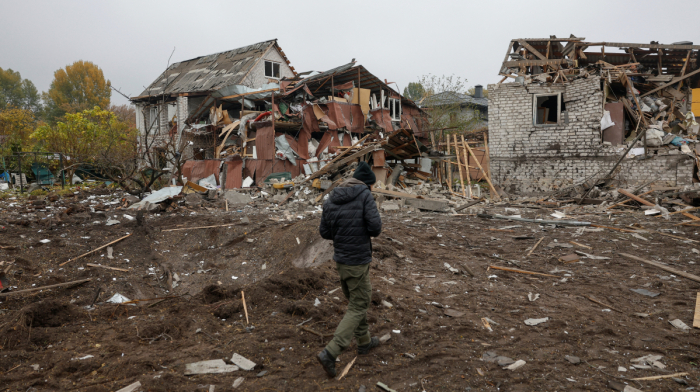
Mines are not limited to battlefields or isolated zones. They have been discovered in residential communities, on farmland, along vital roads, and even near schools and cemeteries.
This widespread contamination has rendered large swathes of land inaccessible, endangering lives and slowing rebuilding efforts.
Hidden obstacles beneath Karabakh's soil
The end of open conflict has not brought peace to Karabakh, instead, a new kind of warfare persists—one against the invisible and insidious threat buried beneath the ground.
The region's reconstruction and reintegration efforts have been significantly slowed down by the massive presence of landmines and UXOs.
Azerbaijani authorities estimate that around 1.5 million explosive devices remain buried across former conflict zones, making it one of the most contaminated regions in the world.
This contamination means that infrastructure development is stalled, roads cannot be laid, power lines cannot be extended, and housing projects are on hold—all because of the lurking danger beneath the earth.
Even essential public services such as schools and hospitals cannot operate safely in some areas. Farmlands that once provided sustenance and income for local populations lie fallow, awaiting clearance.
The slow pace of demining is not merely a logistical issue—it is a humanitarian crisis in motion.
Azerbaijan’s government has launched extensive reconstruction programmes, but these are inherently tied to the pace of demining operations.
Without safe access to land, there can be no meaningful return of life, commerce, or opportunity to the Karabakh region. The promise of post-war prosperity remains hostage to the invisible killers still embedded in the soil.
The Human toll of Azerbaijan's mine crisis
More than 700,000 internally displaced persons (IDPs) remain unable to return to their homes, decades after being forced to flee. Many of these individuals belong to generations born in exile, raised on the hope of return.
In addition to hindering returns, the minefields have also complicated efforts to locate and recover the remains of roughly 4,000 citizens still missing from the war.
Families remain in a prolonged state of grief and uncertainty, unable to bury their loved ones or find closure. The dangers involved in traversing these areas, even for forensic and humanitarian purposes, are immense.
Children, too, have become some of the most tragic victims. Curious and unaware, they are particularly vulnerable to these hidden explosives.
The legacy of conflict is thus passed on, not only through trauma but through injury and death. Efforts to educate returning communities on the dangers of mines are underway, but the scale of the issue demands a far greater response.
The war may be over, but for many Azerbaijanis, the fear and displacement continue, reinforced by every explosion that claims another life.
A call for action: International cooperation needed in demining efforts
Officials from Baku have consistently called for greater international support to accelerate demining operations.
They point out that without swift and comprehensive demining, reconstruction, safe resettlement, and long-term development will remain restricted.
A key obstacle remains the incomplete minefield maps. Azerbaijan claims that Armenia has failed to provide full documentation of mined areas, despite repeated diplomatic and legal efforts.
The lack of precise data has not only slowed the pace of clearance but has also put demining personnel at heightened risk.
In the absence of reliable maps, every field becomes a potential death trap, and every homecoming a gamble.
Nevertheless, Azerbaijan's Mine Action Agency (ANAMA) has been instrumental in locating and neutralising hundreds of thousands of explosive devices.
In 2024, Azerbaijan, in cooperation with the United Nations Development Programme (UNDP), inaugurated an international mine action training centre in Baku. This facility aims to improve expertise, share best practices, and increase regional and global collaboration in humanitarian demining.
The scale of mine contamination in Azerbaijan is a global humanitarian issue, not a localised problem. Just as the world has united in response to other post-conflict scenarios, it must now stand with Azerbaijan to ensure that no more lives are lost to the remnants of war.










What is your opinion on this topic?
Leave the first comment