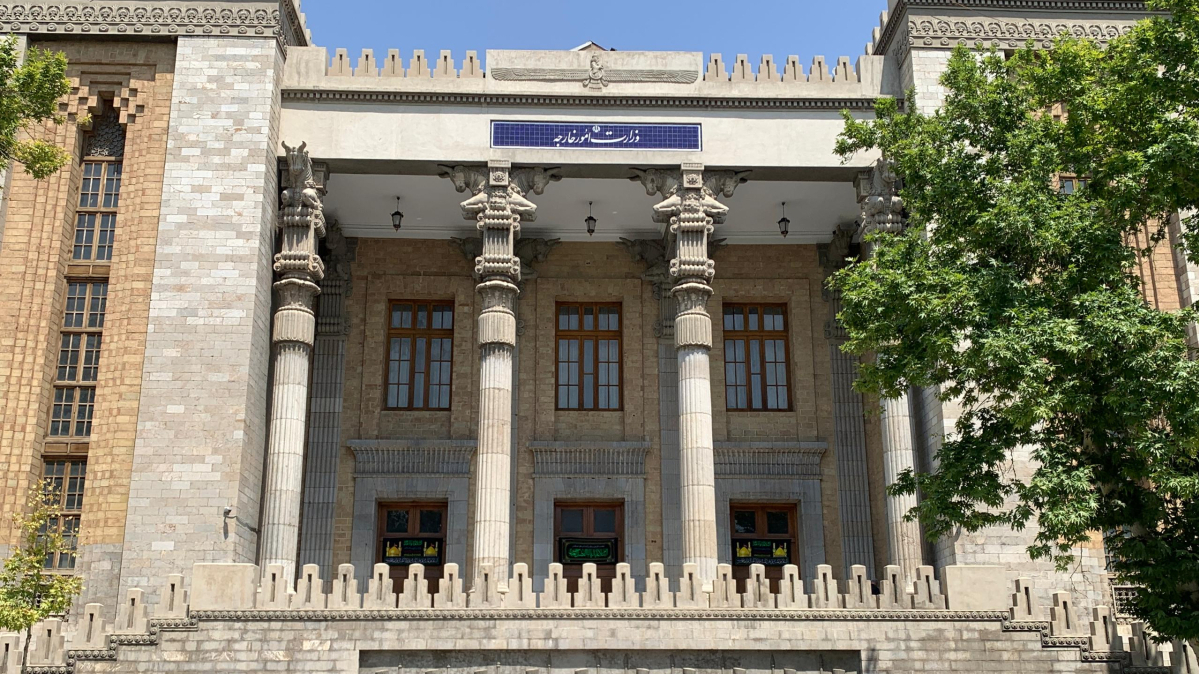
Iran's Ministry of Foreign Affairs on Friday (26 June) condemned as "interventionist, irresponsible and provocative" a statement issued following a joint meeting of foreign ministers from the U.S. and the Gulf Cooperation Council (GCC) in Manama, Bahrain.
Security and regional tensions
Stressing that collective security cannot be achieved through extra-regional interference, the ministry also warned against continued "hostile and interventionist" policies in the Persian Gulf region, according to the state-run IRNA news agency.
"The U.S. claim of enduring commitment to the security of GCC member states is nothing more than rhetoric and a distortion of reality. The U.S. military presence in the countries of the region is merely a burden on the peoples of the region and a source of insecurity and division in the region," the Iranian ministry said in a statement.
Tehran's condemnation of the Manama declaration came amid unconfirmed reports that Saudi Arabia will host a reconciliation meeting between Iran and the Arab states of the Persian Gulf following the Israel-U.S. war on Iran.
While no date has been suggested, reports said the Iran-GCC rapprochement initiative would proceed independently of the Iran-U.S. ceasefire deal signed on June 17, with the aim of securing a peace agreement within 60 days.
The Manama declaration said any trade and investment with Iran would be conditional and reversible, depending on Iran's compliance with the memorandum of understanding (MoU) and any final agreement, the cessation of its "destabilising behaviour", and the creation of conditions necessary for economic engagement, according to Xinhua news agency.
Iran's Foreign Ministry urged countries in the region whose territory and facilities were used during the war to attack Iran to reconsider their positions.
"The U.S. use of military bases and facilities stationed in the countries of the region to commit the crime of aggression against Iran from February 28 to April 8, 2027, demonstrated that the U.S. places no value on the security of the countries of the region or on the relations among them."
Nuclear programme and regional influence
Responding to the joint U.S.-GCC statement on preventing Tehran from acquiring nuclear weapons, the Iranian ministry expressed its "abhorrence at the repetition of the major falsehood fabricated by the genocidal Zionist regime and the United States regarding Iran's peaceful nuclear program".
"The inclusion of the cliché phrase 'threats emanating from Iran' - a concept invented years ago by the Zionist regime and the United States as part of their Iranophobia campaign - is indicative of the U.S. ruling establishment's effort to impose its delusions and ambitions on the countries of the region."
The Iranian Foreign Ministry also expressed regret over the GCC's alignment with the United States and Israel in describing Palestinian and Lebanese resistance groups as "Iranian proxies".
"It is recalled that the only proxy entity in the region is the Zionist regime," it added.
Strait of Hormuz dispute
The U.S. and GCC foreign ministers also rejected tolls, fees or attempts to assert control over the Strait of Hormuz, which links the Persian Gulf to the Gulf of Oman and the Indian Ocean.
In response, Iran said the U.S., Israel and regional countries that participated in military aggression against Iran were responsible for creating insecurity in the Strait of Hormuz. It also noted that the strategic waterway lies within the territorial waters of the two littoral states, Iran and Oman.
"What was agreed upon in Clause 5 of the memorandum of understanding ending the imposed war shall serve as the basis for action regarding the management of navigation through this strait."
"Upon the signing of this MoU, the Islamic Republic of Iran will make arrangements using its best efforts for the safe passage of commercial vessels with no charge for 60 days only from the Persian Gulf to the Sea of Oman and vice versa.
"The Islamic Republic of Iran will conduct dialogue with the Sultanate of Oman to define the future administration and maritime services in the Strait of Hormuz in discussion with other Persian Gulf littoral states in line with the applicable international law and the sovereign rights of coastal states of the Strait of Hormuz," Clause 5 states, as reported by IRNA.
Araghchi discusses navigation with Oman
Meanwhile, Foreign Minister Abbās Arāghchi said in a post on X following a telephone conversation with his Omani counterpart that Iran would define the future administration of the Strait of Hormuz in discussions with neighbouring countries.
"We re-emphasized that Iran and Oman will conduct dialogue 'to define future administration and maritime services in Strait of Hormuz.' We're determined and will do so in discussion with our neighbors," he said.
According to official sources, Arāghchi and Badr Albusaidi held a telephone conversation on Thursday to discuss the latest regional developments and issues of mutual interest, with a particular focus on the Strait of Hormuz.
"During the conversation, the two sides reviewed the latest developments concerning maritime traffic in the Strait of Hormuz and the temporary arrangements envisaged for the 60-day period.
"They underscored the importance of maintaining coordination, bilateral consultations, and technical and expert-level engagements in this regard," a Foreign Ministry news release said.
Shipping routes remain contested
Shipping traffic through the Strait of Hormuz has been gradually increasing since the signing of the Iran-U.S. MoU last week.
However, the Islamic Revolutionary Guard Corps (IRGC) rejected the coordinates of two new temporary evacuation and navigation routes announced by the International Maritime Organization (IMO) in cooperation with Oman.
On Thursday, the IRGC Navy issued a warning after the new shipping routes were announced without informing or coordinating with Iran.
"We inform everyone that the only permitted route for passing through the Strait of Hormuz is the route announced by the Islamic Republic of Iran. Vessel traffic outside these routes is very dangerous and prohibited, and we warn to refrain from any traffic outside the announced routes," according to the Sepah News website, which covers the Revolutionary Guards.
"Coordination with the IRGC Navy is required to pass through the Strait of Hormuz and violating vessels will be dealt with," the statement added.
Iran's Persian Gulf Strait Authority (PGSA) also instructed vessels to sail only through routes designated by the authority, warning against navigation on unauthorised routes.
"Any movement through routes outside the framework of the PGSA is not subject to the guarantee of safe passage and will not be covered by insurance and related liabilities," the Defa Press website, which covers military and defence news, quoted the authority as saying.
"The consequences of movement through unauthorized routes will be the responsibility of the owner, operator and commander of the vessel," it warned.
The main Traffic Separation Scheme (TSS) route that previously operated through the strait remains unusable because of the presence of naval mines.


















What is your opinion on this topic?
Leave the first comment