Four Palestinians, including an eight-year-old boy, were killed in Israeli strikes across Gaza on Monday (8 June), according to local health officials, as mediators continued efforts to preserve a fragile ceasefire agreement between Israel and Hamas.
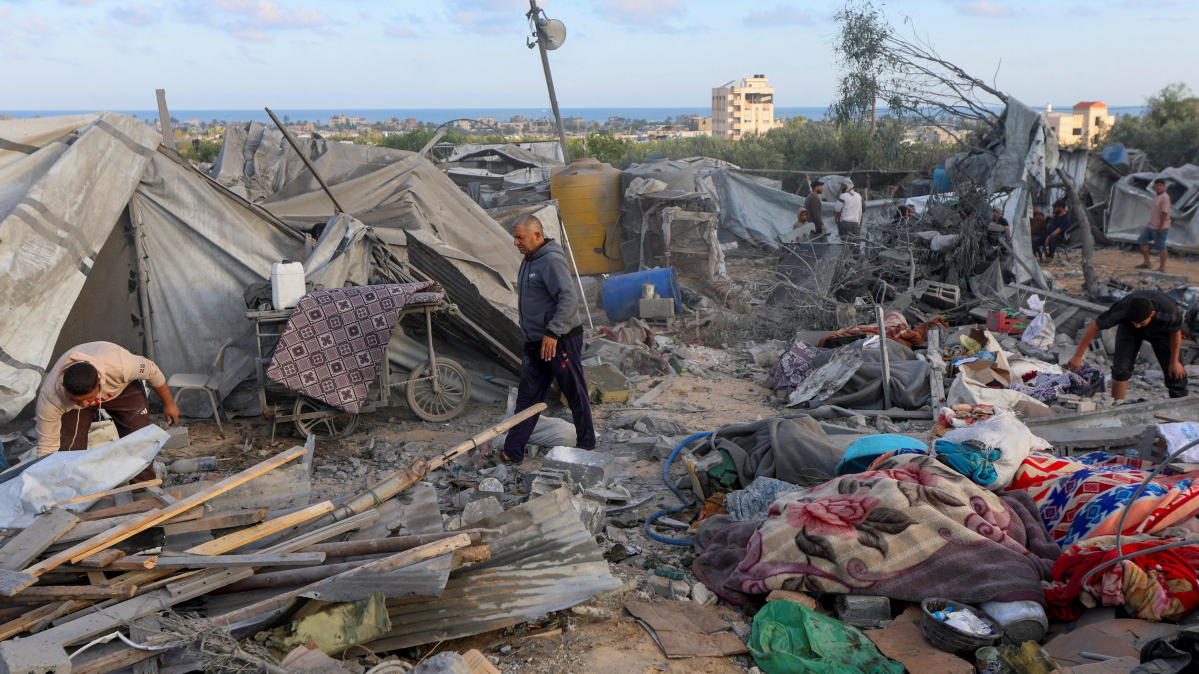
Medics said two people were killed when an Israeli strike hit near a tent encampment in the Mawasi area of Khan Younis in southern Gaza.
In northern Gaza's Jabalia refugee camp, an air strike near a group of people digging a well killed two more people, including a child, and wounded several others.
The Israeli military did not immediately comment on the reported attacks.
Growing pressure on civilians
The latest deaths come as residents report that Israeli forces are expanding areas under their control in parts of southern Gaza.
Witnesses in eastern Khan Younis and northern Rafah said new military markers and concrete barriers have appeared in recent days, extending what is known as the "Yellow Zone" closer to tent camps and displacement centres.
In Bani Suheila, east of Khan Younis, some displaced families said Israeli tanks could now be seen from their tents.
For many of Gaza's two million residents, daily life remains defined by uncertainty. Much of the population is now concentrated in a narrow coastal area, living in temporary shelters or damaged buildings after nearly two years of war.
Netanyahu reaffirms expansion plans
On Sunday, Israeli Prime Minister Benjamin Netanyahu said he had instructed the military to expand its control over Gaza and take hold of around 70% of the territory.
"We are not allowing them to arm themselves or harm us, and we are also eliminating their senior commanders," Netanyahu said.
According to Palestinian health officials, more than 950 people have been killed in Israeli strikes since the ceasefire took effect. Israel says four of its soldiers have been killed by militants during the same period.
Talks continue in Cairo despite deadlock
Meanwhile, mediators in Cairo are continuing negotiations aimed at preserving the ceasefire and moving towards a broader agreement.
Leaders from Hamas and other Palestinian factions have told mediators that Israel must halt attacks before discussions can move to a second phase of the deal. They are also demanding increased aid deliveries and a withdrawal of Israeli forces to positions agreed under the original ceasefire framework.
A Hamas official said no progress had been made on those demands.
"Israel refuses to end attacks on civilians in Gaza, allow 600 trucks of aid and goods into Gaza as agreed and it continues to occupy more land every day," the official said.
No agreement has yet been reached on a wider U.S.-backed plan that would see Israeli troops withdraw, Hamas disarm and Gaza begin reconstruction.
Despite the ongoing talks, the latest violence underlines how fragile the ceasefire remains and how far both sides are from reaching a lasting settlement.










What is your opinion on this topic?
Leave the first comment