live 4 injured by drones near Dubai Airport - Wednesday 11th March
Four people have sustained varying degrees of injuries after two drones fell near Dubai's International Airport on Wednesday, as Iran and Israe...
Israel is preparing for the possibility of receiving a green light from the United States to launch strikes against Iran’s ballistic missile system, according to Israel’s public broadcaster KAN.
KAN reported late Wednesday that Israeli planning is taking place amid growing speculation over whether U.S. President Donald Trump will authorise military action against Iran.
Assessments within Israel’s security establishment over the past 24 hours indicate a rising likelihood of a U.S. strike, Israeli daily Haaretz reported. The paper said that, despite Iran’s public statements following the latest round of negotiations in Geneva, significant differences remain between Washington and Tehran.
According to Haaretz, the most contentious issue is the U.S. demand that Iran abandon uranium enrichment on its own territory - a condition Tehran has repeatedly rejected.
The report said Israeli officials believe negotiations may have reached an impasse and expect that Trump could turn to a military option sooner than previously anticipated.
It added that Israel is not ruling out taking an active role in military action against Iran in the event of a U.S. attack.
The developments come amid close coordination between Washington and Tel Aviv in intelligence-sharing, military communications, information technology and air defence systems.
The latest round of talks on Iran’s nuclear programme was mediated by Oman in Geneva on Tuesday, following a previous session held in Muscat on 6 February.
Israeli preparations coincide with an increased U.S. military presence in the Middle East. American media outlets have reported that the Trump administration may be nearing a major confrontation with Iran, despite ongoing diplomatic efforts.
Social media accounts tracking aviation movements have reported that the United States has deployed a significant number of fighter jets, aerial refuelling aircraft and Airborne Warning and Control System (AWACS) aircraft to bases in Europe and the Middle East over the past 48 hours.
No official U.S. announcement has been made regarding any potential military action.

Tensions in the region remained high on Tuesday (10 March), as the United States and Iran exchanged increasingly sharp warnings, including threats over the strategic Strait of Hormuz, a critical artery for global oil supplies.
China has urged Afghanistan and Pakistan to resolve their dispute through dialogue after Chinese envoy Yue Xiaoyong met Afghan Foreign Minister Amir Khan Muttaqi, as fighting between the two neighbours entered its eleventh day.
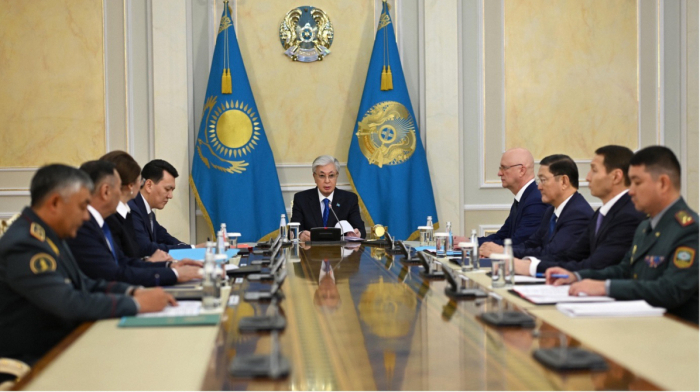
Kazakhstan has evacuated more than 7,300 citizens from the Middle East since regional tensions escalated, using both air and land routes to bring nationals home while closely monitoring political developments and potential economic effects linked to rising oil prices.
Almost 2,000 people have been evacuated from Iran via Azerbaijan since conflict erupted in the Middle East.
Norwegian police are searching for a suspect after an explosion at the U.S. embassy in Oslo on 8 March caused minor damage but no injuries, in what authorities say may have been a deliberate attack linked to the Middle East crisis.
Centuries-old palaces and mosques in Isfahan, Iran’s celebrated cultural capital, lie in ruins after a series of air raids struck the city’s historic centre, leaving officials to warn of a devastating loss to both national and global heritage. AnewZ’s Touraj Shiralilou visited the city.
A freight train carrying more than 1,000 tons of Russian grain will depart for Armenia through Azerbaijani territory on Wednesday. The shipment consists of 11 wagons loaded with a total of 1,023 tons of agricultural cargo.
Iran and the U.S. exchanged threats on Tuesday, as U.S. Defense Secretary Pete Hegseth warned Tehran to expect the “most intense day" of attacks so far. Meanwhile, Iranian President Masoud Pezeshkian said “anyone who entertains the illusion of destroying Iran knows nothing of history."
The Strait of Hormuz has become a focal point of global concern as tensions rise following the conflict involving Iran, the United States and Israel. Tehran has threatened to block the strategic waterway, raising fears of disruption to global oil shipments and energy markets.
Reports of so-called “acid clouds” moving from Iran towards Central Asia are not supported by scientific data, national hydrometeorological services in Kazakhstan, Uzbekistan and Kyrgyzstan say, adding there is no threat to the region.
You can download the AnewZ application from Play Store and the App Store.
What is your opinion on this topic?
Leave the first comment