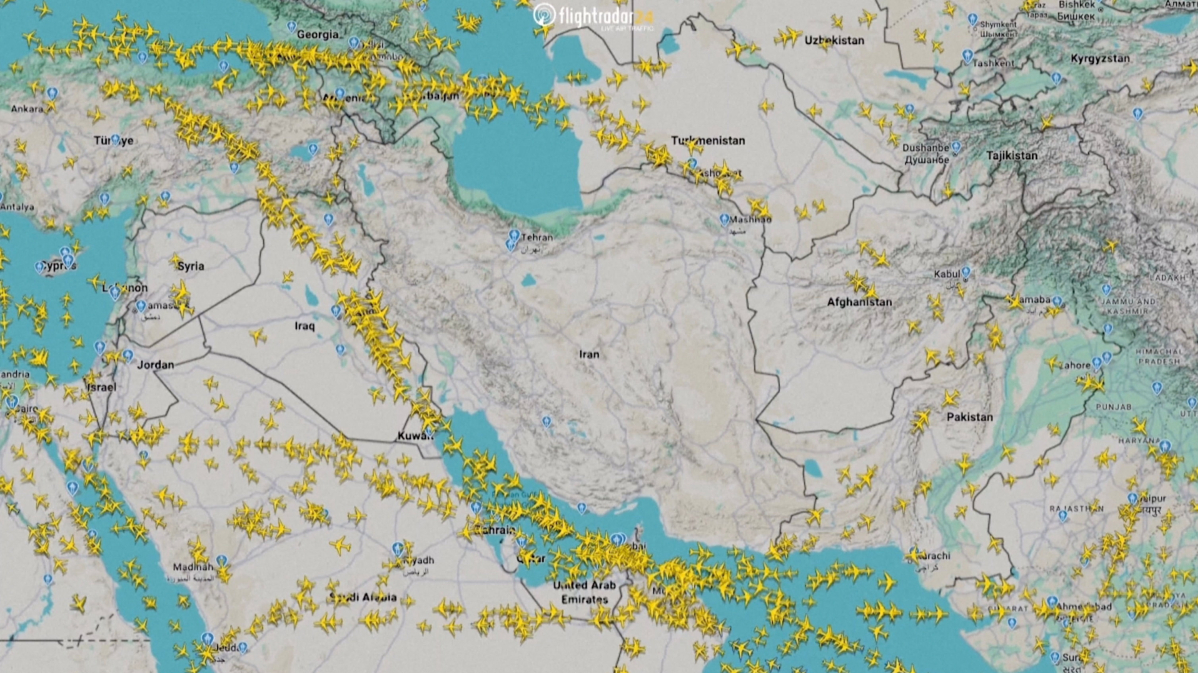
Iran reopened its airspace late on Wednesday after a near five-hour closure that disrupted airline traffic, amid heightened concerns over possible military escalation involving the United States.
According to notices issued by aviation authorities, Iran had temporarily restricted its airspace to most flights before lifting the measures shortly before midnight local time. Flight tracking data showed several Iranian carrier aircraft among the first to resume operations.
The closure forced airlines to cancel, delay or reroute flights, affecting carriers from several countries. Airlines in India, Europe and Russia confirmed disruptions, while others avoided Iranian airspace altogether as a precaution.
The temporary shutdown came as tensions escalated over Iran’s internal unrest and warnings from Tehran that it could retaliate against U.S. military bases in the region if attacked.
U.S. officials said some American personnel had been withdrawn from bases in the Middle East as a precautionary measure.
Several international carriers, including Lufthansa, said they would continue to bypass Iranian and Iraqi airspace, citing safety concerns. Others announced the suspension of night flights to parts of the region or further route adjustments.
Aviation risk groups warned that rising missile and drone activity in multiple conflict zones has increased the danger of misidentification of civilian aircraft, underscoring ongoing risks for commercial aviation in the region.
India's largest airline, IndiGo said some of its international flights would be impacted by Iran's sudden airspace closure. Air India said its flights were using alternative routes that could result in delays or cancellations.
A flight by Russia's Aeroflot bound for Tehran returned to Moscow after the closure, according to Flightradar24 data.
Earlier on Wednesday, Germany issued a new directive cautioning the country's airlines from entering Iranian airspace, shortly after Lufthansa rejigged its flight operations across the Middle East amid escalating tensions in the region.
The United States already prohibits all U.S. commercial flights from overflying Iran and there are no direct flights between the countries.
Airline operators such as flydubai and Turkish Airlines have cancelled multiple flights to Iran in the past week.
"Several airlines have already reduced or suspended services, and most carriers are avoiding Iranian airspace," said Safe Airspace, a website run by OPSGROUP, a membership-based organisation that shares flight risk information.
"The situation may signal further security or military activity, including the risk of missile launches or heightened air defence, increasing the risk of misidentification of civil traffic," it said.
Lufthansa said on Wednesday that it would bypass Iranian and Iraqi airspace until further notice while it would only operate day flights to Tel Aviv and Amman from Wednesday until Monday next week so that crew would not have to stay overnight. Some flights could also be cancelled as a result of these actions, it added in a statement.
Italian carrier ITA Airways, in which Lufthansa Group is now a major shareholder, said that it would similarly suspend night flights to Tel Aviv until Tuesday next week.














What is your opinion on this topic?
Leave the first comment