Iran's Foreign Minister Abbas Araghchi says member states of the Non-Aligned Movement (NAM) have firmly rejected the re-imposition of United Nations sanctions against Iran under the so-called snapback mechanism.
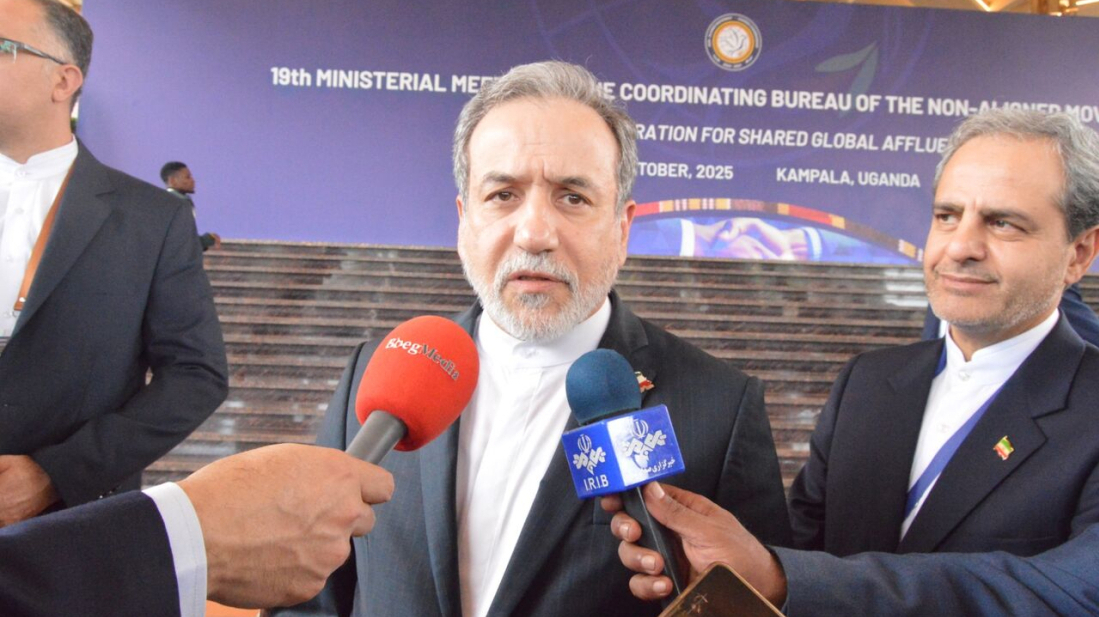
Speaking on Thursday following the NAM foreign ministers’ meeting in Kampala, Uganda, Araghchi said the organization issued a comprehensive final statement containing over 1,500 paragraphs addressing global political, economic, and social issues.
He noted that several key additions were made at Iran’s proposal, including condemnations of attacks by the United States and the Zionist regime on Iranian territory in mid-June. The statement also expressed solidarity with Iran in response to the aggression, he added.
Iran had earlier appealed to the NAM member states to avoid re-instalment of the nuclear sanctions and uphold the movement’s core value of independence to send the message of their unity in the face of pressures and bullying.
Speaking at the NAM ministerial meeting in Kampala, Uganda, Foreign Minister Abbas Araghchi urged the movement’s members not to join the re-imposition of the nuclear sanctions supported by US and European powers which he said seek “political advantage and violating international law”.
“We call on members of the Non-Aligned Movement to adhere to the fundamental principles of this movement and refrain from participating in such null and void and illegal actions that are carried out solely for the purpose of gaining political advantage and violating international law and regulations,” he said.
Taking a unified position, Araghchi added, not only demonstrates the renewed commitment to the core values of the Non-Aligned Movement, but also “sends a clear and decisive message to the world that independent, united, and determined nations will not surrender to pressure and bullying”.
He said from Iran’s perspective which is shared by a number of permanent and non-permanent members of the Security Council, the Resolution 2231 expires on October 18 and its reinstalment is solely a means of “political blackmail”.
“Last month, the United States and European permanent members of the Security Council (France and the UK) attempted to use the UN Security Council to revive expired Security Council resolutions against Iran, a move that is a clear violation of the provisions of Resolution 2231,” Iran’s top diplomat said.
Araghchi described the NAM’s support for Iran’s legal position as a major diplomatic victory.
Earlier this month, in a meeting with the Tehran-based foreign ambassadors, he urged their respective governments and the UN Secretariat to consider that all restrictions in the resolution will terminate in accordance with its provisions.
Iran strongly reacted to the UNSC vote in September on return of pre-2015 nuclear sanctions. Araghchi wrote letters to UN chief and Security Council as well as his counterparts stressing that Tehran will continue to safeguard its sovereign rights and legitimate interests.
The Foreign Ministry issued a statement reiterating that Resolution 2231 shall expire on October 18 as stipulated because about half of Security Council members (6 out of 15) did not vote for return of sanctions.
Also, Iran’s UN Mission protested to the Secretariat over announcement of return of sanctions, arguing that Resolution 2231 did not grant any authority to the Secretary General or the Secretariat to determine, announce or inform Member States about the “so-called re-application of expired resolutions”.
Araghchi arrived in Kampala on Wednesday and has met his counterparts from NAM countries besides taking part in the ministerial meeting which discusses the theme “Deepening Cooperation for Shared Global Affluence” for two days.
Established in 1961 in Bandung, Indonesia, at the height of Cold War geopolitical rivalry, the Non-Aligned Movement is an alliance of 121 developing countries. Uganda is the chair-state of NAM for the period 2024-2026.


















What is your opinion on this topic?
Leave the first comment