The Washington Accords, brokered by U.S. President Donald Trump, have reshaped the strategic balance in the South Caucasus and strengthened America’s position. According to The Washington Times, the shift reflects a broader realignment driven by security, transport corridors.
The report says, the Trump administration used executive powers to lift Section 907 restrictions, in place since 1992, to improve relations with Azerbaijan. The law remains in Congress, but Trump supporters are pushing for its permanent repeal.
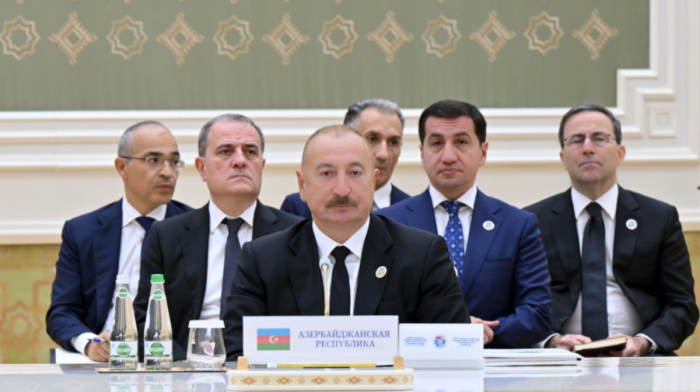
“The Trump administration demonstrated a lot of dedication to our agenda of peace,” Hikmet Hajiyev, Assistant to the President of Azerbaijan told The Washington Times, adding that “Trump’s immediate reciprocity and full engagement” helped build momentum for the agreement.
Despite this shift, some lawmakers continue to advocate policies that analysts quoted in the report say inadvertently benefit Russia by limiting U.S. involvement. Brenda Shaffer of the Naval Postgraduate School said Azerbaijan’s geography makes it strategically unique.
“Azerbaijan matters strategically because it is the only country in the world that borders Russia and Iran,” she said.
The Washington Times underscores that Azerbaijan is a key partner for the U.S. and Israel, supplying 40–50% of Israel’s crude oil and relying on Israeli companies for military support.
“Israel and Azerbaijan have a real strategic alliance,” Ms. Shaffer said. “It goes far beyond oil and arms and has been developing steadily for three decades.”
The country is also boosting investment in the Middle Corridor, a transport route linking Central Asia to Europe via the Caspian. Container traffic at Baku port rose by over 30% in 2025, while railway restoration in Nakhchivan will secure access to Türkiye and Europe independently of Russia or Armenia.
At the center of the political dispute is Section 907 of the 1992 Freedom Support Act, which restricted U.S. aid to Azerbaijan following the first Karabakh war. Although presidents have waiver authority, the provision still requires annual renewal. The Trump administration argues this undermines long-term diplomacy.
“Both governments, Azerbaijan and Armenia, are making an uphill struggle of strengthening the peace,” Hikmet Hajiyev said. “But some in Congress are introducing completely unnecessary and divisive legislative acts.”
Analysts cited by The Washington Times say the main strategic challenge for both Azerbaijan and Armenia is Russia, rather than their bilateral conflict. While Azerbaijan reclaimed its territories in 2020, Armenian minefields and damaged infrastructure require long-term reconstruction.
The report adds that the U.S. and Armenia are negotiating joint management of infrastructure under the 'International Route for Peace and Prosperity,' with U.S. Ambassador Kristina Kvien saying relations now reach a strategic partnership level.
But Armenian Foreign Minister Ararat Mirzoyan emphasised deeper ties with Washington do not mean a rupture with Moscow.
The Washington Times highlights Azerbaijan's efforts to building a brighter future for the region. Azerbaijan is fostering economic interdependence with Armenia, exporting oil products and facilitating grain shipments to Armenian markets.













What is your opinion on this topic?
Leave the first comment