Mexico confirms World Cup venues unchanged after cartel leader killing
Mexico’s President Claudia Sheinbaum on Thursday thanked FIFA and its president, Gianni Infantino, for reaffirming that the country’s 2026 World C...
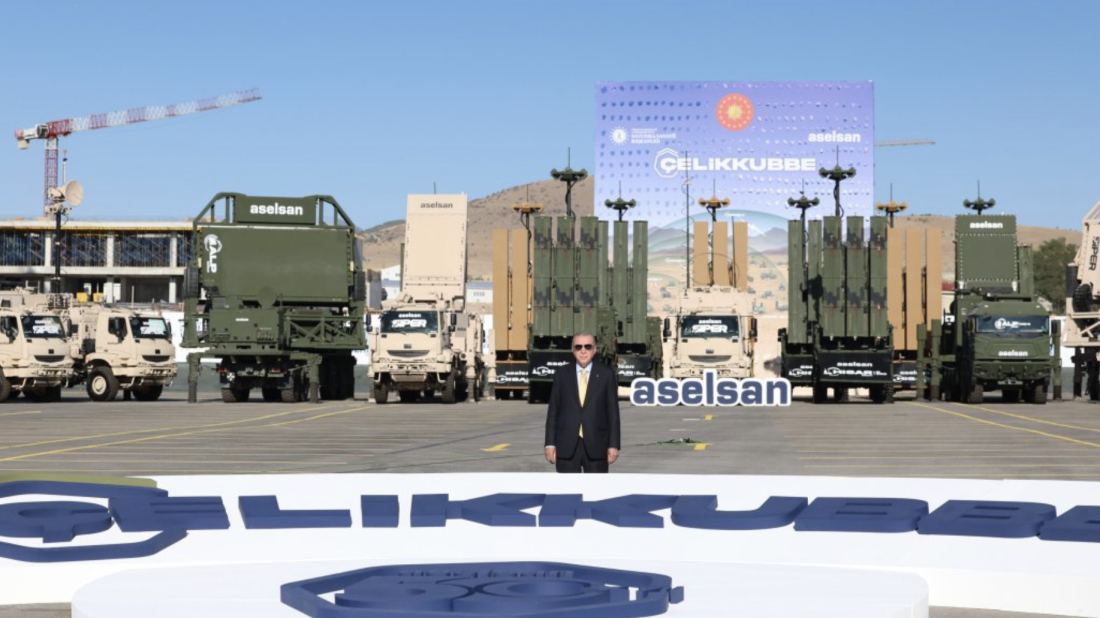
Turkish President Recep Tayyip Erdoğan is highlighting Türkiye’s push for homegrown air defence, as the country develops new systems and deepens defence ties internationally.
President Erdoğan said 47 vehicles worth $460 million are now being delivered to the Turkish Armed Forces, alongside three HISAR medium-range systems.
He stressed that "no country can look to the future with confidence without its own air defence architecture."
The president also hailed the delivery of key components of the country’s multilayered 'Steel Dome' system, calling it a turning point for national security.
The system, designed to counter low, medium, and high-altitude threats, integrates land and sea-based platforms developed locally.
Turkish defence firm Aselsan is playing a central role, developing artificial intelligence-based command and control software that allows hundreds of systems to operate as one.
Officials say Türkiye’s defense industry localisation rate has now reached 83%, with exports nearing $7.5 billion annually.
Ankara’s defence push is reaching abroad. Turkish defence giant Havelsan signed has a strategic deal with Egypt’s Arab Organization for Industrialization to co-produce a new generation of unmanned aerial vehicles.
The partnership covers the BAHA, BULUT, and BOZBEY UAVs, set to be produced for both Egypt and the wider African sector.
These moves highlight Türkiye’s strategy to secure its skies at home while building long-term industrial and defence partnerships globally.

A F-16 fighter jet of the Turkish Air Force crashed near a highway in western Türkiye early on Wednesday (25 February), killing its pilot, officials and media reports confirmed.
U.S. President Donald Trump declared a “golden age” for America in his first second-term State of the Union on Tuesday evening, delivering the longest-ever address at more than 90 minutes. Here are the main takeaways.
President Donald Trump delivered the first State of the Union address of his second term to Congress on Wednesday (25 February), declaring that America’s “golden age” had begun and that the country was experiencing a “turnaround for the ages.”
Start your day informed with AnewZ Morning Brief. Here are the top news stories for the 25th of February, covering the latest developments you need to know.
Peace-making has a habit of creating new enemies - especially when it reduces someone else’s leverage. As Azerbaijan and Armenia move toward a settlement architecture that no longer depends on Moscow as the indispensable broker, pressure has not vanished; it has shifted shape.
Pakistan’s Foreign Minister Ishaq Dar received a phone call from Qatar’s Deputy Foreign Minister Mohammed bin Abdulaziz Al-Khulaifi on Thursday, as fresh border clashes erupted between Pakistani and Afghan forces.
Ankara has rejected media reports claiming it plans to deploy military forces into Iranian territory in the event of a U.S. attack on the Islamic republic.
Georgia’s path towards European Union membership is facing its most serious crisis to date, with senior European lawmakers warning that the country is now a “candidate in name only” and accusing the ruling government of reversing democratic progress and drifting away from Europe.
As Iran and the United States continue with nuclear talks in Geneva on Thursday, Tehran’s extensive ballistic missile programme remains a central point of contention.
More than 11 million Afghans have been displaced or have returned to the country between 2021 and 2025, as drought, floods and mass returns from neighbouring states deepen an already fragile humanitarian crisis, according to a new report from the International Organization for Migration (IOM).
You can download the AnewZ application from Play Store and the App Store.
What is your opinion on this topic?
Leave the first comment