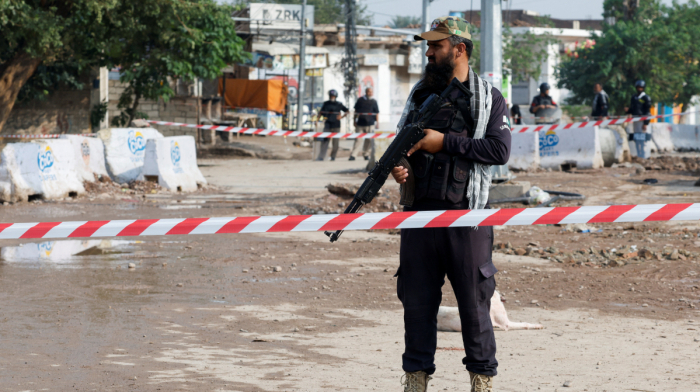
International aid to Afghanistan should be reassessed, says the U.S.
U.S. Ambassador to the United Nations, Mike Waltz, has addressed the U.N. Security Council, saying the world must consider how effective ...
Iran’s Foreign Minister Abbas Araqchi said on Wednesday that his country cannot “completely cut our cooperation with the agency”, referring to the International Atomic Energy Agency (IAEA), even after parliament passed legislation suspending future inspections without security council approval.
“Inspectors must be there to get this work done,” Araqchi told state media, though he did not elaborate on how this would happen under the new constraints.
His comments follow the June conflict that saw Iranian nuclear sites bombed by Israel and the U.S. during a 12-day war, after which IAEA inspectors were blocked from access. The IAEA has insisted inspections are vital, with Director General Rafael Grossi repeatedly stating their importance to ensure transparency.
Iran’s parliament approved the new law after accusing the IAEA of fuelling the June strikes. Officials said a 31 May agency report led to the Board of Governors declaring Tehran in breach of its non-proliferation obligations, which Iran interpreted as justification for the attacks.
Under the new rules, any future access by IAEA personnel must be cleared by Iran’s Supreme National Security Council.
Despite this, Iran has signalled it will continue talks with the agency. A foreign ministry spokesperson said this week that a new round of negotiations is expected “in the coming days”.
On the subject of nuclear negotiations with Washington, Araqchi said talks “needed to reach maturity” before resuming. Talks were suspended following the joint Israeli-U.S. strikes in June, which had derailed what would have been the sixth round of discussions.

Mojtaba Khamenei, son of the late Ayatollah Ali Khamenei, is a hardline cleric with strong backing from the Islamic Revolutionary Guard Corps. His rise signals continuity in Tehran's anti-Western policies.
Global oil prices surpassed $119 a barrel on Monday (9 March, 2026), an almost four year high, as the Middle East conflict rumbled on.
China has urged Afghanistan and Pakistan to resolve their dispute through dialogue after Chinese envoy Yue Xiaoyong met Afghan Foreign Minister Amir Khan Muttaqi, as fighting between the two neighbours entered its eleventh day.
Iran named Mojtaba Khamenei to succeed his father Ali Khamenei as supreme leader on Monday (9 March), signaling that hardliners remain firmly in charge, as the week-old U.S.-Israeli war with Iran pushed oil above $100 a barrel.
Entry and exit across the state border between Azerbaijan and Iran for all types of cargo vehicles, including those in transit, will resume on 9 March, according to a statement by the Cabinet of Ministers of Azerbaijan.
Azerbaijan is evacuating nearly 200 people from the Middle East on a special charter flight departing from Oman.
Up to 30 tonnes of food will be delivered to Iran amidst ongoing hostilities with U.S. and Israel, following a phone converstation between the President of Azerbaijan Ilham Aliyev and Iranian counterpart Massoud Pezeshkian.
Schools across Pakistan are being forced to close for a fortnight from next week with government departments down to a four-day week, according to Prime Minister Shehbaz Sharif in a televised address to the nation.
Just under a year after being arrested and imprisoned at Silivri prison in the west of İstanbul, İmamoğlu appeared in good spirits when he arrived in court on Monday to face around 140 charges including leading a criminal organisation for profit and bribery.
Global oil prices reached a four year high on Monday (9 March), surpassing $119 a barrel, as conflict in the Middle East rumbled on. Meanwhile, the Turkish Military said NATO air defence systems destroyed a missile fired from Iran towards the country.
You can download the AnewZ application from Play Store and the App Store.
What is your opinion on this topic?
Leave the first comment