Iran-U.S. peace talks stalled as Iranian FM Araghchi arrives in St Petersburg for talks with Putin
President Donald Trump said on Sunday Iran could telephone if it want...
Türkiye’s fast-growing defence industry is gaining global recognition. European countries are rearming and demand for reliable suppliers rising.
Türkiye’s fast-growing defence industry is gaining global recognition. European countries are rearming and demand for reliable suppliers is rising.
Türkiye is fast emerging as a key player in Europe’s evolving defense landscape—rising from regional partnership to a global defense supplier in the face of mounting geopolitical tensions.
From the ongoing war between Russia & Ukraine, to growing uncertainty over the long-term U.S. military presence on the continent, European nations are rapidly rearming—and Türkiye’s defence sector is stepping in to fill that demand.
Defence exports from Türkiye soared from $2.3 billion in 2020 to more than $7.1 billion in 2024, placing the country as the world’s 11th-largest arms exporter, according to Stockholm International Peace Research Institute.
Much of this success is driven by indigenously developed, combat-tested technologies such as the Bayraktar TB2 drone—widely used in conflicts from Azerbaijan's Karabakh region to Ukraine.
Türkiye’s exports to Europe alone jumped from $369 million to $1.2 billion over the past three years, now accounting for 22% of its total defence sales.
Poland, the first European Union and NATO member to purchase Bayraktar TB2 drones, received all 24 units by mid-2024. Albania and Croatia followed, which acquired logistics, training and command-and-control systems.
In 2024, Aselsan launched a regional office in North Macedonia to coordinate activities across the Balkans.
Havelsan, another important Turkish defence player, won a Romanian tender to modernize maritime surveillance using its MATRA software platform.
Recent collaborations that took place this year in 2025 are also reinforcing its foothold: Turkish drone-maker Baykar is partnering with Italy’s Leonardo, while Turkish Aerospace Industries is co-producing the HURJET light combat jet in Spain.
NATO Secretary-General Mark Rutte recently called Türkiye’s defence base “impressive” and urged deeper integration with European systems.
With both innovation and reliable delivery, Türkiye is not only purchasing—but increasingly, the builder of Europe’s future security architecture.

Disney+ has debuted Disney Animation’s Songs in Sign Language, a new collection of animated musical sequences reimagined in American Sign Language (ASL), released on 27 April to mark National Deaf History Month.
U.S. President Donald Trump and First Lady Melania Trump were rushed out of the White House Correspondents' Association Dinner by Secret Service agents after a 31 year old suspect attempted to storm event.
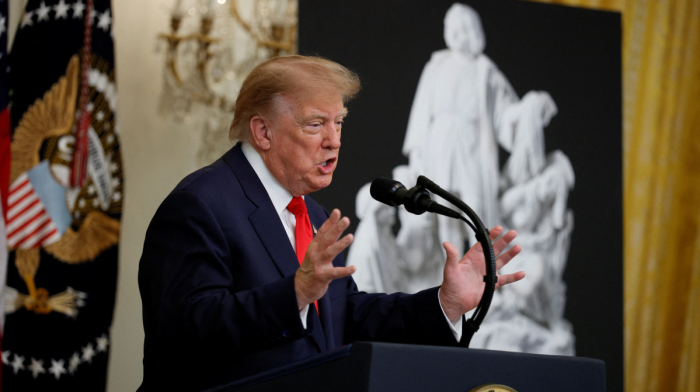
President Donald Trump said on Sunday Iran could telephone if it wants to negotiate an end to their two-month war. Tehran said the U.S. should remove obstacles to a deal, including its blockade of Iran's ports. Meanwhile Iranian Foreign Minister Abbas Araghchi arrives in St Petersburg for talks.
Market reaction to DeepSeek’s preview of its next-generation artificial intelligence model has been relatively subdued, in sharp contrast to the global shock triggered by its breakthrough releases last year.
Adidas shares rose after Kenya’s Sebastian Sawe delivered a historic performance at the London Marathon on Sunday (26 April), becoming the first athlete to run an official marathon in under two hours.
The months-long disarmament process involving the outlawed Kurdistan Workers’ Party (PKK) has made little tangible progress, Turkish intelligence chief İbrahim Kalın has said.
Azerbaijan is expanding its diplomatic and economic footprint amid European energy insecurity and global geopolitical tensions. The Czech Prime Minister’s 27 April visit to Gabala highlighted growing Azerbaijan–Central Europe cooperation, particularly in energy, industry and defence.
Afghanistan’s disaster authority says it is working with the International Organization for Migration (IOM) to boost emergency response, shelter support and volunteer networks following talks in Kabul on Sunday.
Kazakhstan, Kyrgyzstan and Uzbekistan are advancing one of Central Asia’s largest joint energy projects: the construction of the Kambarata HPP-1 hydropower plant on the Naryn River in Kyrgyzstan, with a planned capacity of nearly 2,000 megawatts.
150 senior leaders from the oil and trade industry met in Baku last week for the second annual Caspian and Central Asia Oil Trading and Logistics Forum, as the world grapples with oil and energy shortages linked to the Middle East conflict.
You can download the AnewZ application from Play Store and the App Store.
What is your opinion on this topic?
Leave the first comment