The resignation of Bulgaria's government on Thursday (11 December) puts an end to an increasingly unpopular coalition but is likely to usher in a period of prolonged political instability on the eve of the Black Sea nation's entry into the euro zone.
The European Union and NATO member state has held seven national elections in the past four years as consecutive governments failed to keep control of a fractured parliament.
The outgoing government, in power since January, had looked set to oversee the transition to the euro on 1 January, but Prime Minister Rosen Zhelyazkov handed in his government's resignation after weeks of street protests against state corruption and a new budget that would have increased taxes.
Bulgaria's largely ceremonial head of state, President Rumen Radev, had also called for Zhelyazkov to resign.
The dramatic move came just minutes before Parliament was scheduled to hold a crucial no-confidence vote—a ballot the opposition had triggered over allegations of fiscal mismanagement and deep-seated corruption.
Addressing the National Assembly, Zhelyazkov insisted he still commanded enough political support to survive the vote but acknowledged that his mandate had lost public legitimacy.
"We have no doubt that in the upcoming vote of no confidence, for the sixth time, the government will receive support and the vote will not pass," Zhelyazkov told legislators.
"Nevertheless, for us, the decisions of the National Assembly have meaning only when they express the will of the sovereign. Therefore, I inform you that before the vote of no confidence, today the government resigns," he said.
The resignation was precipitated by a controversial economic package intended to prepare Bulgaria for adopting the Euro currency on the 1st of January. To meet the stringent fiscal requirements of the Eurozone while simultaneously increasing public spending, the government had proposed a series of sharp tax hikes.
These measures proved to be the breaking point for a populace already grappling with inflation and weary of endemic graft. Opponents argued that the minority government was burdening ordinary citizens to finance a transition that has been marred by a lack of transparency.
Critics and opposition leaders have long accused the ruling coalition of failing to dismantle the oligarchic networks that have stifled Bulgaria's development since it joined the European Union in 2007.
Anti-government nationwide protests
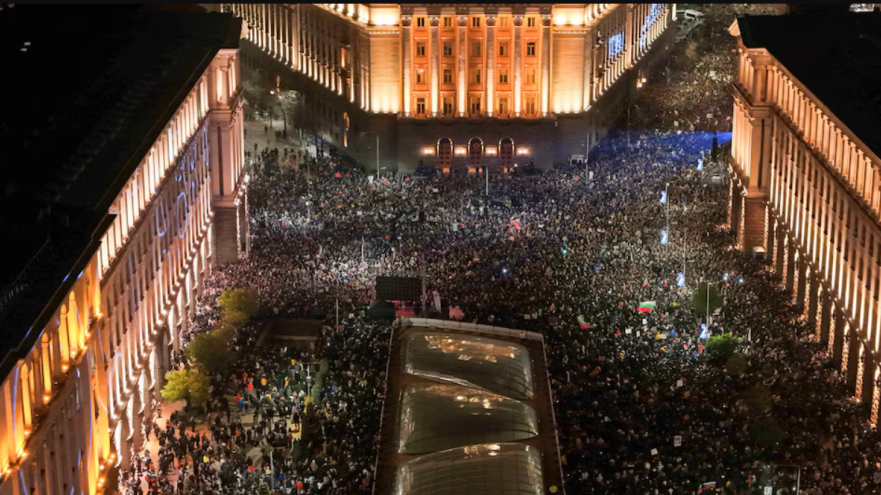
The resignation follows weeks of unrest on the streets of Sofia and other major cities.
For the thousands who gathered in front of the government buildings in Sofia, the reaction was muted but some were quietly optimistic on one point - that the government had listened to the protesters.
"It is normal — this is how it should have been. It was about time. Long overdue," said Hristiyan Marinov, an IT specialist protesting in the capital.
"Now we hope that smarter people will come out of those 240 who were in parliament. There are certainly intelligent, sensible people there who can come up with something meaningful and put an end to the abuses we've seen," Marinov said.
However, amidst the relief, there remains a sense of caution regarding what comes next.
"I hope for something positive," said Dr Milka Peneva. "But since I'm from the older generation, I have quite a few reservations about being overly optimistic. Still, I support the young people and I genuinely hope things will turn out well for them."
These protests represented some of the biggest anti-government gatherings since the end of communism in 1989 and the broad demographics and politics of the protesters set them apart from other recent demonstrations, political analysts said.
"This was an accumulation of things. The tension has been growing over time, and the budget was the tipping point," Dimitar Markov, Director of the Law Program at the Center for the Study of Democracy in Sofia said.
Many of the protesters were urban professionals who back Bulgaria's adoption of the euro and want to see it join the European mainstream after a difficult transition to democracy marred by organised criminal networks and corrupt politicians.
But the demonstrators have also included those who fear that joining the euro will fuel inflation or who oppose Bulgaria's official pro-Western stance on issues such as the Ukraine war, preferring to repair ties with Moscow, Sofia's historic ally.
Some analysts said the protests could lead to real change.
"People realise that their will, when they express it, matters," said Vessela Tcherneva, deputy director at the European Council on Foreign Relations in Sofia.
"Whoever the next government is will be more aware and will need to be more accountable," Tcherneva said.
What Happens Next?
The president will now give the largest party in parliament, GERB, the mandate to form a new government but it is likely to struggle to find wider support in a fragmented parliament containing some nine parties, some of them very small.
If GERB fails, or rejects the mandate, two other parties will be given the opportunity. If they fail or refuse, President Radev will appoint an interim government and call a snap election. This could pitch Bulgaria back into a cycle of repeated polls if no one can form a functioning coalition.
"There is a great risk that we actually end up with another series of elections," said Dimitar Markov, Director of the Law Program at the Center for the Study of Democracy in Sofia.
Bulgarians remain split over the euro, polls show, and there is some concern that without strict government oversight, retailers will take advantage of public confusion over the conversion to jack up prices.
"The state has a critical role to make sure there are no major shocks to the system," said Mario Bikarski, Senior Europe Analyst at risk consultancy Verisk Maplecroft.
"In the absence of a budget and the absence of a government, the risks to the system are increasing quite a bit," Bikarski added.










What is your opinion on this topic?
Leave the first comment