Turkish President Tayyip Erdoğan has called Israel 'a terrorist state', stating that its aggression poses a threat to the entire region.
The Turkish president made the comment after the Turkish and Syrian leaders spoke over the phone on Thursday and discussed the latest developments in Syria following Israel's attacks, according to Türkiye’s Communications Directorate.
Turkish President Recep Tayyip Erdogan told his Syrian counterpart Ahmad al-Sharaa that Israel’s attacks on Syria are “unacceptable,” adding, “Israel's aggression poses a threat to the entire region,” according to a directorate statement.
Noting that Ankara welcomes the ceasefire reached with the Druze in Syria, Erdogan said that Türkiye will continue to support the Syrian people as it has done so far.
Al-Sharaa, for his part, expressed his gratitude to the Turkish president for Ankara’s support in preserving Syria’s political unity, ensuring territorial integrity, and upholding its sovereignty, according to the statement.
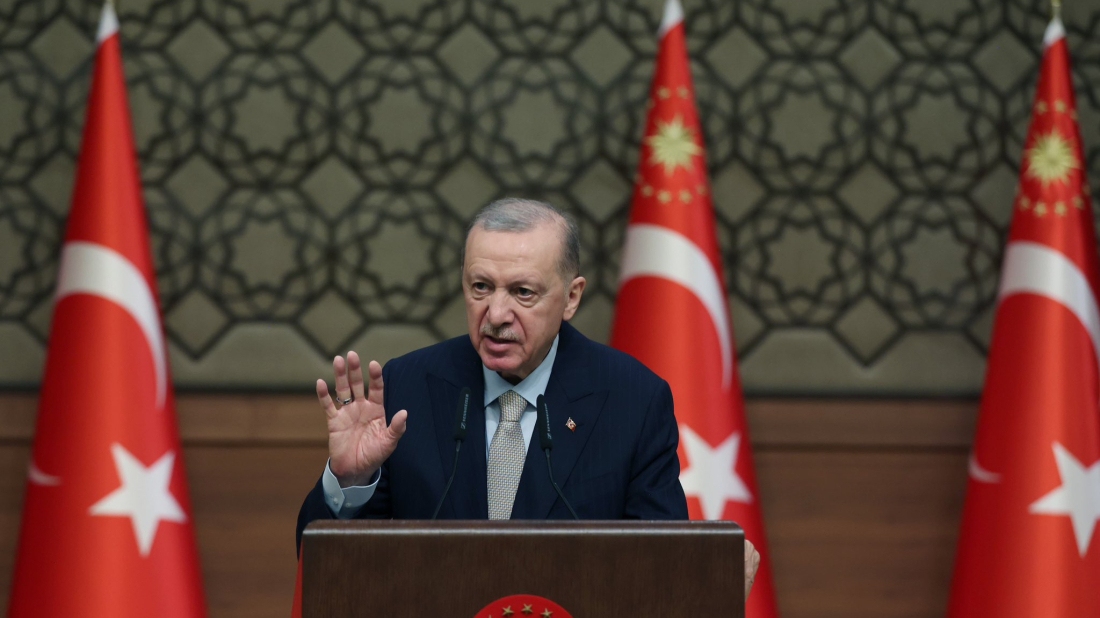
Speaking after a cabinet meeting in Ankara, President Erdoğan strongly condemned Israel’s escalating attacks in Syria and throughout the region, warning that unchecked Israeli aggression could spark a wider conflict.
"Israel is a terrorist state that does not recognize law or rules, and does everything to draw the region into chaos," said Erdogan in an address to the nation as broadcast by TRT Haber TV channel.
"We opposed the disintegration of Syria in the past, we firmly reject it today and will continue to do so in the future," he added.
"For the past two days, Israel has been using the Druze as a pretext to extend its acts of banditry into neighbouring Syria," added President Erdoğan.
"At this point, the greatest threat to our region is Israel’s aggression. If this monster is not stopped now, it will ignite not only our region, but the entire world."
The Turkish president also cautioned regional actors against forming alliances with Israel, warning that such partnerships would ultimately prove detrimental.
“Those who descend into the well, holding Israel’s rope, will sooner or later realize they have made a serious miscalculation,” he said. “Those who depend on Israel will inevitably come to understand their grave error.”
On 13 July, violent clashes broke out between Bedouin Arab tribes and Druze armed groups in the southern Syrian province of Suwayda. These confrontations resulted in the deaths of dozens of soldiers when Druze groups attacked Syrian security forces stationed in the area.
Following an escalation of fighting between security forces and local Druze community, a ceasefire was reached. However, the calm was short-lived, after Israeli forces launched attacks targeting Syrian security personnel according to officials. All sides blame each other.
On 16 July, authorities said that the Israeli air force conducted strikes on several significant sites, including the Syrian presidential compound, the General Staff Headquarters, and the Defence Ministry. Although a ceasefire was reestablished that same day between the government and local groups in Suwayda, officials said Israeli warplanes continued to carry out attacks on Damascus and Daraa.
According to reports Israeli Prime Minister Benjamin Netanyahu said on Thursday that it will continue to protect the Druze community in Syria.


















What is your opinion on this topic?
Leave the first comment