Tajikistan and China have launched a high-capacity digital corridor across the Pamir Mountains, creating a direct telecommunications link that could strengthen Tajikistan’s internet connectivity and turn the country into a key transit route for data between Central and South Asia.
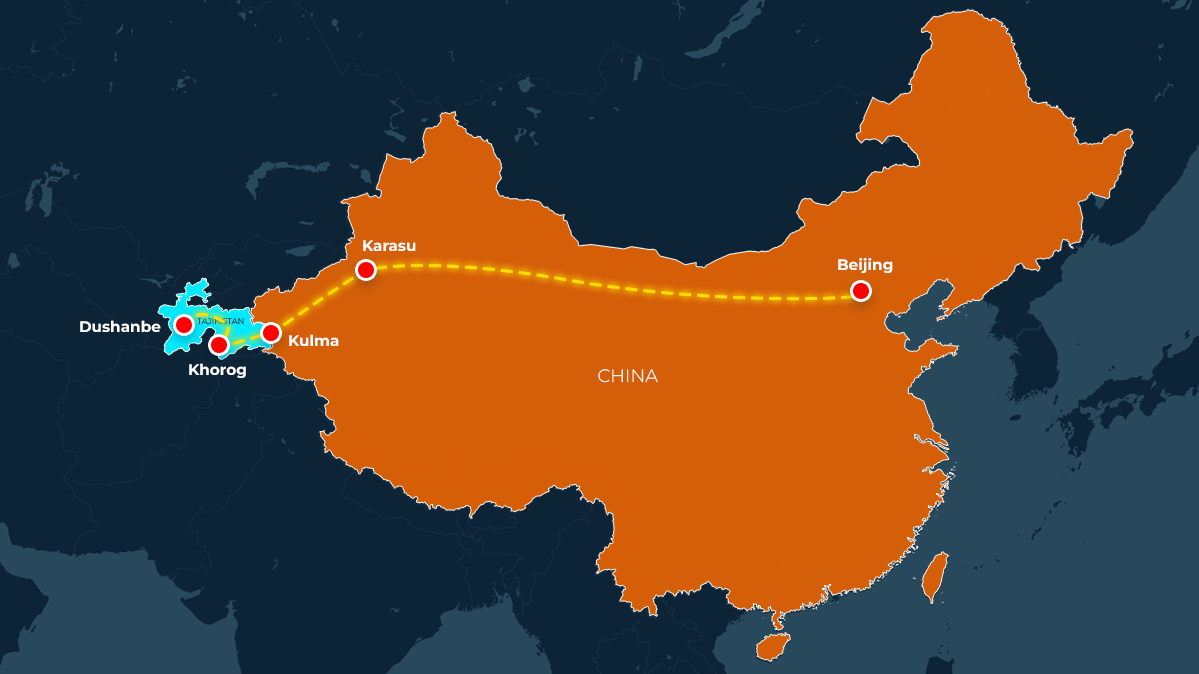
The new fibre-optic connection follows the Dushanbe–Khorog–Kulma–Karasu–Beijing route, spanning 1,010 kilometres across Tajikistan and approximately 6,100 kilometres through China.
Construction on the Tajik side included a particularly challenging 435-kilometre section through the mountainous Gorno-Badakhshan Autonomous Region. The networks connect at the Kulma Pass, 4,363 metres above sea level, on the border with China’s Xinjiang region.
A new route for international internet traffic
The project aims to tackle one of Tajikistan’s longstanding telecommunications challenges.
Landlocked and with mountains covering around 93 per cent of its territory, the country faces considerable difficulties in building and maintaining international communications infrastructure.
Tajikistan has historically depended heavily on fibre-optic routes through neighbouring Central Asian states to connect to wider international networks, leaving it vulnerable to disruptions beyond its borders.
The new link with China provides an alternative route for international data traffic, giving Tajikistan greater flexibility and strengthening the resilience of its national network.
Connecting Central and South Asia
Tajikistan’s strategic location along China’s western border gives the corridor wider regional importance.
Kyrgyzstan and Uzbekistan lie to the north and west, offering connections to other Central Asian telecommunications networks. Afghanistan, to the south, provides a potential gateway to Pakistan and the wider South Asian market.
The Kulma Pass provides a direct connection between Tajikistan and China’s Xinjiang region, opening another route for data traffic entering Central Asia.
The corridor could eventually position Tajikistan as a transit hub for data moving between regional markets. However, expanding connectivity towards South Asia would require additional infrastructure and cross-border agreements.
Plans to boost network capacity
The corridor marks Tajikistan’s fifth international telecommunications gateway and forms part of the country’s ambition to raise the combined capacity of its international connections to two terabits per second by 2030.
The Dushanbe–Khorog–Kulma section operates using a 16-fibre optical cable equipped with dense wavelength division multiplexing (DWDM) technology, offering an initial capacity of up to one terabit per second.
Operators plan to expand capacity to 10 terabits per second, with further upgrades potentially increasing it to several hundred terabits per second.
Faster connections and opportunities for AI
The new route also provides Tajiktelecom with direct access to the Hong Kong Internet Exchange (HKIX), a major internet traffic exchange point in the Asia-Pacific region.
This is expected to improve data exchange with international services and make cross-border internet traffic more reliable.
Within Tajikistan, the infrastructure could improve access to digital education and business services in remote Gorno-Badakhshan.
It could also encourage investment in data centres equipped with graphics processing unit (GPU) servers for artificial intelligence applications. Tajikistan’s hydropower resources could provide an advantage in powering these energy-intensive facilities.
Tajikistan's ambitions along the Digital Silk Road
Tajikistan’s Communications Service has positioned the project as part of the country’s efforts to secure a role along the Digital Silk Road.
While the immediate benefits include greater network capacity and a more resilient international connection, the corridor’s longer-term success will depend on whether Tajikistan can attract enough cross-border data traffic to become a major regional transit hub.
Achieving that ambition will require stronger telecommunications links with neighbouring countries and a growing regional market for digital services.
Read more:





















What is your opinion on this topic?
Leave the first comment