Uzbekistan could lose up to $1.5 billion if escalating Middle East tensions disrupt vital trade and logistics routes through Iran, putting pressure on supply chains and the wider economy.
The potential losses, estimated at $1–1.5 billion, are equivalent to around 0.7–1 per cent of GDP, according to the country’s Fiscal Strategy for 2027–2029.
In 2025, goods worth $3.9 billion were transported to Uzbekistan through Iranian territory, accounting for around 9 per cent of the country’s total imports. The scale of the trade underscores Iran’s importance not only as a trading partner, but as a key transit route linking Uzbekistan with international markets.
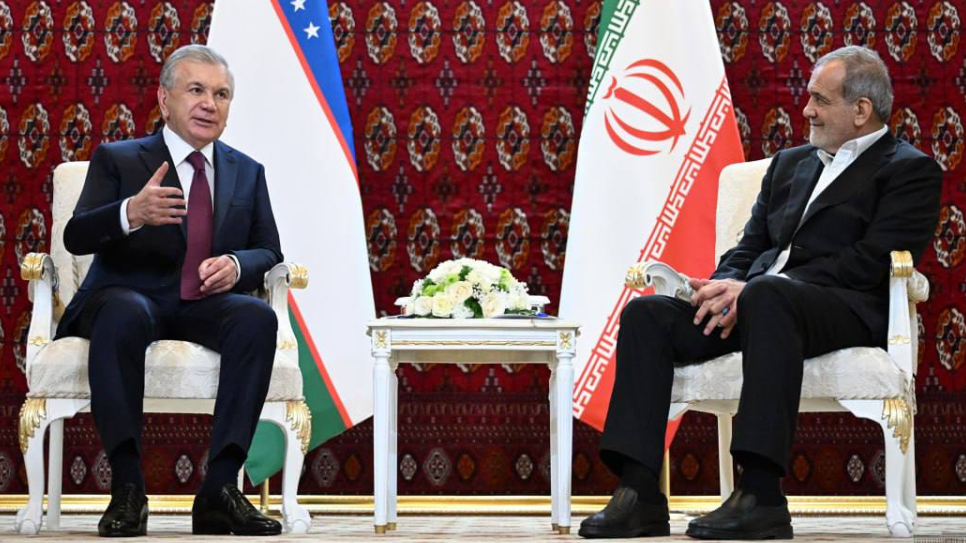
Uzbekistan and Iran have sought to strengthen those connections. In June 2025, the two countries signed a memorandum aimed at expanding transit cooperation, including potential Uzbek investment in Iran’s Shahid Rajaee port and the construction of a dedicated terminal and logistics centre.
What does Uzbekistan transport through the southern route?
A wide range of goods moves through Iran, with machinery and technological equipment accounting for a significant share. Other shipments include food products, chemicals, metals, vehicles and spare parts, pharmaceuticals and electrical equipment. Uzbek exports using the route include textiles, metals and chemicals.
Some of these supply chains ultimately depend on access to Iran’s southern ports and maritime routes connected to the Strait of Hormuz.
The Strait is one of the world’s most important shipping chokepoints. The International Energy Agency estimates that nearly 20 million barrels of oil per day passed through it in 2025, representing around a quarter of global seaborne oil trade. It is also an important route for liquefied natural gas (LNG), petroleum products and fertilisers.
For Uzbekistan, the potential impact goes well beyond its direct trade with Iran. Disruptions to shipping, insurance, ports and transit routes could lengthen delivery times and drive up freight costs, while rerouting cargo could put additional pressure on already lengthy supply chains.
The Ministry of Economy and Finance estimates that disruptions to foreign trade and logistics could cost the Uzbek economy $1–1.5 billion. Authorities also warn that higher global prices for oil, food and fertilisers could fuel inflation and weigh on broader economic performance.
Uzbekistan looks for alternatives
The potential disruption is adding urgency to Uzbekistan’s efforts to diversify its transport links. The country has been developing alternative corridors through the Caspian Sea and the South Caucasus, while also working with neighbouring countries to expand multimodal connections.
In June 2025, Uzbekistan and Iran agreed to create conditions for Uzbek private-sector investment in Shahid Rajaee port, including a dedicated terminal and logistics centre.
Despite efforts to diversify, Uzbekistan remains significantly dependent on Iranian transit. According to analysis by the Institute for Advanced International Studies, the country transported around 1.2 million tonnes of cargo through Iran in 2025, with shipments moving towards Türkiye and Western markets.
Bilateral economic ties are continuing to expand despite the logistical risks. Uzbekistan’s trade turnover with Iran reached $305 million in January–June 2026, up 37.5 per cent year on year.
The two countries are also discussing 29 joint projects and preparing for a business forum scheduled to take place in Tashkent in November.
For Uzbekistan, the challenge is not only to maintain trade with Iran, but to ensure that disruptions along the southern route do not undermine access to wider international markets.
The growing risks are increasing pressure on Tashkent to diversify its logistics network, strengthen alternative corridors and build more resilient supply chains.

















What is your opinion on this topic?
Leave the first comment