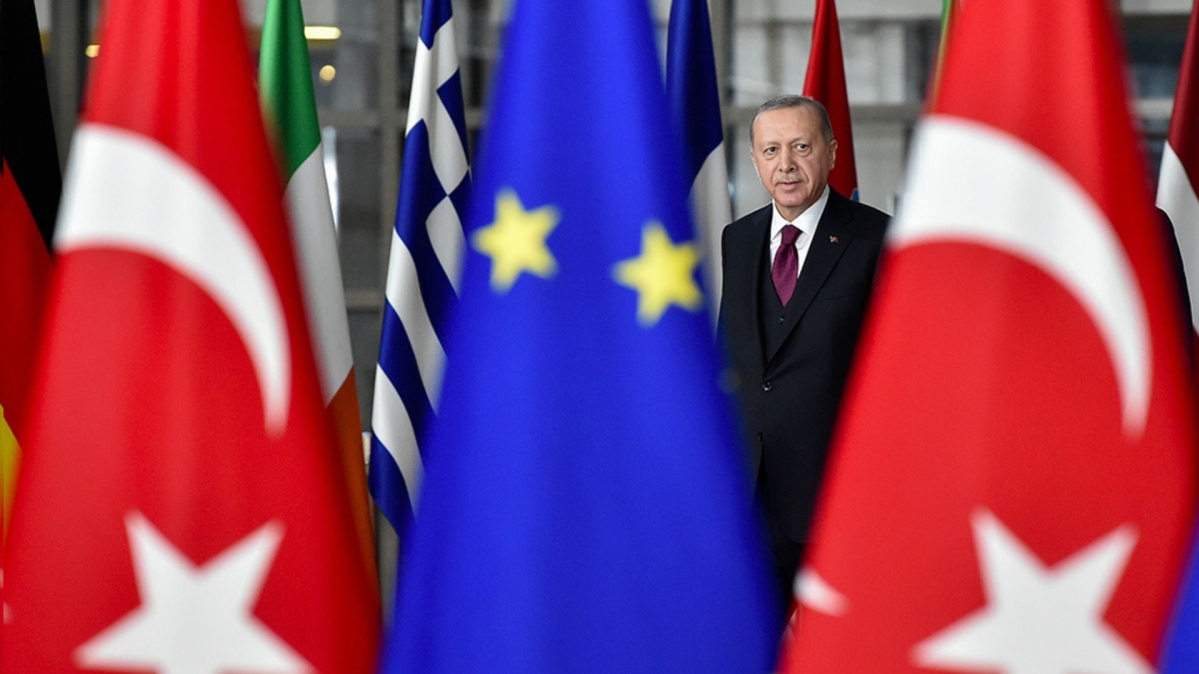
Türkiye’s President, Recep Tayyip Erdoğan, has called for stronger Türkiye-European Union relations, saying modernising the Customs Union is essential to closer integration amid shifting geopolitical and economic realities.
Speaking on the Daybreak programme on AnewZ, geopolitical analyst Akbar Novruz said the proposal comes amid long-standing structural trade concerns and evolving political dynamics between Ankara and Brussels.
Novruz noted that the Customs Union, in force since 1996, governs trade worth around €210 billion, making Türkiye the EU’s fifth-largest trading partner.
Structural imbalances
According to Novruz, one of the central issues lies in Türkiye’s application of the EU’s Common External Tariff, which creates an asymmetric trade structure.
He explained that when the EU signs free trade agreements with third countries, goods from those countries can enter Türkiye’s market under the same tariff conditions, while Turkish exporters do not receive equivalent reciprocal access.
“So those countries’ goods gain potential access to Turkish markets as well,” Novruz said. “The third country gets more benefit rather than the Turkish companies.”
He said this creates a “one-sided” dynamic that limits the expansion of Turkish export opportunities despite rising trade volumes.
Novruz added that both sides have acknowledged these concerns since at least 2016, although they remain unresolved.
Political barriers remain
Beyond technical trade issues, Novruz said political tensions remain the main obstacle to modernising the Customs Union, particularly disputes involving Cyprus and Greece.
“Whenever any sort of enhancement between the European Union and Türkiye is discussed, they actually make an obstacle,” he said, referring to Athens and Nicosia.
He argued that, despite progress in technical negotiations, political disputes continue to slow broader institutional reform.
At the same time, he pointed to estimates suggesting that full modernisation could add around 2.5–3% to Türkiye’s GDP and increase EU trade flows by approximately €25 billion over the next three to four years, underlining strong interest from business communities on both sides.
“The business lobbies are actually interested in that matter,” Novruz said. “The improvement most certainly can happen.”
Strategic alignment
Novruz also highlighted growing convergence in areas such as defence, energy and industrial cooperation, particularly as the European Union reassesses its long-term security architecture.
He said Türkiye’s participation in EU defence initiatives would be in the mutual interest of both sides, especially amid changing regional security dynamics.
“If they’re actually looking forward to enhancing this in the defence products as well, given the fact that the European Union is looking forward to having a new bloc, Türkiye remains an important partner,” he said.
EU perceptions and geopolitical influence
Commenting on the European Commission’s recent positioning of Türkiye alongside Russia and China as a source of external influence, Novruz said this reflected geopolitical framing rather than a structural deterioration in relations.
“There is nothing, in my opinion, to be upset about this,” he said. “The geopolitical leverage of Türkiye is significant.”
He argued that Türkiye retains strategic importance because of its position between Europe, Russia and the Middle East, as well as its role in regional diplomacy and upcoming international summits, including the NATO leaders’ meeting and COP31.
Novruz said Ankara’s ability to maintain relations with multiple actors enhances its value as a geopolitical partner for the EU.
Regional connectivity
Turning to regional developments, Novruz said progress in Türkiye-Armenia normalisation could have wider implications for economic integration and connectivity in the South Caucasus.
He noted that Armenia’s landlocked position and historical conflicts have limited its economic potential, but said improved relations with Türkiye could open new trade routes and markets.
“Turkish companies are most certainly interested because it’s a new market that hasn’t been touched for more than three decades,” he said.
According to Novruz, such developments would also strengthen regional energy and logistics corridors involving Azerbaijan and Georgia.
He concluded that, if supported by a durable peace framework, the region could see a gradual expansion of economic cooperation, with the European Union likely to support incremental progress in both political normalisation and trade integration.












What is your opinion on this topic?
Leave the first comment