Kazakhstan has announced its readiness to take part in the creation of a Turkic large language model, a joint initiative designed to unite the scientific and technological potential of Turkic-speaking nations in the field of artificial intelligence.
The announcement was made in Astana during a meeting between Kazakhstan’s Deputy Prime Minister and Minister of Artificial Intelligence and Digital Development, Zhaslan Madiev, and Azerbaijan’s Minister of Digital Development and Transport, Rashad Nabiyev. The project, initiated under the Organisation of Turkic States, seeks to enhance regional cooperation in developing AI systems that reflect the linguistic and cultural diversity of the Turkic world.
Madiev underlined that digital sovereignty has become one of the key priorities for Kazakhstan. “The development of artificial intelligence is inseparable from the issue of digital sovereignty,” he said.
“Access to national data and culturally specific datasets is crucial for building AI systems that truly reflect the identity of our nations.
Kazakhstan has already developed its own large language models - KazLLM and AlemLLM - including versions in the Kazakh language.We are ready to share our experience and contribute to the creation of a Turkic large language model that brings together the scientific potential of the Turkic world.”
Artificial intelligence has been identified as one of Kazakhstan’s top national priorities.The government is currently preparing a Law on Artificial Intelligence, designed to establish clear ethical and legal standards for AI development and deployment.
Earlier this year, Astana also opened the Alem.AI International Centre for Artificial Intelligence, which combines research, education and start-up incubation.
The centre works in partnership with leading technology companies such as Telegram, Microsoft, Google, Apple and Huawei.
Regional collaboration remains a key pillar of Kazakhstan’s digital policy. Cooperation with Azerbaijan continues to expand through Astana Hub and the Silkroad Innovation Hub in the United States, which connect start-ups, researchers and investors from across the Turkic world.
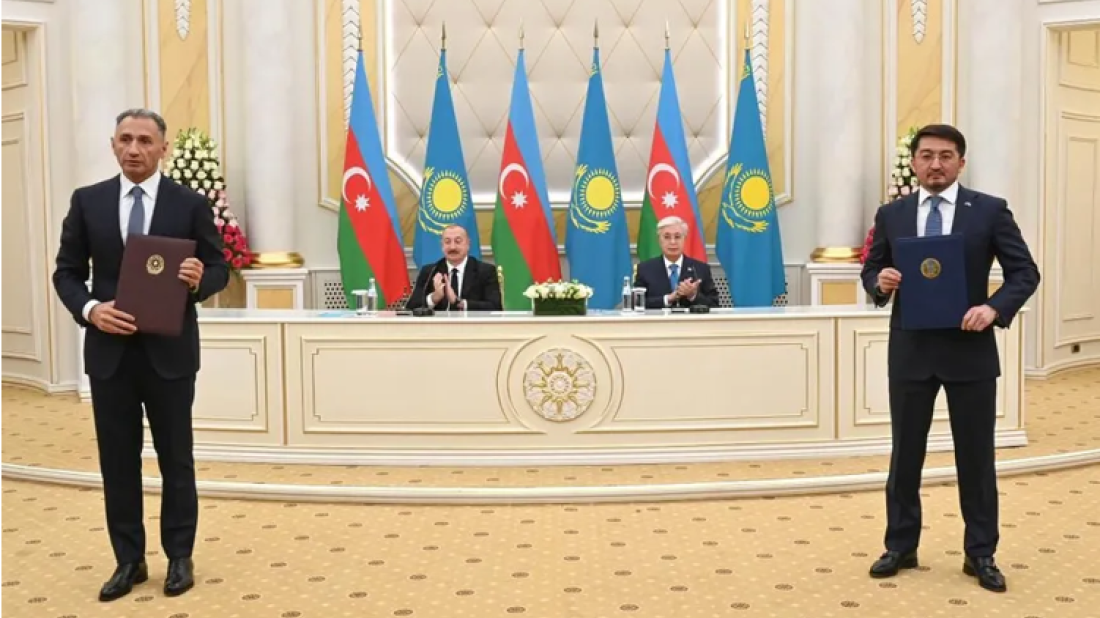
Several Azerbaijani start-ups, including Tryverse, Metatesk, Voiceloft and Tripsome.com, have already completed acceleration programmes at Astana Hub and are now scaling up internationally.Kazakh IT firms are also entering the Azerbaijani market. Their projects were showcased at a technology exhibition held during the recent official visit of President Ilham Aliyev to Kazakhstan.During the visit, the two countries signed memorandums of cooperation in the fields of artificial intelligence and public services, marking a new stage in their digital partnership.
“The current visit will give a new impetus to our partnership and further strengthen cooperation between our innovation ecosystems,” Madiev said. “We look forward to expanding collaboration through Astana Hub and Silkroad Innovation Hub, and to greater participation of Azerbaijani start-ups in global acceleration programmes.”
The talks in Astana also covered several large-scale projects, including the planned construction of a Kazakhstan–Azerbaijan undersea fibre-optic communication line, the development of the Alem Ventures investment platform, and closer collaboration in AI and satellite technologies within the framework of the Organisation of Turkic States.
Both countries also expressed support for establishing a Regional Centre for Digital Solutions for Sustainable Development in Almaty, in partnership with the United Nations ESCAP.
















What is your opinion on this topic?
Leave the first comment