Kazakhstan and Pakistan have pledged to expand bilateral collaboration between the two countries by signing a mutual agreement hoping to bolster total trade volume to $1 billion.
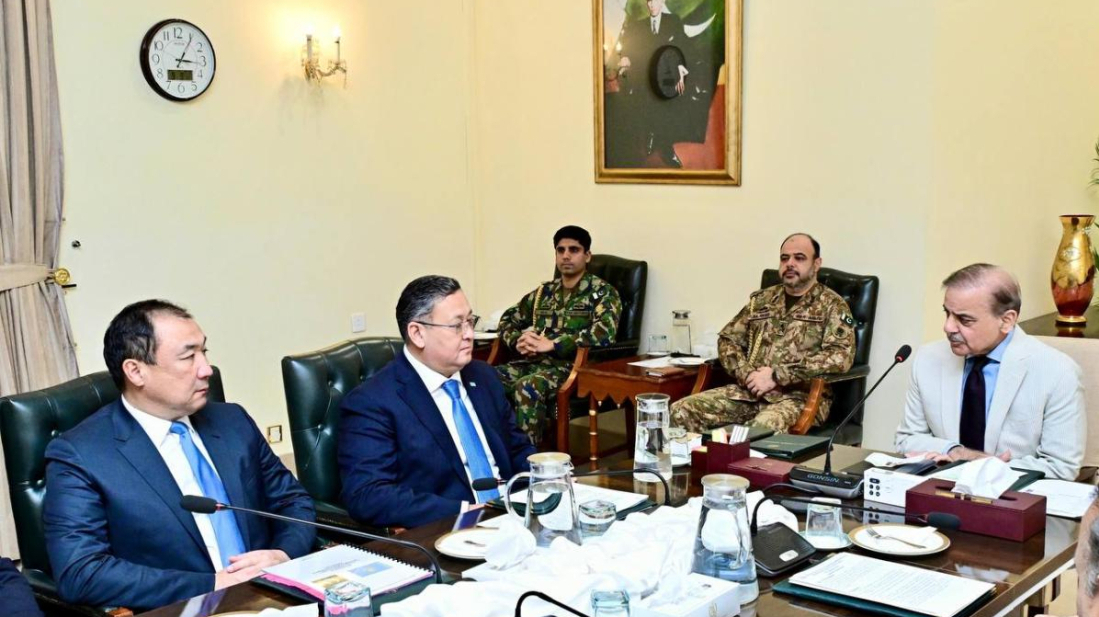
The announcement was made during the official visit of Kazakhstan’s Deputy Prime Minister and Minister of Foreign Affairs, Murat Nurtleu, to Islamabad
The Kazakh delegation held important closed door meetings with the President of Pakistan, Asif Ali Zardari, Prime Minister Shehbaz Sharif, and Foreign Minister Muhammad Ishaq Dar. Both sides reaffirmed their commitment to strengthening strategic cooperation and expanding economic ties.
“This is my first official visit to Pakistan. We are not only looking to deepen our relationship but to elevate it to a new level. Our partnership has stood the test of time and holds significant potential," Nurtleu said"
"During the talks, we discussed concrete steps to enhance cooperation and explore new directions,” added Nurtleu during the extended meeting at Pakistan’s Ministry of Foreign Affairs.
Following the talks, the foreign ministers signed a Joint Action Plan for 2025–2026 outlining key areas for collaboration.
A central focus of the discussions was the growing trade between the two countries, which has already increased 2.5 times since the beginning of 2025, reaching $86.8 million.
Kazakhstan exports vegetables, grains, legumes, garlic, onions, and ferrous metal products to Pakistan, while importing citrus fruits, pharmaceuticals, clothing, potatoes and other food products.
Kazakhstan’s Minister of Trade and Integration, Arman Shakkaliev, highlighted infrastructure and transport routes as the main obstacles to trade growth.
However, he noted that Kazakhstan is rapidly becoming a major regional transit hub, opening opportunities not only for bilateral trade but also for exports from Pakistan to the Eurasian Economic Union, China and Russia. Kazakhstan also proposed the establishment of a wholesale trade centre in Almaty to further facilitate business.
“Kazakhstan is well positioned to become Pakistan’s strategic partner in the region. Conversely, Pakistan could play a vital role in the development of the North–South transport corridor, giving Kazakhstan access to the markets of the Middle East, Southeast Asia and Africa,” said Shakkaliev.
During the visit, the Kazakh delegation met with leading Pakistani companies, including National Logistics Corporation and TCS Logistics, both specialising in freight and transport services.
Pakistani business leaders expressed interest in long-term cooperation, particularly in the agricultural sector. TCS Logistics CEO H. Awan stated the company is ready to expand fresh fruit and vegetable exports to Kazakhstan, highlighting how the two economies complement each other.
Another major development was the announcement by Fauji Foundation, one of Pakistan’s largest business conglomerates, of its intention to invest $1.1 billion in Kazakhstan.
Representatives from the foundation confirmed that cooperation has already begun in the energy, oil and gas, and fertiliser industries. They also noted plans by Askari Bank to establish a partnership with a Kazakh bank to support business payments.
“We discussed a wide range of topics, from food security to digitalisation. The Kazakh delegation demonstrated openness and a strong practical approach. We are confident this marks the beginning of a serious strategic partnership,” said Irfan Khan, Secretary of the Administrative Committee of Fauji Foundation.
Currently, more than 240 companies with Pakistani capital are operating in Kazakhstan, and an official Pakistani Trade Mission is active in Almaty. Diplomatic relations between the two countries were established on 24 February 1992.
















What is your opinion on this topic?
Leave the first comment