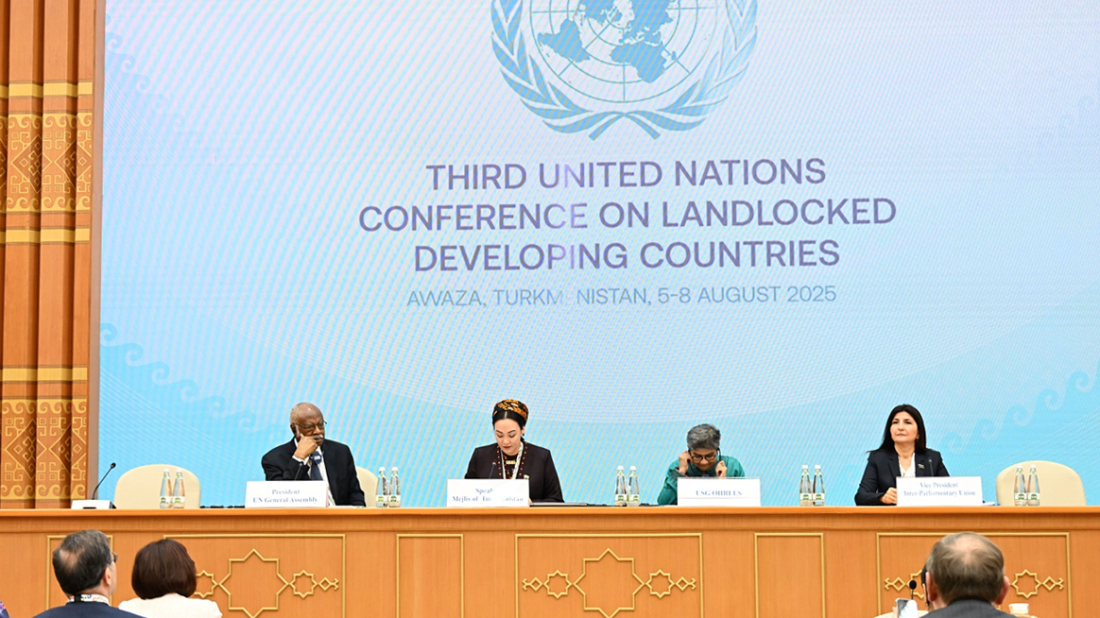
A series of events within the Third UN Conference on Landlocked Developing Countries (LLDC3) under the theme “Driving Progress Through Partnerships” has been launched today in Turkmenistan's national resort.
In Awaza, the flags of the United Nations and Turkmenistan were raised ahead of the conference to welcome world leaders and delegates for a week of high-level discussions focused on development of countries whose economies are often “locked out” due to lack of access to the sea.
At the flag-raising ceremony, Foreign Minister Rashid Meredov formally welcomed participants. “Welcome to Awaza. I wish all participants success in the conference,” he said.
The forum coincides with the 30th anniversary of Turkmenistan’s permanent neutrality and the 80th anniversary of the United Nations’ founding. The event reflects the international community’s endorsement of Turkmenistan’s initiatives in sustainable energy, transportation, ecology, and environmental protection—efforts aimed at promoting universal prosperity and security, he added.
UN High Representative Rabab Fatima expressed hope that the gathering would "become a historic milestone defined by solidarity, significant decisions, and global commitments to the advancement of landlocked developing countries."
She said that the conference aims to mobilize global support for the comprehensive implementation of the Awaza Programme of Action for 2024-2034, adopted by the UN General Assembly last December.
"This significant, forward-looking document provides a clear roadmap to accelerate structural reforms, strengthen regional connectivity, and enhance the stability of landlocked developing countries. Our mission is to link every landlocked developing country to global markets, eliminate the transport and trade obstacles that hinder their progress, and secure the climate finance and investments necessary to safeguard their future" stated Fatima at the ceremony.
More than 20 heads of state and government and some 3,000 delegates from international organizations, civil society, youth, academia and the private sector are expected to attend the conference.
UN Secretary-General António Guterres will arrive from Almaty, Kazakhstan where he participated at at the opening of new Centre for Sustainable Development Goals for Central Asia and Afghanistan.
The Centre, he spoke, can become “a vital pioneer” for implementing the Programme of Action for Landlocked Developing Countries, turning geographic constraints into opportunities through regional cooperation.
Today, a series of events has been started within the conference:
Parliamentary Forum
The event was organized by the Mejlis of Turkmenistan in collaboration with the Office of the High Representative of the United Nations for the Least Developed Countries, Landlocked Developing Countries, and Small Island Developing States, alongside the Inter-Parliamentary Union.
The primary goal of the forum is to facilitate the exchange of experiences among parliamentarians and to develop recommendations for legislative bodies in landlocked developing countries. These recommendations focus on incorporating the priorities of the Programme of Action into legislative agendas.
The event will offer a platform to share best practices in implementing the Vienna Programme of Action and to advance the execution of the Awaza Programme of Action through political engagement by parliamentarians at local, national, and regional levels.
Parliamentarians will play a crucial role in ensuring transparency, accountability, and inclusiveness in implementing the Programme of Action, acting as a vital bridge between governments, civil society, and international partners.
Civil Society Forum
The Forum offers a platform for dialogue among high-level government and UN representatives, along with other stakeholders, to exchange experiences and formulate solutions that shape the sustainable development agenda for implementing the Awaza Programme of Actio.
Successful implementation of this Programme demands a multilateral approach and civil society plays a crucial role in promoting sustainable development by providing innovative solutions and ideas, while also helping to integrate the priorities of LLDCs into the global political agenda on issues such as finance, trade, and climate change.
The Forum focuses on enhancing the role of civil society in advancing the international agenda and fosters the inclusion of LLDCs’ interests in global decision-making processes.
Youth Forum
The forum offeres a platform for dialogue between youth, UN bodies, and other stakeholders; to enhance youth participation in implementing the Awaza Action Programme for LLDCs; to share experiences from the Vienna Programme of Action; to showcase innovative solutions and initiatives for advancing the Sustainable Development Goals and the Awaza Action Programme; and to foster collaboration among youth, UN Member States, UN agencies, civil society, and the private sector at national, regional, and global levels.












What is your opinion on this topic?
Leave the first comment