The AnewZ Opinion section provides a platform for independent voices to share expert perspectives on global and regional issues. The views expressed are solely those of the authors and do not represent the official position of AnewZ
U.S. President Donald Trump and Chinese President Xi Jinping met in Busan, South Korea, on October 30, 2025, concluding Trump's five-day tour of Asia
Coinciding with the Asia-Pacific Economic Cooperation (APEC) Summit, the meeting was the culmination of previous, largely unsuccessful, talks aimed at reversing the escalating U.S.-China trade war.
Since the publication of the United States’ Trade Policy Memorandum on January 20, 2025, President Trump has frequently used his authority under the International Emergency Economic Powers Act (IEEPA) to threaten the implementation of fentanyl-related and reciprocal tariffs on imports from China. Prior to the Busan meeting, the trade conflict had intensified significantly.
Over 20,000 Chinese entities were targeted by export controls, due to national security risks. China had retaliated by expanding export controls on rare earth minerals that are crucial for U.S. manufacturers and high-technology firms, prohibiting imports of soybeans and logs from U.S. producers, and imposing retaliatory tariffs on several U.S. agricultural products. Further escalation included Chinese regulators banning the country's largest firms from purchasing U.S. Nvidia's artificial intelligence (AI) chips, followed by a mandate that new data centers receiving state funding must exclusively use domestically produced AI chips.
Offering limited relief to producers in both nations, the 100-minute discussion between Xi Jinping and Trump yielded a temporary agreement involving mutual concessions. The U.S. announced it would lower the "fentanyl-tariff" on imported goods from China and suspend port fees on Chinese vessels calling into U.S. ports. China, in turn, declared it would suspend the rare earth export ban to the U.S. for one year, and lift the ban on imports of soybeans and logs from the U.S.
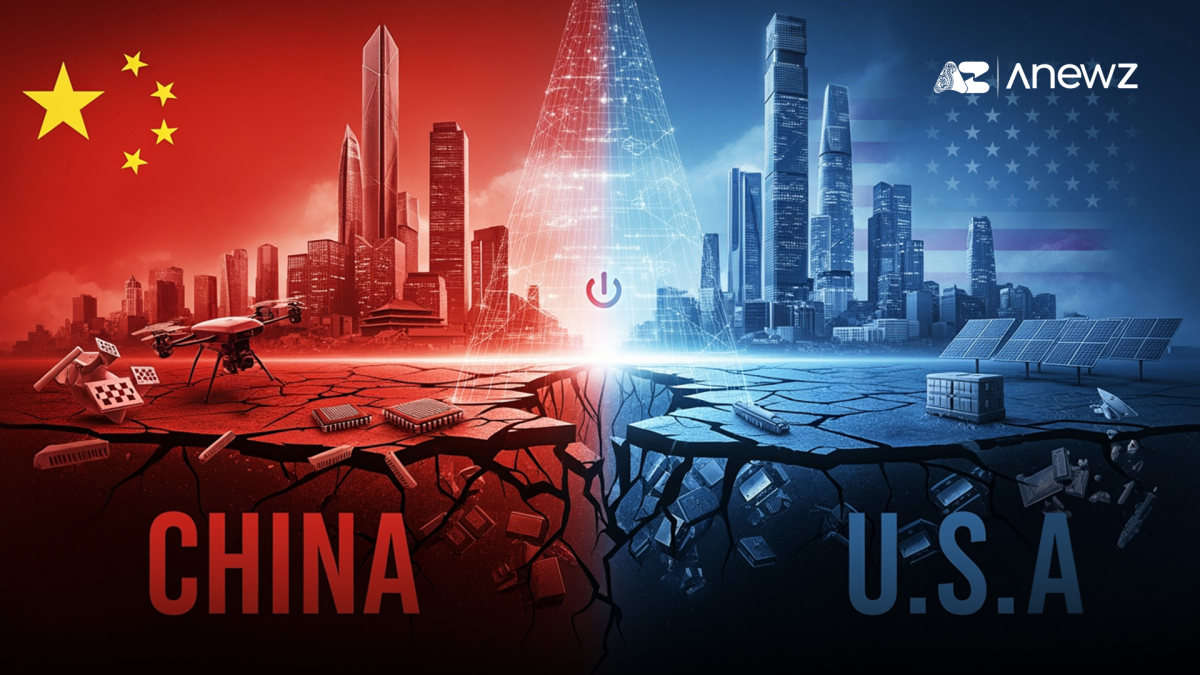
While the agreement’s text remains unpublished and the risk of a sudden policy U-turn is noted by pundits, the truce is expected to favor investment and trade. However, the Busan meeting signifies more than just a pause in the trade war; it is an expression of a geopolitical earthquake where the international system's epicenter is rapidly moving East. China is quickly advancing its superpower vision, modernizing as a military titan that expects full readiness by the end of the decade, and aiming to become a world technological power and the center of global affairs by the centenary of the People’s Republic in 2049.
The Chinese government’s use of the rare earth export ban starkly illustrates how the supply chains of key components for the tech and defense industries have become the new "nuclear weapon" in this competition. Through a long-term investment and acquisitions strategy initiated in the 1970s and solidified in a series of national directives and grand strategy, such as the widely known Belt and Road Initiative (2013-), Chinese firms have achieved a stronghold on the global supply chain of nickel, lithium, and cobalt, and hold large stakes in leading global mining operations, namely in the Democratic Republic of Congo and Indonesia. Beyond China’s strategic control of these mining and processing of the essential elements for battery production, China controls a substantial portion of the supply chains for gallium and germanium (key for solar cells and semiconductors) and samarium (critical for jets and missiles).
China has not only become the central player in global trade but has reached hegemony in the world market of critical minerals and rare earths, controlling approximately 90% of the world's rare earth processing capacity. This near total chokehold capacity places U.S. national security at peril. U.S. policy-makers in the Trump administration widely believe that without reversing China's mineral and rare earth dominance, the U.S. risks losing its capacity to sustain industrial, technological, and military strength, and ultimately, its Great Power status.
Several U.S. foreign policy documents and legislative acts—including the Energy Act of 2020, the Inflation Reduction Act of 2022, and the Critical Minerals Act of 2025—underscore that securing access to rare earths and other critical minerals is vital for U.S. national security and urgently needed to address vulnerability to China’s supply hegemony. The U.S. counter-strategy to secure autonomy relies on international cooperation mechanisms, such as the recent deal with Australia on rare earths. Last week’s Central Asia-U.S. C5+1 Summit in Washington also showcases the U.S. administration’s effort to counter Chinese industrial partnerships.
The meetings with the leaders of Kazakhstan, the Kyrgyz Republic, Tajikistan, Turkmenistan, and Uzbekistan were crucial in view of the region’s wealth in mineral resources and its transport connectivity infrastructures. The U.S. administration views Central Asian governments and leading mining and metals companies (e.g., the Eurasian Resources Group (ERG) and the Uzbekistan Metals and Technological Company (UzTMK)) as ideally positioned to advance industrial and technological innovation. These partnerships will contribute to decreasing U.S. vulnerability in access to critical minerals and rare earths, provided political, economic, social stability, as well as regional integration, are sustained.
Notwithstanding the temporary trade truce attained in Busan, the race between the two global titans for self-sufficiency and influence is expected to intensify as both sides endeavor to secure control of supply sources and transport connectivity. The Trump administration will keep working toward the strategic goal of autonomy from China for rare earths and magnets. Xi Jinping’s government will continue to pursue its strategic ambition for self-sufficiency in key core technologies, including AI and semiconductors, as clearly stated in the 15th Five-Year Plan for Economic and Social Development (2026-2030). Trump has deployed tariffs as a key foreign policy tactic; Xi Jinping has countered with critical raw materials restrictions as a nuclear foreign policy weapon.
Ultimately, the bipolar Cold tech-industry-military competition is motivated by irreconcilable approaches to world geopolitics. Trump’s "Making America Great Again" campaign promise is incompatible with China’s vision of an alternative to the post-1945 liberal international order, which positions China at the center of a "global civilization with a common destiny" - a vision articulated by Xi Jinping during the 25th Summit of the Shanghai Cooperation Organization in Tianjin, China, in August. In this vision, the Middle Kingdom will become the political, technological, industrial, and cultural center of the world. The problem is that Great Powers are not fond of being replaced, a dynamic Thucydides captured perfectly in History of the Peloponnesian War: "What made war inevitable was the growth of Athenian power and the fear which this caused in Sparta."
















What is your opinion on this topic?
Leave the first comment