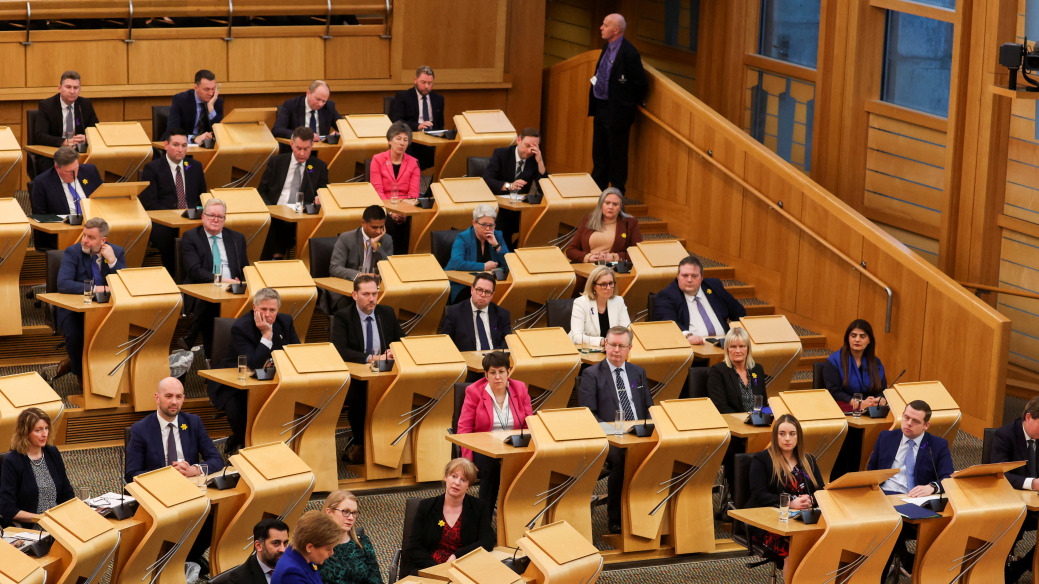
The Scottish Parliament has voted against legalising assisted dying, ending a years-long campaign to make Scotland the first part of the UK to allow the practice.
The bill was proposed by Liberal Democrat Liam McArthur and would have allowed terminally ill, mentally competent adults who have lived in Scotland for at least 12 months to end their lives legally through medical assistance.
However on Tuesday, 69 Members of the Scottish Parliament (MSPs) voted against passing the bill, as against 57 Scottish lawmakers who backed the bill.
Fifty-seven lawmakers in Scotland, who backed the bill, would have seen Scotland become the first part of the UK to legalise assisted dying. One lawmaker abstained from voting, while two others did not vote.
Lawmakers who opposed the bill voiced concerns that people could potentially be pressured to accept assisted death.
A report by the BBC stated that a bill to legalise assisted dying in England and Wales is being considered, but said it is unlikely to be successful.
Eligibility for the bill proposed?
The bill proposed by McArthur would legally allow terminally ill adults in Scotland, who are eligible, to lawfully request and be provided with assistance by health professionals to end their own life.
Eligibility was based strictly on these criteria:
- be terminally ill (have an advanced and progressive disease, illness or condition which they cannot recover from, and which is expected to cause their premature death)
- be aged 16 or over
- have been resident in Scotland for at least 12 months and be registered with a GP practice in Scotland
- have sufficient mental capacity to make and understand the decision
Voices against the Bill
The members of Parliament who voted against the bill raised mutual concerns which can be summed up in one word: 'coercion'.
Independent MSP Jeremy Balfour, who was born with no left arm and a right arm that ends at the elbow, warned that the bill would open a "Pandora's box” and would offer no protection against "coercion" and said, "I'm begging you to consider the consequences for the most vulnerable."
He also said that disabled people were "terrified" of the assisted dying bill proposition.
'Not good enough,' said Ruth McGuire, an MSP, who was diagnosed with stage three cervical cancer in 2021.
She drew insight from her own experience while speaking to the parliament and said, "My blood runs cold thinking about sitting in a room in a hospital and having a doctor raise (assisted dying) with me as we weigh up treatment options," she told parliament.
Maguire, a member of the Scottish National Party, cited more concerns about the cost of the proposals and said, "It's not a free choice if you do not have access to good palliative care."
Other voices against the bill include Pam Duncan-Glancy, who urged lawmakers against the bill.
Duncan-Glancy urged MSPs to "choose to make it easier to live than to die".
Another concern raised by the MSPs who opposed the bill was on protection for medics who did not want to participate in assisted dying and a lack of oversight on doctors who would sign off on the process.
Critics of the bill also argued that the focus should be on improving palliative care.
Voices in support of the bill
There were several strong voices in support of the bill; McArthur, who raised the bill, cited the case of one man who was left "begging to have his life ended" after his penis was removed due to cancer.
He debated that it was time Scotland adopted the bill and said, "This is the time. This is the bill. This is the change that dying Scots desperately need us to take.”
Lorna Slater, former Green co-leader, in an emotional moment, shared her experience of her father's "beautiful" assisted death in Canada and said, "We should all have the right to choose."
The SNP's George Adam also shared the personal experience of his wife, who has Multiple Sclerosis (MS) and was watching the proceedings.
He said to his fellow MSPs, “If the worst should ever come to her, if she were ever facing that unbearable suffering at the end of life, she would want a choice."
History of the Assisted Dying Bill in Scotland
- There were two other major proposals for the assisted dying bill in Scotland before the recent one by McArthur.
- The End of Life Assistance Bill was introduced to the Scottish Parliament on 20 January 2010. It was introduced by Margo Macdonal. The bill fell at stage 1 on 1 December 2010.
- The Assisted Suicide Bill, May 2015. Introduced by Margo MacDonald; taken over by Patrick Harvie after her death. Votes were 82-36 against the bill.




















What is your opinion on this topic?
Leave the first comment