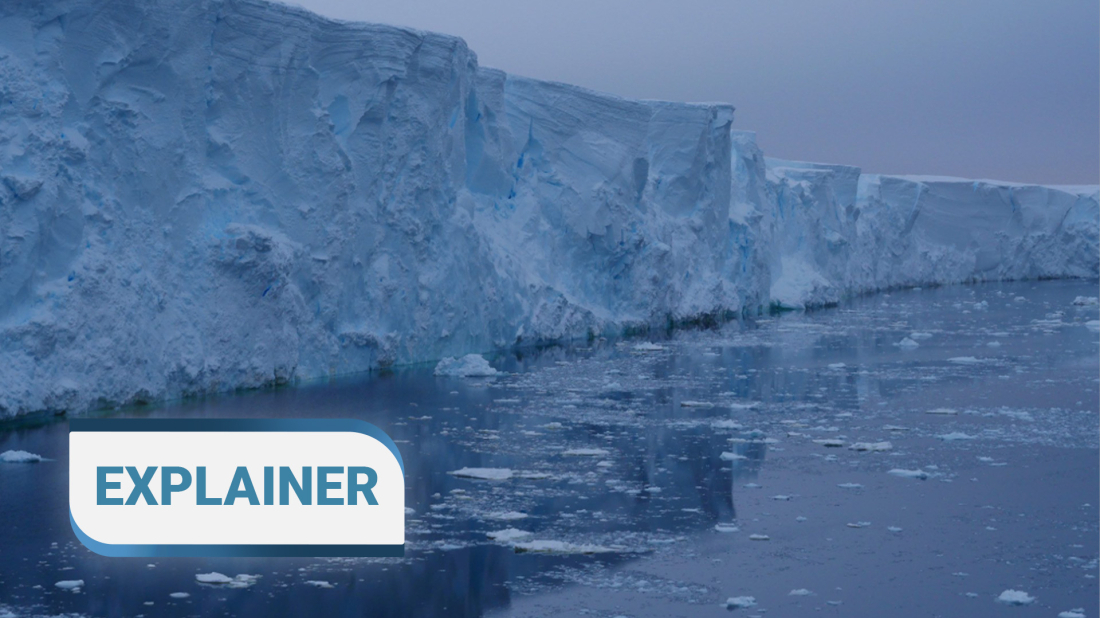
It’s vast, it’s unstable, and it holds enough ice to reshape the world’s coastlines. Thwaites Glacier, ominously nicknamed the “Doomsday Glacier”, has become one of the most closely watched pieces of ice on the planet.
A frozen giant on the brink
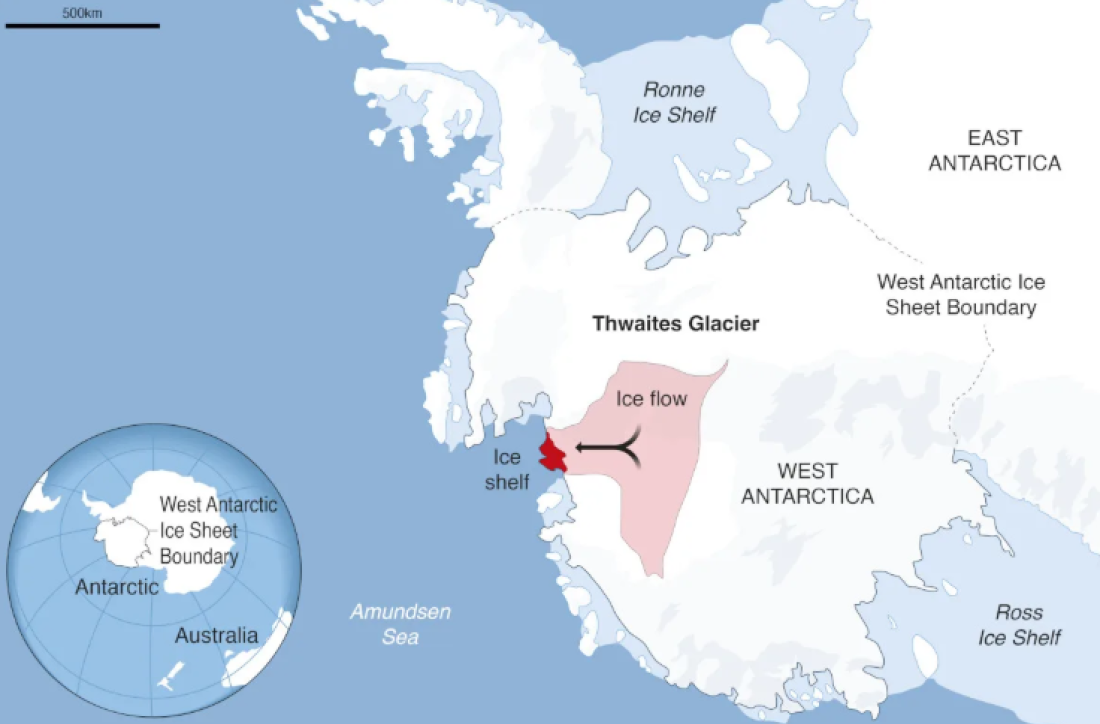
Thwaites Glacier is located in remote West Antarctica and is roughly the size of the United Kingdom. Spanning 120km across and covering nearly 192,000 square kilometres, it plays a critical role in holding back the West Antarctic Ice Sheet, a vast store of frozen water sitting on land below sea level.
But that role is now under threat.
Every year, Thwaites sheds around 50 billion tonnes more ice than it gains. If the glacier were to collapse entirely, it could raise global sea levels by up to 65 centimetres. And that’s just the start.
“It’s a monster of a glacier,” says Dr Kaitlin Naughten, an ocean modeller with the British Antarctic Survey (BAS). “And it’s losing ice faster than it’s accumulating.”
Why is it called the “Doomsday Glacier”?
Thwaites has earned its dramatic nickname because of the chain reaction it could unleash. It acts like a natural dam, holding back neighbouring glaciers such as Pine Island and Haynes. If it fails, these glaciers could also accelerate into the sea, leading to a collapse of the broader West Antarctic Ice Sheet.
In the worst-case scenario, this could eventually push sea levels up by over 1.5 metres, enough to flood major cities including New York, Bangkok, and Amsterdam.
Scientists say that although a full collapse could take centuries, the retreat has already begun, and it’s accelerating.
“The more Thwaites retreats, the more it destabilises the entire West Antarctic Ice Sheet. It’s like pulling a brick out of the bottom of a wall.”
— Dr Peter Davis, physical oceanographer, BAS
What’s happening beneath the surface?
Thwaites is currently stabilised by a floating ice shelf, but that support is rapidly weakening. Warmer ocean currents are melting the glacier from below, causing the ice shelf to thin and crack. Some scientists believe parts of it could collapse within the next decade.
This would remove one of the last barriers holding the glacier back.
A key concern is the glacier’s grounding line, the point where it lifts off the seabed and begins to float. As this line retreats inland, more of the glacier becomes exposed to warm water, creating huge cavities beneath the ice and speeding up the melting.
In 2021, NASA discovered a massive underwater cavern beneath Thwaites, nearly 300 metres tall and large enough to hold 14 billion tonnes of ice. It formed in just three years.
The warning signs: crevasses, cracks, and collapse
New research has revealed just how fragile parts of Thwaites have become. Using advanced underwater robotics and satellite imagery, scientists have uncovered a chaotic underside, a landscape of jagged crevasses, scalloped terraces, and stair-like formations vulnerable to melting.
These structurally weak areas are being targeted by warm ocean currents. Melting here is happening much faster than previously believed.
“The combination of deep cracks and warm water could destabilise the ice shelf within the decade,” says Dr Peter Davis, who has spent five field seasons studying Thwaites with the BAS.
Why is it melting so fast?
The root cause is climate change. Greenhouse gas emissions have warmed the planet, and the oceans have absorbed most of this extra heat. Polar regions are feeling the effects more acutely than anywhere else, a phenomenon known as polar amplification.
In the case of Thwaites, warming oceans, shifting winds, and feedback loops are working together to undermine the glacier from below and within. Even temporary warm water events, such as lake drainage beneath the ice, can accelerate melting dramatically.
“The rapid deterioration of Thwaites Glacier is being driven by human-induced climate change. These consequences are not distant—they’re already unfolding.”
— International Thwaites Glacier Collaboration
Could we save Thwaites?
Some scientists believe that radical geoengineering may one day help slow Thwaites’ decline.
One proposal involves installing a giant seabed curtain to block warm ocean water from reaching the glacier. Another idea is to freeze the glacier to the bedrock using thermosyphons, heat-extracting pipes similar to those used around oil pipelines in permafrost regions.
“It’s a choice between two impossible problems — stabilising an ice block the size of a country, or orchestrating mass migrations to escape sea-level rise.”
— Prof Brent Minchew, MIT
But such schemes are expensive, logistically complex, and not without risk. The cost of building a curtain under Thwaites has been estimated at $40–80 billion. Critics argue that resources might be better spent adapting coastlines and reducing emissions.
“Even if we can’t stop it, delaying collapse gives the world time to adapt,” says MIT geophysicist Professor Brent Minchew.
What happens if Thwaites collapses?
The impacts would be global.
- Sea level rise: Up to 65cm from Thwaites alone, and potentially 1.5m if the West Antarctic Ice Sheet follows.
- Flooding: Coastal cities from Manila to London would face serious inundation.
- Mass displacement: More than 230 million people live within one metre of current sea levels.
- Climate disruption: Freshwater from melting glaciers could interfere with global ocean circulation patterns.
- Ecosystem loss: Antarctic marine life depends on stable ice environments.
What can be done now?
There’s still a window of time, but it’s narrowing.
- Cut emissions: Limiting warming through rapid decarbonisation remains the most effective strategy.
- Adapt: Coastal cities must invest in sea walls, flood planning, and population movement strategies.
- Keep researching: International teams are racing to improve models and forecasts to better understand what’s coming.
“The question is no longer whether Thwaites will collapse,” says Dr Naughten. “It’s when, and how much time we have to prepare.”
Final thoughts: a race against time
For scientists camped in Antarctica, studying Thwaites means enduring some of the most remote and extreme conditions on Earth. But their work could shape the future for hundreds of millions of people.
As one researcher put it: “We’re not here to feel doom. We’re here to understand, to learn, and to give the world a fighting chance.”

















What is your opinion on this topic?
Leave the first comment