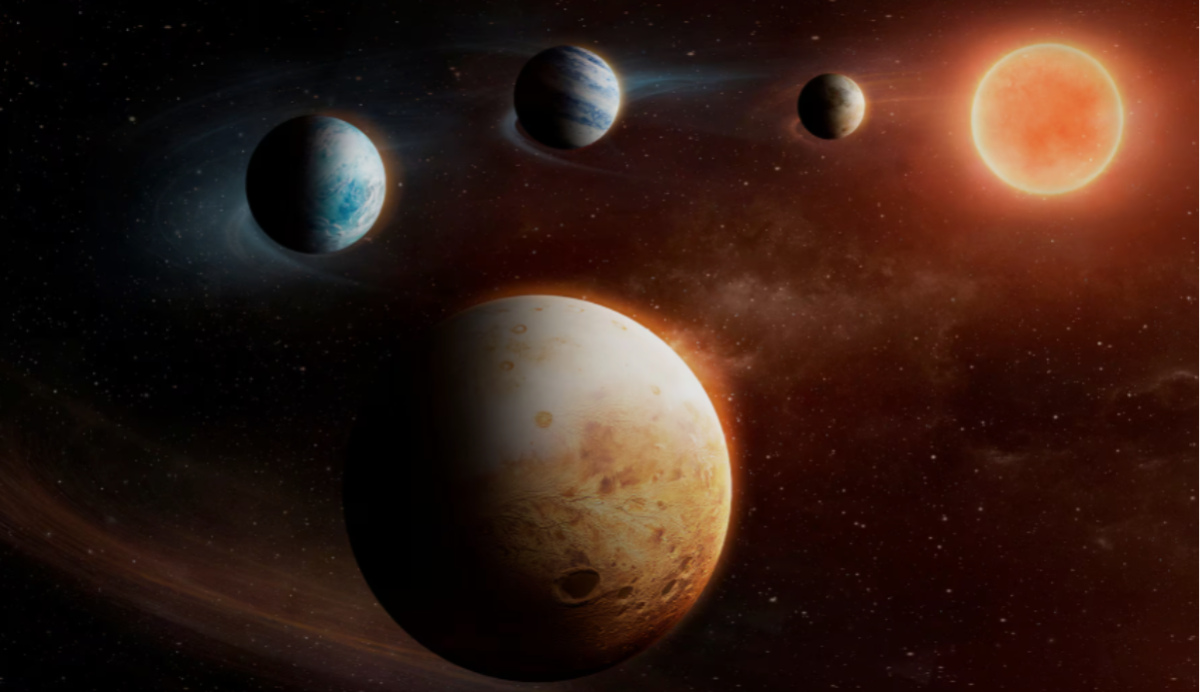
Scientists have identified a planetary system in the Milky Way unlike anything seen before, leaving astronomers debating how to classify one of its unusual worlds. The discovery challenges long-held definitions of planets, moons and stars.
The system includes a red dwarf star with about 40% of the mass of the Sun, orbited by a brown dwarf, a celestial body that blurs the line between a planet and a star.
The brown dwarf, in turn, is orbited by a gaseous world roughly the size of Jupiter, newly discovered using the European Southern Observatory's Very Large Telescope in Chile.
Using our solar system as a frame of reference, a body that orbits another body that itself orbits a star would normally be called a moon - or, in this case, an exomoon, because it lies beyond our solar system.
However, the object orbiting the brown dwarf is unlike any of the many moons in our solar system, all of which are relatively small rocky or icy worlds, both in terms of its composition and its size.
So what should we call it?
"This will certainly be a matter of debate. In general, most astronomers are fine with the term exosatellite, at least as a placeholder until we formally adopt definitions for objects like the one we found," said Kevin Hoy, a doctoral student in astrophysics.
The system is about 71 light-years from Earth. A light-year is the distance light travels in one year, about 5.9 trillion miles (9.5 trillion km).
The exosatellite has at least 90% of Jupiter's mass. It completes an orbit of the brown dwarf every 170 days at a distance roughly one-fifth of that between Earth and the Sun.
A Pandora's box
"I think this discovery has opened a Pandora's box for the scientific community. This type of object is completely new and unusual, truly different from what we are familiar with in our solar system," said study co-author Alice Zurlo, an astrophysicist at Universidad Diego Portales and director of YEMS.
More than 6,300 exoplanets – planets beyond our solar system – have been discovered. However, finding exomoons has proved more challenging, with only a handful of strong candidates identified.
The researchers are now trying to determine the origins of the exosatellite.
"It may have formed from the disk of gas and dust around the brown dwarf, just as planets form around stars. Or it may have been captured (gravitationally) by the brown dwarf later on," Zurlo said.
A brown dwarf is neither a star nor a planet, but something in between. The one in this system is about 33 times more massive than Jupiter, around 50% larger and much hotter.
"Because the system is very young, the brown dwarf is still shining with the heat left from its formation," Zurlo said.
Since the first detection of exoplanets in the 1990s, scientists have identified a wide variety of planetary systems, some resembling our own and others markedly different. The newly studied system stands out as one of the most unusual yet discovered.
























What is your opinion on this topic?
Leave the first comment