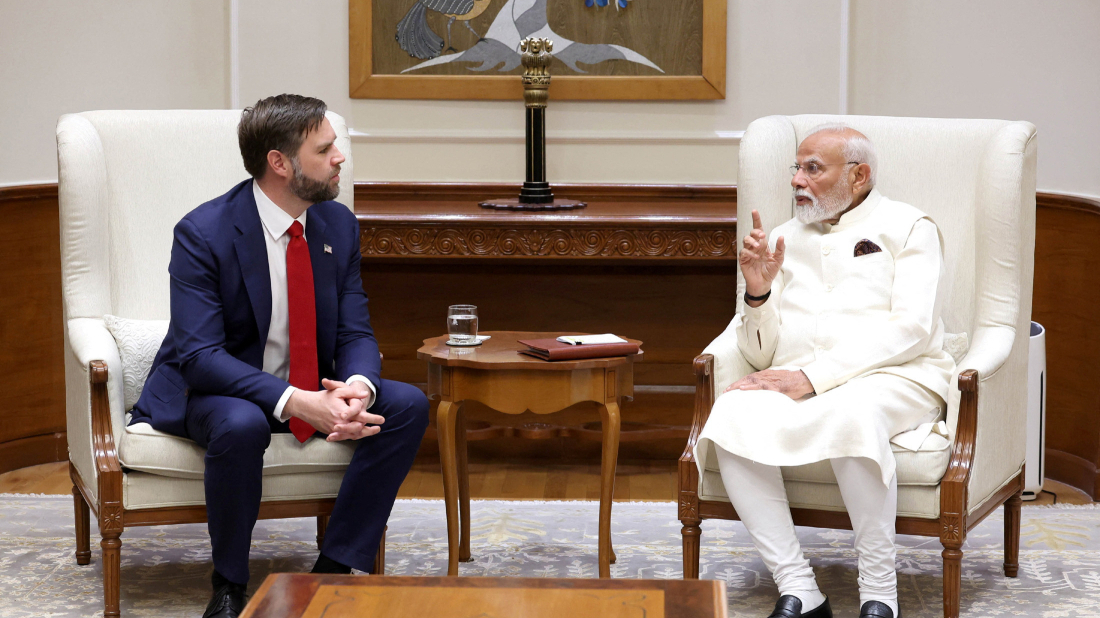
U.S. Vice President JD Vance met Indian Prime Minister Narendra Modi in New Delhi on Monday, with both leaders welcoming progress in talks toward an early trade deal, as India races to finalise an agreement and avoid fresh American tariffs.
The visit, while officially personal, carried diplomatic weight. Vance was accompanied by his family, including wife Usha, whose parents are of Indian origin. Beyond a stop at the Taj Mahal and a scheduled speech in Jaipur, the vice president’s four-day stay has helped set the stage for President Donald Trump’s expected visit to India later this year.
Modi’s office said the two leaders discussed ongoing efforts to deepen cooperation in energy, defence and strategic technology. They also addressed broader regional and global developments, though without explicitly naming conflicts like Ukraine.
“Prime Minister conveyed his warm greetings to President Trump and said he looked forward to his visit later this year,” the statement said. The White House has not issued its own readout.
The trade talks follow a February meeting between Modi and Trump in Washington, where both sides pledged to resolve long-standing tariff disputes and strengthen defence ties. India remains the U.S.’s largest trade partner, with bilateral goods trade reaching $129 billion in 2024 — nearly $46 billion of that in India’s favour, according to U.S. data.
Modi’s government has signalled it is willing to slash tariffs on over half of its U.S. imports — valued at $41.8 billion — to secure a deal. That window narrowed after President Trump paused tariff hikes for key partners, including India, for 90 days starting April 9.
Finance Minister Nirmala Sitharaman, speaking from San Francisco on Monday, confirmed India was aiming to complete the first phase of the trade pact by autumn. “It’s not just about reciprocal tariffs,” she said. “We need an agreement with our largest trading partner.”
Despite ongoing talks, Trump continues to refer to India as a “tariff abuser” and the “tariff king.” Still, officials in New Delhi remain optimistic that Vance’s visit and Trump’s upcoming appearance at the Quad leaders’ summit in India will help push the deal across the finish line.
The trip marks a notable moment for Vance, who in recent months has taken on a more visible diplomatic role amid escalating U.S.-China tensions.
“The timing is critical,” said Harsh Pant, foreign policy head at the Observer Research Foundation in Delhi. “Vance’s growing profile signals that this isn’t just a symbolic visit — it’s strategic.”











What is your opinion on this topic?
Leave the first comment