South Korean President Lee Jae Myung has urged North Korea to help rebuild trust and return to dialogue, while outlining plans for a major modernisation of the South’s armed forces.
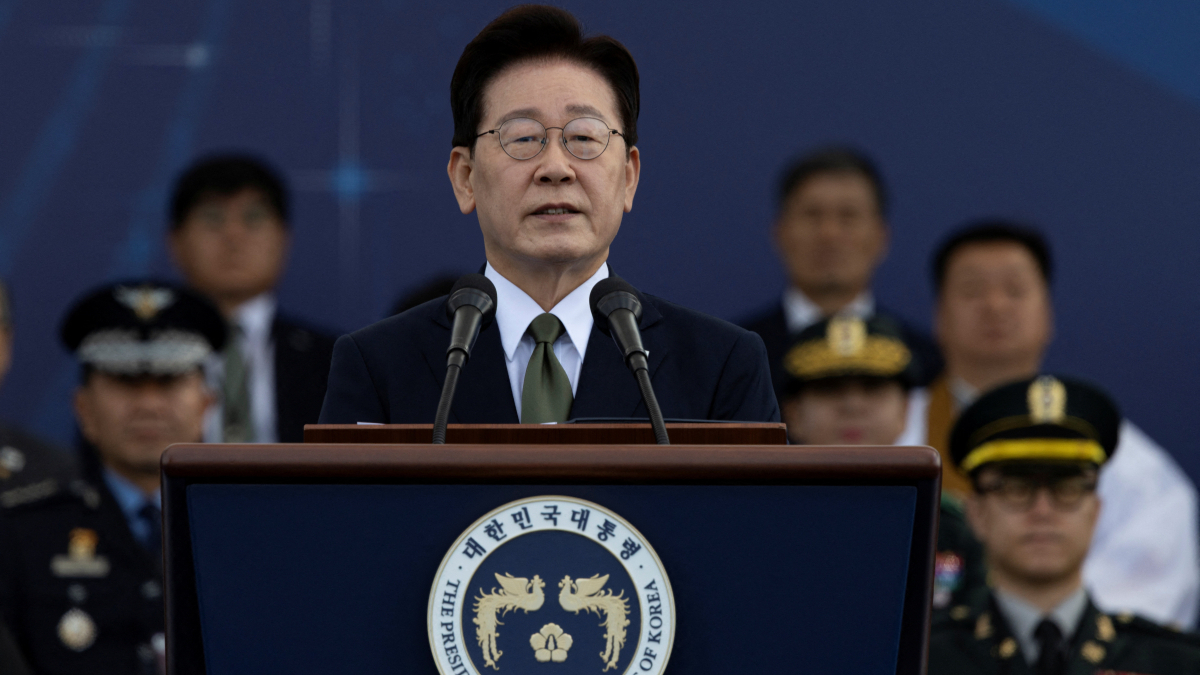
Speaking on Thursday during celebrations marking South Korea’s 78th Armed Forces Day, Lee said his government would continue pursuing practical measures aimed at reducing military tensions on the Korean Peninsula.
“I hope that the North joins us now on the path of restoring trust and resuming dialogue, following a long interruption,” Lee said.
Lee’s appeal came a day after Seoul and Pyongyang exchanged accusations over a landmine explosion in the Demilitarised Zone (DMZ) that wounded three South Korean soldiers.
South Korea’s military and the United Nations Command said North Korea had violated the armistice that ended fighting in the 1950-53 Korean War.
Kim Yo Jong, the influential sister of North Korean leader Kim Jong Un, rejected the findings on Wednesday. She accused Seoul of fabricating the results and warned of retaliation.
Despite the latest tensions, Lee said his administration would continue efforts to reduce military risks and restore communication between the two Koreas.
Lee pushes for greater control over South Korean forces
The president also reaffirmed his goal of securing the transfer of wartime operational control from the United States to South Korea.
The move is part of a long-running effort to strengthen South Korea’s ability to manage its own national defence.
Under the current alliance structure, the two countries have for years been working towards conditions under which Seoul would assume greater command responsibility during wartime.
Lee also outlined an extensive military modernisation programme, saying South Korea intends to build nuclear-powered submarines by the mid-2030s.
Seoul will also upgrade its missile defence capabilities, including the development of artificial intelligence-based command-and-control systems and high-energy laser interceptors.
The president said South Korea would expand the military’s use of AI and restructure its armed forces to prepare for future forms of warfare.
Another priority will be strengthening South Korea’s three-axis defence system, designed to detect, track and intercept missile threats.
The plans underline Lee’s approach of pursuing dialogue with Pyongyang while simultaneously strengthening South Korea’s military capabilities.
His government has repeatedly sought to reopen communication with North Korea, but Pyongyang has largely rejected Seoul’s overtures and continued fortification work along the DMZ.











What is your opinion on this topic?
Leave the first comment