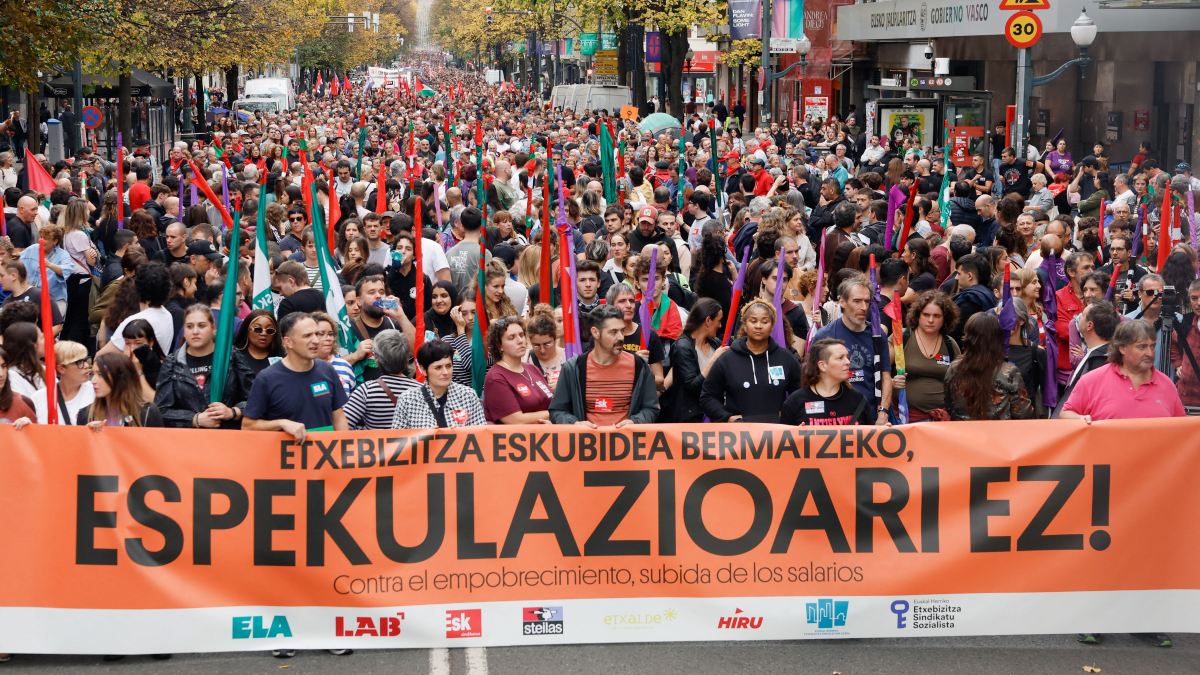
Four million workers across Spain joined a general strike on Wednesday over the country’s deepening housing crisis, unions said, bringing disruption to factories, ports, shops and public transport just weeks before a snap general election.
Despite stormy weather, protesters took to picket lines less than three weeks before the 29 November vote.
It was Spain’s first general strike since 2012, when workers walked out over austerity measures during the eurozone debt crisis.
The walkout was supported by the country’s two largest unions, UGT and CCOO, which represent more than a million workers, alongside tenants’ associations protesting against soaring rents and evictions.
Unions hailed the strike as a success, although participation varied across the country. Support was strongest in coastal regions, where housing pressures are especially severe.
Shutters down on Gran Vía
On Madrid’s Gran Vía, one of the capital’s busiest shopping streets, protesters cheered as retailers including Primark, H&M and Pull & Bear closed their doors amid a heavy riot police presence.
“We’re going to close the Mango store,” protesters chanted, shaking house keys above their heads.
In Barcelona, numerous shops remained closed, with windows boarded up in anticipation of unrest.
Ports and car plants hit hardest
According to UGT and CCOO, strike participation reached 90 per cent at ports and in the automotive industry. They reported “total stoppages” at major manufacturing sites, including Volkswagen’s factory in Navarre and SEAT’s plant in Barcelona.
Electricity demand dropped by as much as 15.5 per cent between 10:00 and 11:00, according to grid operator Red Eléctrica.
Barcelona’s metro announced that trains would operate only during peak commuting hours, while Madrid’s metro reported a 42 per cent drop in passenger numbers compared with the same period the previous week.
The tenants’ union predicted that the number of strikers could reach five million by the end of the day. Spain has approximately 23 million workers, according to the national statistics institute.
Arrests and injuries
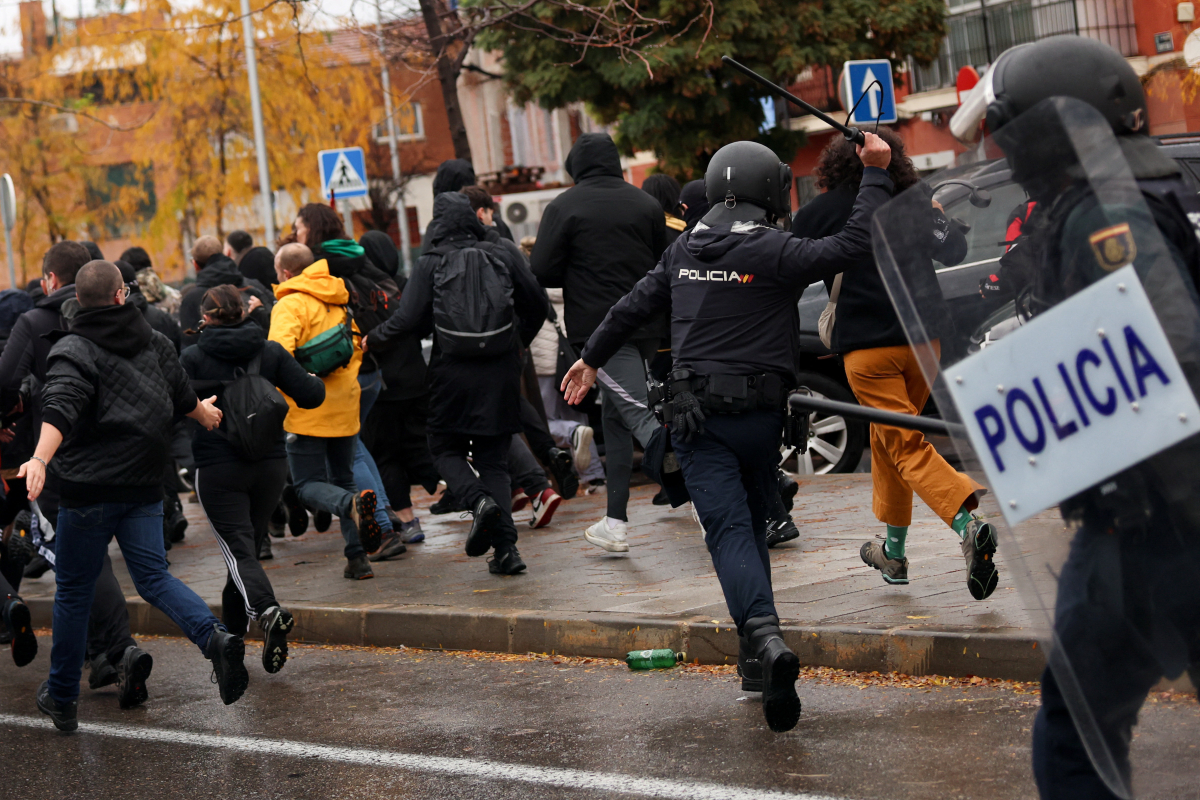
By midday, police had reported 40 arrests following 476 incidents linked to the strike, including the blocking of offices and industrial estates and the burning of rubbish bins.
Unions announced plans to file a criminal complaint over what they described as a “disproportionate” police operation involving tear gas and batons, which they said had left 20 protesters injured.
Meanwhile, Storms Charles and Bruna threatened to disrupt large demonstrations planned for the afternoon, forcing unions to cancel a march in the southern port city of Cádiz.
A housing shortfall of 750,000
Spain faces a housing shortfall of approximately 750,000 homes, with the deficit forecast to surpass one million by 2028, according to the central bank.
As home ownership becomes increasingly unaffordable, demand for rental properties has surged. According to the Youth Council of Spain, average monthly rent stands at €1,176 ($1,315), equivalent to about 98.7 per cent of a young person’s average monthly salary.
“I’m 36 years old and I still can’t move out on my own,” said Jesús González, a Madrid resident who works in a hospital IT department and supports the strike. “Rents just keep going up, house prices just keep going up, and it’s simply impossible.”
Business lobby: “Counterproductive”
Ángela de Miguel, vice-president of Spain’s main business lobby, CEOE, criticised the walkout as counterproductive, arguing that small businesses are also struggling with the housing shortage because it makes recruiting staff more difficult.
Speaking to state broadcaster TVE, she said the solution was to build more homes and reduce taxes on construction and property purchases.
Limited economic hit
Miguel Cardoso, chief economist at BBVA Research, predicted that the strike would have a smaller economic impact than previous walkouts, citing the rise of remote working and the growing importance of the services sector.
He estimated it could shave between 0.1 and 0.2 per cent off Spain’s annual gross domestic product.
Spain’s rapidly expanding hospitality and finance sectors are less unionised than the public sector and manufacturing industries, potentially limiting the wider economic disruption.
Housing at the heart of the election
The strike comes after weeks of protests triggered by the eviction and subsequent death of an 87-year-old woman in Madrid.
The demonstrations, combined with parliament’s rejection last month of government measures designed to prevent evictions and ease rental pressures, prompted Prime Minister Pedro Sánchez to call a snap general election.
Sánchez is seeking to capitalise on public anger over housing ahead of the 29 November vote, while diverting attention from corruption cases involving his inner circle and a deadly train crash last month.
However, his Socialist Party continues to trail in opinion polls.
Read more:


















What is your opinion on this topic?
Leave the first comment