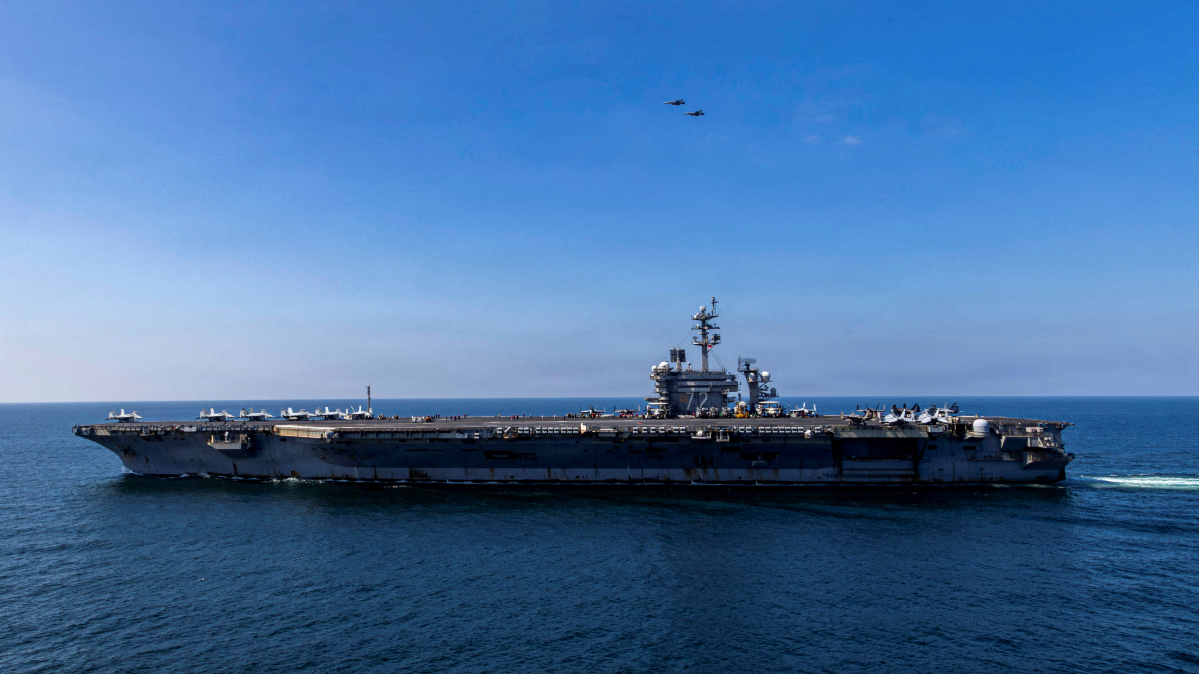
U.S. Defense Secretary Pete Hegseth said on Thursday that reports about poor conditions aboard aircraft carrier the USS Abraham Lincoln in the Middle East were "completely misrepresented."
Concerns have been mounting over conditions aboard the vessel after reports of food shortages, sanitation problems and growing mental health strains emerged from one of the U.S. Navy's longest-running deployments in recent years.
The aircraft carrier, which has been at sea for more than 250 days, has become a focus of scrutiny in Washington as lawmakers seek answers from the Pentagon and families of sailors raise concerns about life onboard.
The situation has also drawn attention to the wider pressures being placed on U.S. military personnel as the Trump administration continues operations linked to the conflict with Iran.
Families describe exhaustion and declining morale
According to a BBC report, some sailors and their families have described severe fatigue, deteriorating morale and concerns over the welfare of crew members aboard the vessel.
Reports from military news outlets Navy Times and Stars and Stripes cited claims that several sailors considered jumping overboard, while one sailor was recovered from the sea earlier this month after going overboard in an incident that remains under investigation. The U.S. Navy has said it has not observed an increase in suicide attempts or suicidal ideation aboard the ship.
The BBC reported that relatives spoke of sailors struggling with the psychological effects of an unusually long deployment.
One family member, speaking anonymously, said their relative had lost nearly 30 kilogrammes during the deployment and described crew members as exhausted after months at sea.
In messages shared with the BBC, the family quoted the sailor in a WhatsApp message, who reportedly said: "I'm dead tired. Dead."
The relative described a relentless environment of aircraft operations and engine noise.
"It's not a vacation. And he knows what he has to do. But it's just without a port, without stepping foot on land, without any kind of decompression," the family member told the BBC. "There's never a moment of peace in your mind."
A deployment extended by the Iran conflict
The USS Abraham Lincoln departed San Diego in November 2025 for operations in the Pacific before being redirected to the Middle East in January, ahead of the launch of U.S. military action against Iran in late February.
Originally expected to return home in May, the deployment has been extended multiple times, with no official return date announced.
The carrier's crew of around 5,000 sailors has spent more than eight months supporting military operations in what Navy officials have described as a highly contested environment.
Lawmakers demand answers
Democratic lawmakers have increasingly questioned whether the conditions onboard are sustainable.
Connecticut Senator Richard Blumenthal, a member of the Senate Armed Services Committee, outlined a series of reported problems in a letter to Hegseth and Navy leadership.
"There have been widespread reports of shortages of basic supplies, water contamination, plumbing issues, deteriorating mental health, deck safety concerns, and disruptions in the mail system, which have caused many care packages in route to the ship to be lost in transit for months," Blumenthal wrote.
He warned that the reports required immediate attention and raised broader concerns about whether the Navy could continue sustaining such a demanding operational pace.
Arizona Senator Ruben Gallego, a Marine Corps veteran, called for a congressional oversight visit to the carrier.
Gallego later described the reported treatment of sailors as "not just disgusting; it's dangerous."
California Congressman Mike Levin also highlighted allegations circulating among families and crew members in a post on X.
Pentagon rejects claims of crisis
The Pentagon has strongly pushed back against allegations of severe hardship aboard the ship.
Speaking to reporters during a visit to Panama, U.S. Defense Secretary Pete Hegseth dismissed reports about conditions on the carrier.
"We make sure that every ship, every crew, every captain has everything we can provide them at every single moment."
Hegseth acknowledged the challenges associated with lengthy deployments but praised the crew's efforts.
"Some deployments are longer than others, and I have more respect and gratitude for those sailors than anybody."
He added that "what they do in those high seas in those austere conditions with less port calls, it's incredible," describing the reports of deteriorating conditions as "completely misrepresented."
White House spokeswoman Olivia Wales also defended the administration's approach, saying President Donald Trump and Hegseth were committed to ensuring the military remained fully equipped to address security threats.
Navy cites wartime supply disruptions
Navy officials have acknowledged logistical difficulties but argue they stem largely from operational realities connected to the war with Iran.
According to the service, combat operations disrupted traditional supply hubs in the Middle East, affecting the delivery of food, personal items and mail.
A Navy official told the BBC that the service prioritised deliveries in a specific order:
"First food, then hygiene items, then mail."
The official also disputed suggestions that conditions had become unsafe.
"Current reports from the ship confirm continuous access to clean water, functional AC (air conditioning), and healthy meal options."
Officials said they had not identified a rise in reports of suicide attempts or suicidal ideation, although they declined to release detailed figures, citing privacy and operational security concerns.
Relief may be on the way
As scrutiny intensifies, the Navy appears to be moving closer to ending the deployment.
Multiple reports indicate the USS George Washington is heading towards the Middle East to replace the Abraham Lincoln as part of a planned carrier rotation.
The carrier has already departed Southeast Asia and was recently reported to be moving through key maritime routes linking the Pacific and Indian oceans.
If the rotation proceeds as expected, it would finally bring relief to a crew that has endured one of the longest uninterrupted carrier deployments in recent U.S. naval history.
A broader challenge for the Navy
The controversy has revived a longstanding debate over the impact of lengthy deployments on sailors and military readiness.
A study published earlier this year found that personnel serving aboard U.S. Navy vessels experience some of the highest rates of serious psychological distress in the American armed forces. Researchers cited poor living conditions, lack of sleep, constant noise and demanding schedules as significant sources of stress.
The USS Abraham Lincoln is not the first carrier to face such challenges. Other vessels involved in extended operations in recent years have reported problems ranging from damaged facilities to declining morale.
For critics in Congress, the current situation raises difficult questions about the human cost of maintaining a sustained military presence in multiple regions simultaneously.
For the Pentagon, however, the carrier's deployment remains a demonstration of operational endurance during a period of heightened tensions in the Middle East.
As lawmakers continue to demand answers, the focus is increasingly shifting from the mission itself to the thousands of sailors tasked with carrying it out.


















What is your opinion on this topic?
Leave the first comment