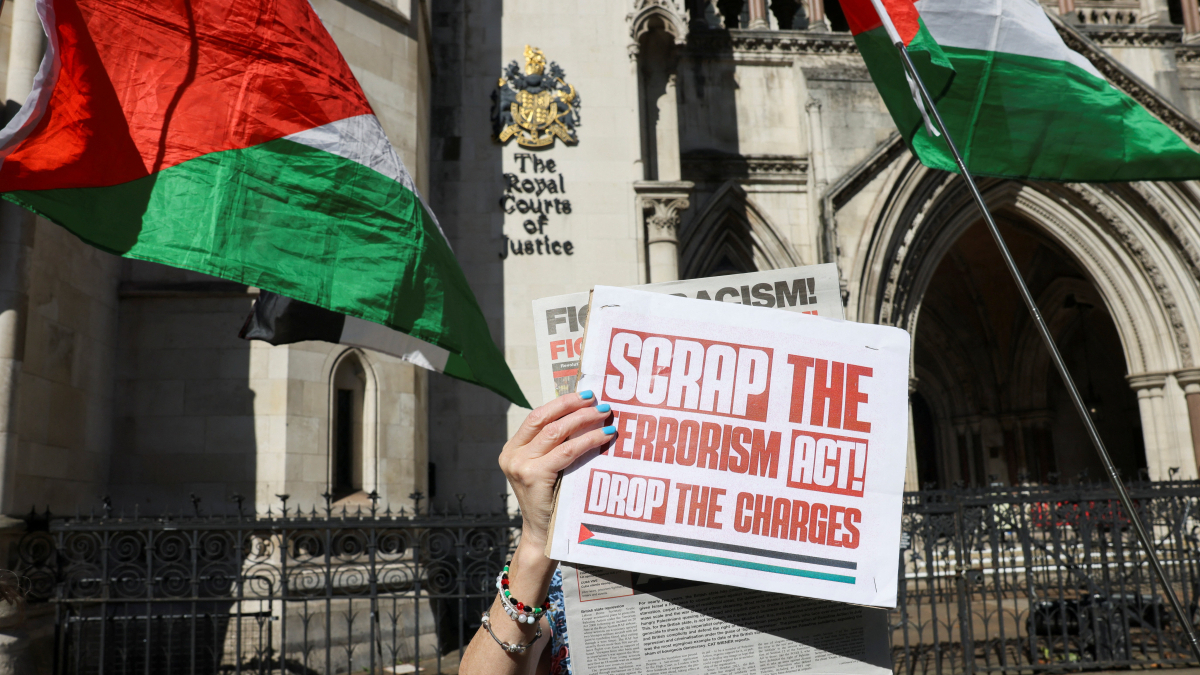
The Court of Appeal in London ruled on Monday (15 June) that the government's decision to ban pro-Palestinian campaign group Palestine Action as a terrorist organisation was lawful, handing ministers a victory in a closely watched legal battle over protest rights and national security.
Palestine Action, founded in 2020, was proscribed under UK terrorism laws last year following a series of actions targeting Israel-linked defence companies, particularly Israeli defence firm Elbit Systems.
The ruling overturns a High Court decision issued in February, which found that the ban unlawfully interfered with freedom of expression. Despite that judgment, Palestine Action remained proscribed while the government pursued its appeal.
Court backs government position
Delivering the ruling, Lady Chief Justice Sue Carr said the court had concluded that the ban was justified and proportionate.
She rejected arguments that Palestine Action should be regarded as a non-violent direct-action movement, saying its conduct went beyond peaceful protest.
"The behaviour of Palestine Action was not that of a non-violent direct action organisation," Carr said.
While acknowledging that the ban was "highly controversial", she added that "it is a fundamental mistake to overlook the fact that Palestine Action overtly promoted unlawful violence amounting to terrorism."
The government had argued that the earlier High Court ruling placed too much emphasis on the impact of the ban on free speech.
Lawyers representing Home Secretary Shabana Mahmood told an appeal hearing in April that the conclusion that proscription had significantly restricted freedom of expression was "overstated and wrong."
Campaign group criticises decision
Palestine Action co-founder Huda Ammori challenged the government's decision, arguing that the ban had far-reaching consequences for supporters of the Palestinian cause.
Ammori said proscription had imposed "severe restrictions on the fundamental free speech and assembly rights of vast numbers of people" who support Palestinian rights.
The case has attracted significant attention in Britain because of its implications for protest movements and the use of anti-terrorism legislation.
Under UK law, membership of or support for a proscribed organisation is a criminal offence. The ruling by the Court of Appeal of England and Wales means Palestine Action will remain on the list of banned organisations unless a further legal challenge succeeds.



















What is your opinion on this topic?
Leave the first comment