South Korea's presidential Blue House said on Monday it was reviewing U.S. President Donald Trump's comments on scaling back joint military drills. It added that it hoped a favourable relationship between Washington and Pyongyang could lead to meaningful talks.
In a statement, the Blue House said it would continue diplomatic consultations on U.S.-South Korea military cooperation related to the Strait of Hormuz, while discussing details of joint military drills with the United States.
Trump said on Sunday that he had instructed Defense Secretary Pete Hegseth to “substantially reduce” the exercises, arguing that they send a hostile signal to Pyongyang.
“Based on my very good relationship with Kim Jong Un, of North Korea, I am not happy with the fact that the United States has, long ago, agreed to participate in Joint Military Exercises with South Korea,” Trump wrote on Truth Social.
He said it was too late to cancel the exercises entirely, but described them as costly and the signal they send to North Korea as “totally inappropriate and hostile”.
South Korea's Joint Chiefs of Staff said the drills began on Monday (17 August) as scheduled. About 18,000 South Korean military personnel are taking part in the annual exercises, which are due to run until 27 August.
Pyongyang has long opposed joint drills
The decision comes as Washington and Seoul begin their annual Ulchi Freedom Shield exercises.
The drills combine computer-simulated command-post training with field exercises aimed at strengthening the allies’ readiness. North Korea has repeatedly condemned such exercises as rehearsals for invasion, while Washington and Seoul say they are defensive.
Sanjay Kumar, a journalist at The Korea Herald, told AnewZ' Daybreak programme that there is currently no prospect of restarting negotiations between South Korea and North Korea.
He said South Korean President Lee Jae Myung has been reaching out to North Korea and Kim Jong Un to promote peaceful coexistence, but that Pyongyang's silence shows it has little interest in resuming dialogue.
“And when it comes to the nuclear issue, particularly denuclearisation, North Korea does not even want negotiations. That is a very strong message,” Kumar added.
Trump has frequently highlighted his relationship with Kim, whom he met three times during his first term. Their diplomacy ultimately failed to produce an agreement on North Korea’s nuclear programme.
Kumar said Trump's latest comments are also raising eyebrows because North Korea's relationship with Russia has been growing rapidly.
Russia and North Korea signed a Comprehensive Strategic Partnership Treaty in 2024, and their cooperation has expanded through military exercises, troop deployments and naval cooperation.
“This kind of cooperation is sending a very strong signal to South Korea,” Kumar said. He added that North Korea is seeking to leverage its relationships with Russia and China while gaining strategic attention from the United States.
North Korean leader Kim Jong Un speaks with Russian President Vladimir Putin in Beijing, 3 September 2025.
Reuters
Trump also linked his decision to a recent exchange with South Korean President Lee Jae Myung, saying he asked whether Seoul would join U.S. efforts to “denuclearise Iran” and received the response: “No thanks.”
The Blue House said Seoul was discussing potential military contributions while considering its defence readiness on the Korean Peninsula and domestic legal procedures.
Lee has sought to ease tensions with Pyongyang and on Saturday called for direct inter-Korean talks aimed at formally ending the Korean War.
Kumar said South Korea should also strengthen cooperation with Japan and use the existing trilateral framework with the United States and Japan to address regional security concerns.
“South Korea should reach out to Japan and bring the U.S. also to the table through a trilateral cooperation channel,” he said.
The analyst also said Seoul is facing a difficult diplomatic balancing act over the Russia-Ukraine war and Iran, as it faces pressure from Washington, Kyiv and European partners while seeking to avoid direct involvement in either conflict.
The U.S. has banned government employees working in Saudi Arabia from using airports in the country without special authorisation. It comes after a deadly Houthi strike on Riyadh's King Khalid International Airport killed at least 13 people last week.
U.S. President Donald Trump has called it “a disgrace” that Ukraine has resumed attacks on Russian oil refineries. Attacks are continuing from Russia and Ukraine as media reports say Ukraine has almost run out of Patriot interceptor missiles.
Ukraine is set to restart attacks on Russian oil refineries following a two-day pause, President Volodymyr Zelenskyy said, amid growing tensions with Washington over energy strikes and U.S. military support.
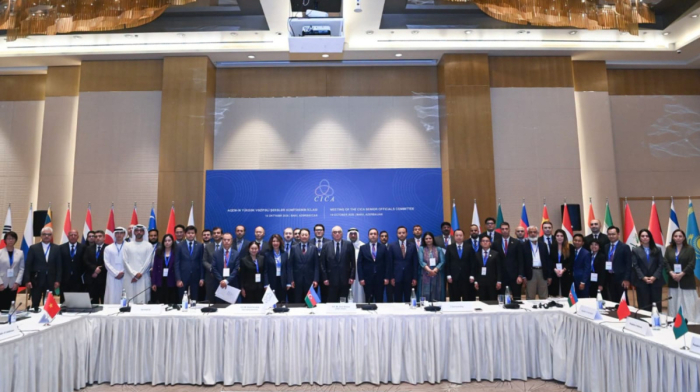
Azerbaijan is hosting the seventh summit of the Conference on Interaction and Confidence Building Measures in Asia (CICA) in Baku on Thursday, 15 October, following agreements that could extend the country's leadership of the Asian security forum until 2028.
U.S. President Donald Trump has called it “a disgrace” that Ukraine has resumed attacks on Russian oil refineries. Attacks are continuing from Russia and Ukraine as media reports say Ukraine has almost run out of Patriot interceptor missiles.
A Norwegian teenager recruited by a Swedish criminal network to carry out a contract killing in Britain has been sentenced to 20 years’ detention after police uncovered the murder plot.
Romanian rescuers resumed their search for seven missing sailors on Friday (16 October) after a drone strike set a chemical tanker ablaze near the country’s Black Sea coast. The attacks have raised fresh security concerns along a vital regional trade route.
Students, lecturers and university staff marched on Argentina’s Congress in Buenos Aires on Thursday to demand President Javier Milei’s government implement a university funding law which would boost staff salaries and increase financial support to institutions to cover operating costs
A 16-year-old shooter opened fire on Thursday at an elementary school in Bend, Oregon in the United States, killing four people, including three children, before being killed by an armed member of the community who had pursued the assailant into the school, police said.
Download the AnewZ app
You can download the AnewZ application from Play Store and the App Store.
















What is your opinion on this topic?
Leave the first comment