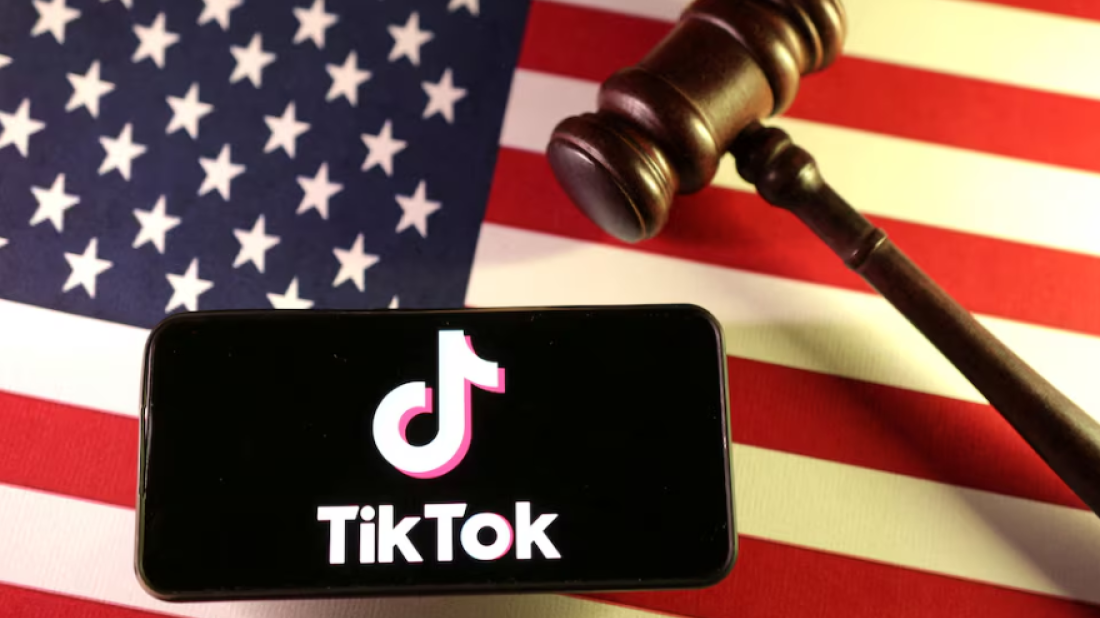
The U.S. Supreme Court refused to rescue TikTok on Friday from a law that required the popular short-video app to be sold by its Chinese parent company ByteDance or banned on Sunday in the United States on national security grounds - a major blow to a platform used by nearly half of all Americans.
The justices unanimously ruled that the law, passed by an overwhelming bipartisan majority in Congress last year and signed by Democratic President Joe Biden, did not violate the U.S. Constitution's First Amendment protection against government abridgment of free speech. The justices affirmed a lower court's decision that had upheld the measure after it was challenged by TikTok, ByteDance and some of the app's users.
"There is no doubt that, for more than 170 million Americans, TikTok offers a distinctive and expansive outlet for expression, means of engagement, and source of community. But Congress has determined that divestiture is necessary to address its well-supported national security concerns regarding TikTok's data collection practices and relationship with a foreign adversary," the court said in the unsigned opinion.
The court added that "we conclude that the challenged provisions do not violate petitioners' First Amendment rights."
The Supreme Court acted speedily in the case, having held arguments on Jan. 10, just nine days before the deadline set under the law. The case pitted free speech rights against national security concerns in the age of social media.
TikTok is one of the most prominent social media platforms in the United States, used by about 270 million Americans - roughly half the country's population, including many young people. TikTok's powerful algorithm, its main asset, feeds individual users short videos tailored to their liking. The platform presents a vast collection of user-submitted videos, often under a minute in duration, that can be viewed with a smart phone app or on the internet.
China and the United States are economic and geopolitical rivals, and TikTok's Chinese ownership for years has raised concerns among American leaders. The TikTok fight has unfolded during the waning days of Biden's presidency - Republican Donald Trump succeeds him on Monday - and at a time of rising trade tensions between the world's two biggest economies.
The White House and Trump's team did not immediately respond to requests for comment.
The Biden administration has said the law targets control of the app by a foreign adversary, not protected speech, and that TikTok could continue operating as-is if it is freed from China's control.
During arguments in the case, Justice Department lawyer Elizabeth Prelogar said Chinese government control of TikTok poses a "grave threat" to U.S. national security, with China seeking to amass vast quantities of sensitive data on Americans and to engage in covert influence operations. Prelogar said China compels companies like ByteDance to secretly turn over data on social media users and carry out Chinese government directives.
TikTok's immense data set, Prelogar added, represents a powerful tool that could be used by the Chinese government for harassment, recruitment and espionage, and that China "could weaponize TikTok at any time to harm the United States."
The law was passed last April. Biden's administration defended it in court. TikTok and ByteDance, as well as some users who post content on the app, challenged the measure and appealed to the Supreme Court after losing on Dec. 6 at the U.S. Court of Appeals for the District of Columbia Circuit.
Trump's opposition to the ban represents a reversal in stance from his first term in office when he aimed to prohibit TikTok. Trump has said he has "a warm spot in my heart for TikTok," opining that the app helped him with young voters in the 2024 election.
In December, Trump asked the Supreme Court to put the law on hold to give his incoming administration "the opportunity to pursue a political resolution of the questions at issue in the case." But while Trump has vowed to "save" TikTok, many of his Republican allies supported the ban.
Mike Waltz, Trump's incoming national security adviser, said on Thursday the new administration will keep TikTok alive in the United States if there is a viable deal. Waltz said the incoming administration would "put measures in place to keep TikTok from going dark," and cited a provision in the law allowing for a 90-day extension if there is "significant progress" toward a divestiture.
Senate Democratic leader Chuck Schumer said on Thursday that TikTok should be given more time to find an American buyer and that he would work with the Trump administration "to keep TikTok alive while protecting our national security."
TikTok CEO Shou Zi Chew will attend Trump's inauguration on Monday, seated among other high-profile invitees.
TikTok has said the law endangers the First Amendment rights not only of it and its users, but also of all Americans. TikTok has said that the ban would hit its user base, advertisers, content creators and employee talent. TikTok has 7,000 U.S. employees.
Noel Francisco, the lawyer for TikTok and ByteDance, told the Supreme Court that the app is "one of America's most popular speech platforms," and said that the law would require it to "go dark" unless ByteDance executes a qualified divestiture.
TikTok plans to shut U.S. operations of the app on Sunday barring a last-minute reprieve, people familiar with the matter told Reuters on Wednesday.
Francisco said the U.S. government's real target with this law is speech - specifically a fear that Americans could be "persuaded by Chinese misinformation." But the First Amendment leaves that up to people of the United States, not the government, Francisco said.
The law bars providing certain services to TikTok and other foreign adversary-controlled apps including by offering it through app stores such as Apple and Alphabet's Google, effectively preventing its continued U.S. use absent divestiture.















What is your opinion on this topic?
Leave the first comment