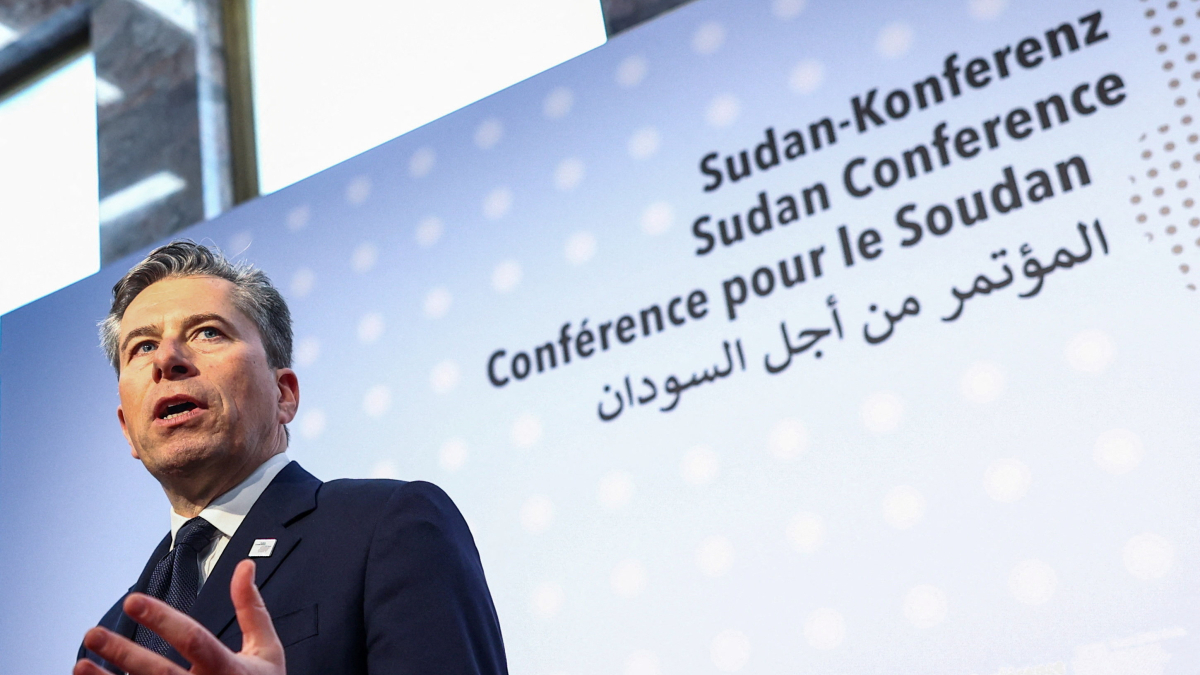
Germany has announced an additional €20 million in humanitarian support for Sudan as Berlin hosts a major international conference aimed at raising more than $1 billion to address one of the world’s most severe and increasingly overlooked crises.
The funding boost comes on the third anniversary of the conflict between Sudan’s army, led by Abdel-Fattah Burhan, and the paramilitary Rapid Support Forces (RSF) under Mohamed Hamdan Dagalo.
What began as a power struggle has spiralled into a devastating war that has upended millions of lives.
German Foreign Minister Johann Wadephul said the Berlin gathering was as much about urgency as visibility.
“This isn’t a quick fix,” he warned, stressing that simply keeping Sudan on the international agenda was itself a step towards ending the war.
A crisis slipping from view
As conflicts in Ukraine and the Middle East dominate headlines, aid agencies warn Sudan risks becoming a “forgotten war” despite its staggering human cost.
Behind the statistics are families forced to flee their homes, children missing school, and communities struggling to survive without basic services. Aid workers describe a country where hunger is widespread and healthcare systems are collapsing.
- Tens of thousands have been killed, with estimates varying widely
- Millions have been displaced within Sudan or forced to flee across borders
- Around 19-21 million people face acute hunger
- Health facilities and civilian infrastructure have been repeatedly attacked
In Darfur and other regions, reports of sexual violence and alleged war crimes have deepened the sense of a nation in freefall.
Berlin conference seeks global response
The conference in Berlin brings together representatives from European nations, African partners, the United Nations and humanitarian organisations. Notably, neither of the warring Sudanese factions is present, with discussions focused on civilian needs rather than direct peace negotiations.
Germany’s Development Minister, Reem Alabali Radovan, said the new €20 million commitment builds on more than €155 million already pledged.
Other countries have followed suit. The United Kingdom, represented by Yvette Cooper, announced an additional £146 million, while Norway also committed further funds.
Cooper acknowledged the scale of international failure so far, saying the global response has fallen far short of what Sudan’s people need.
“We need to ensure every possible pressure is put on those warring parties to reach the urgent ceasefire,” she said.
Aid and self-interest
German officials have been candid that humanitarian support is not only a moral duty but also a strategic necessity.
Wadephul noted that preventing famine and instability could help avoid large-scale migration flows towards Europe, echoing the refugee crisis of 2015–16.
At the same time, Berlin faces its own financial pressures, with tighter budgets and reduced global aid contributions - particularly following cuts by the U.S. - leaving a significant funding gap.
A war with no clear end
Sudan today is effectively divided: the military controls much of the north and east, while RSF forces dominate large parts of Darfur and the west. The conflict has drawn in regional interests linked to oil, gold and geopolitical influence.
For ordinary Sudanese people, however, the stakes are far more immediate.
As one UN official put it, the figures “are not abstract” - they represent broken families, lost livelihoods and a generation growing up in crisis.
Three years on, the message from Berlin is simple but urgent: without sustained global attention and funding, Sudan’s humanitarian catastrophe will only deepen - quietly, but catastrophically.











What is your opinion on this topic?
Leave the first comment