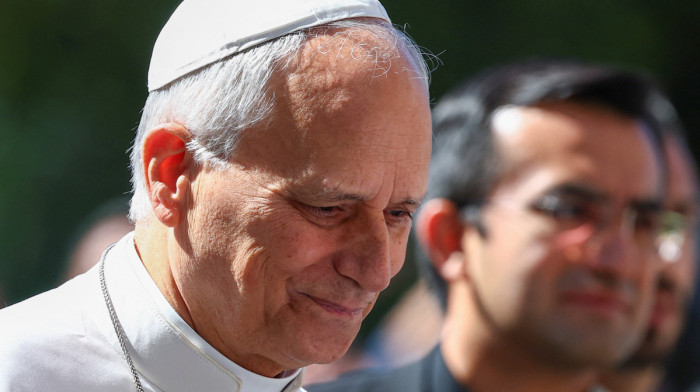
U.S. President Donald Trump forcefully criticised Pope Leo XIV late on Sunday in an unusually direct attack on the leader of the global Catholic Church, triggering a backlash from religious leaders and believers worldwide.
The president’s remarks appeared to reflect mounting frustration over the pope’s increasingly vocal criticism of the ongoing U.S.–Israeli war on Iran, as well as the Trump administration’s hard-line immigration policies.
"Pope Leo is WEAK on Crime, and terrible for Foreign Policy," Trump wrote in a post on his social media platform, Truth Social.
The reaction from the Catholic community was swift. Believers on social media criticised the U.S. president for attacking the spiritual leader of their Church, whom Catholic doctrine holds as the successor of St Peter, one of Jesus’ twelve apostles.
Theologians highlighted the historical rarity of a sitting American president openly confronting the Vatican. "There is no ambiguity about the situation now," Massimo Faggioli, a prominent expert on the papacy, told Reuters.
He noted that even during the darkest periods of the 20th century, such public attacks were rare, comparing the moment to efforts by leaders in Germany and Italy during World War Two to win the support of Pope Pius XII. "Not even Hitler or Mussolini attacked the pope so directly and publicly," Faggioli said.
The leadership of the American Church also moved quickly to defend the pontiff. Archbishop Paul S. Coakley, president of the U.S. Conference of Catholic Bishops, said he was deeply disheartened by Trump’s comments.
"Pope Leo is not his rival; nor is the Pope a politician. He is the Vicar of Christ who speaks from the truth of the Gospel and for the care of souls,” Coakley said in a statement.
A uniquely American Pope vocal on war and immigration
Pope Leo XIV, originally from Chicago, is the first American-born pope. Known for his measured tone, he has in recent weeks emerged as a vocal critic of the war in Iran.
A day before Trump’s comments, Leo led a prayer vigil and rosary for peace in St Peter’s Basilica, condemning the "madness of war" in a global appeal.
Tensions between the two leaders extend beyond foreign policy. Last year, the pope questioned whether the Trump administration’s immigration policies and mass deportations were compatible with the Church’s pro-life teachings.
"Someone who says, 'I am against abortion but I am in agreement with the inhuman treatment of immigrants in the United States', I don't know if that's pro-life," the pontiff said last September.
Trump’s post signalled a rejection of criticism from the Vatican. He wrote that "Leo should get his act together as Pope," later telling reporters he was "not a big fan" of the pontiff.
The president also accused Leo of being "weak on nuclear weapons", days after the pope criticised Trump’s threat to destroy Iranian civilisation as "truly unacceptable."
The pontiff has used stark language in condemning the conflict. During a Palm Sunday address in St Peter’s Square, he said God rejects the prayers of leaders who start wars and have their "hands full of blood," calling the conflict in Iran "atrocious."
He has repeatedly urged Trump to pursue diplomacy and "decrease the amount of violence."
Political tensions and historical precedent
In his Truth Social post, Trump also suggested political motives behind Leo’s election, claiming the pope was chosen "because he was an American, and they thought that would be the best way to deal with President Donald J. Trump."
The Vatican press office did not immediately respond to requests for comment. Pope Leo is due to depart Rome on Monday for a 10-day apostolic visit to four African countries, where he is expected to highlight the plight of refugees displaced by conflict.
Before his departure, Leo renewed calls for "deep reflection" in American society over the treatment of migrants, advocating a more compassionate approach aligned with Church teaching.
Trump, however, defended his stance, arguing the U.S. must curb immigration to reduce crime. "He's a very liberal person and he's a man who doesn't believe in stopping crime," he told reporters.
This is not the first clash between Trump and the Holy See. He previously had a strained relationship with Pope Francis. During the 2016 presidential campaign, Francis criticised Trump’s proposed border wall, saying a person who builds walls instead of bridges is "not a Christian."
Trump responded at the time by calling Pope Francis "disgraceful", setting the tone for tensions that have now resurfaced with Pope Leo XIV.








What is your opinion on this topic?
Leave the first comment