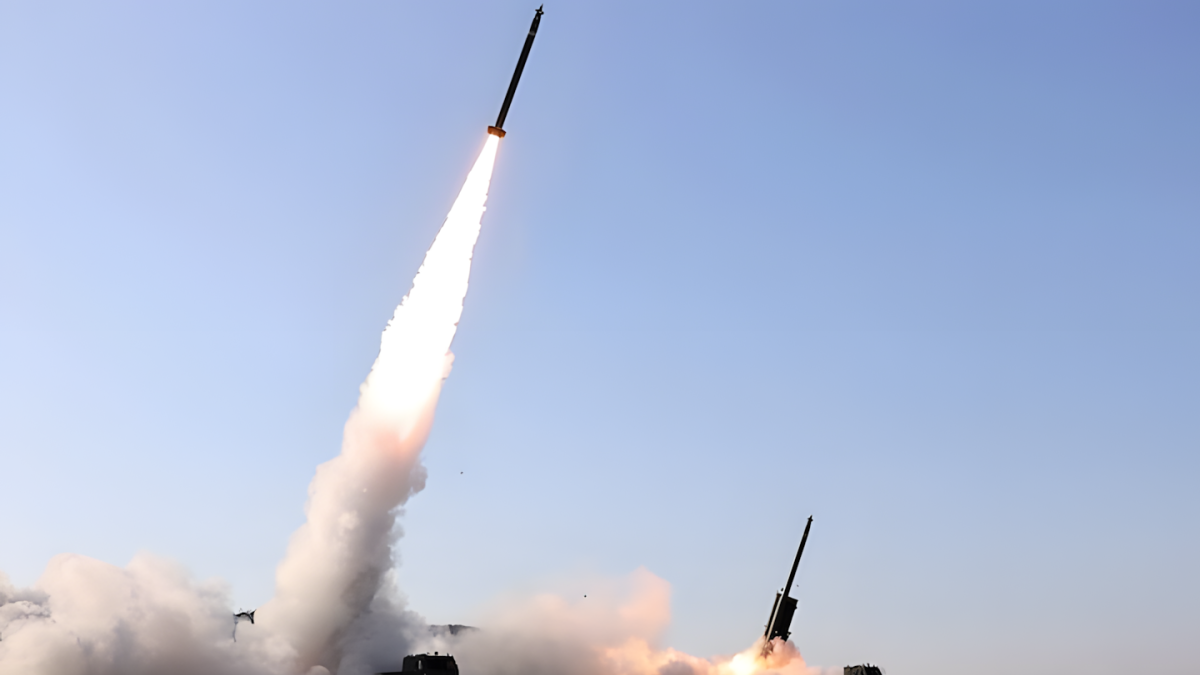
North Korea has tested a new cluster-bomb warhead mounted on a tactical ballistic missile, alongside advanced electromagnetic and infrastructure-targeting weapons, in a significant escalation of its military capabilities.
The tests, reported by state media on Thursday, are seen as a calculated effort by Pyongyang to demonstrate its capacity for modern asymmetric warfare.
The country’s Academy of Defence Science and its Missile Administration carried out the tests earlier this week. According to the official Korean Central News Agency (KCNA), these included carbon-fibre bombs and a new highly mobile short-range anti-aircraft missile system.
The rapid succession of launches, tracked over several days by South Korea’s Joint Chiefs of Staff, represents an ongoing violation of United Nations Security Council sanctions, which prohibit Pyongyang from testing ballistic missile technology.
Kim Jong Sik, a senior general who oversaw the tests, was quoted by KCNA describing the electromagnetic weapon system and carbon-fibre bombs as “special assets” for the North Korean military, underlining their strategic importance in any potential conflict.
A message to adversaries and allies alike
Defence analysts say the display of conventional weaponry is a deliberate show of force. While North Korea frequently highlights its nuclear deterrent, these tests signal to adversaries in Seoul and Washington, as well as allies in Beijing and Moscow, that it also has a capable conventional arsenal.
The timing is notable. Chinese Foreign Minister Wang Yi is due to begin a two-day visit to North Korea on Thursday. There is also speculation that U.S. President Donald Trump could seek a summit with North Korean leader Kim Jong Un during a planned visit to China in mid-May.
By unveiling these weapons now, Kim Jong Un appears to be strengthening his negotiating position, signalling that his military can inflict significant damage regardless of developments in nuclear diplomacy.
The tests also follow a shift in North Korean rhetoric. In recent months, Pyongyang has repeatedly described South Korea as its primary “hostile enemy,” ending hopes of a return to earlier periods of détente.
The threat of infrastructure and electronic warfare
The capabilities of the newly tested weapons are raising concern in South Korea. KCNA reported that a surface-to-surface tactical ballistic missile, designated the Hwasongpho-11 Ka and fitted with a cluster-bomb warhead, could “reducing to ashes any target” across an area of up to 7 hectares (17 acres).
However, analysts say the most significant development is the focus on electronic and infrastructure-targeting systems.
Lim Eul-chul, a professor at Kyungnam University, said North Korea appears to be upgrading its military with technology suited to modern warfare. The electromagnetic weapon system is designed to generate a pulse capable of disabling electronic circuits within enemy equipment.
He warned that such technology could potentially cripple South Korea’s F-35A stealth fighter jets or disrupt radar systems on Aegis-equipped destroyers, reducing Seoul’s technological advantage.
The testing of carbon-fibre bombs also suggests a shift towards targeting infrastructure. These weapons, previously developed by countries including the U.S. and China, disperse conductive fibres over facilities such as power plants or substations, causing widespread electrical failures.
Lim noted they would be a highly "potent weapon" in the opening hours of any conflict.
North Korea also stated that it conducted a firing drill using “low-cost raw materials”. Yang Moo-jin, a professor at the University of North Korean Studies, said this indicates a focus on mass production and preparation for a prolonged conflict.
This combination of scalability and asymmetric capability complicates South Korea’s defence planning.
Shin Jong-woo, secretary general at the Korea Defense and Security Forum, said North Korea appears to be drawing lessons from conflicts in Ukraine and the Middle East.
For the first time, he noted, Pyongyang is openly signalling a strategy focused on bypassing hardened military targets and instead striking critical infrastructure.
“North Korea appears to be developing these weapons with that asymmetric warfare model very much in mind,” Shin said, warning of a scenario in which conflict begins with attacks on power grids and communications networks.














What is your opinion on this topic?
Leave the first comment