North Korea's test of a solid-fuel rocket engine is intended for intercontinental ballistic missiles (ICBM) built with carbon fibre to extend range and allow for delivery of heavier and possibly multiple warheads, South Korean lawmakers said on Monday.
In March, North Korea conducted a ground test of a solid-fuel rocket engine that analysts believe is being developed for its latest ICBM.
The new engine likely has greater thrust than the previous model it tested in 2024, which was already assessed as capable of striking anywhere in the mainland United States, they said.
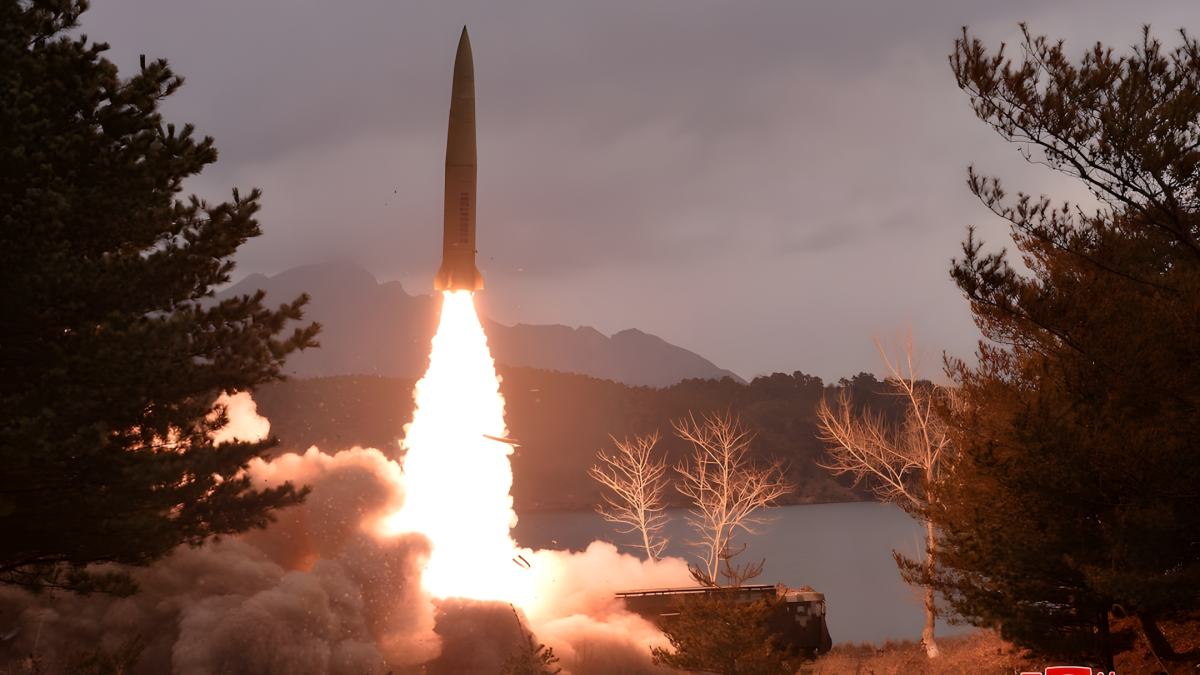
North Korea has conducted all its longer-range missile launches at a lofted trajectory to splash down the projectiles in the ocean off its east coast or to the east of Japan to test them without flying them for a distance they are designed for.
North Korean media showed the airframe of the missile at the new engine test that was built with carbon fibre, which is lightweight while strong, allowing the projectile to carry multiple warheads, member of parliament Park Sun-won said.
Park was speaking to reporters following a closed-door briefing by the National Intelligence Service (NIS), South Korea's main spy agency.
North Korean leader Kim Jong Un was on hand for the 28 March test and said it was a significant upgrade to the country's strategic forces.
North Korea has defied a United Nations Security Council ban on missile and nuclear tests, steadily progressing in the development of more powerful and technically superior missiles.
Carbon fibre ICBM
According to South Korean officials, this next-generation weapon relies heavily on carbon-fibre construction, a critical technological leap intended to drastically reduce the missile's weight. This weight reduction directly translates to an extended operational range and, crucially, the capacity to deliver heavier payloads, potentially including multiple independently targetable reentry vehicles (MIRVs).
A high-profile ground test was conducted in late March, where North Korean engineers successfully fired a new solid-fuel rocket engine. Supreme Leader Kim Jong Un publicly declared the test last month a significant operational upgrade to the country's strategic deterrence forces.
By transitioning to solid-fuel systems, which can be deployed and launched far more rapidly than their liquid-fuelled predecessors, analysts say that Pyongyang is attempting to neutralise the preemptive strike capabilities of its adversaries, fundamentally altering the military balance on the Korean Peninsula and threatening the continental United States.
Mastering advanced materials to overwhelm missile defences
The specific use of carbon fibre in the airframe of this developmental ICBM represents a sophisticated engineering milestone for North Korea’s heavily sanctioned aerospace sector.
This advanced composite material is prized in aerospace manufacturing because it is exceptionally lightweight whilst maintaining immense structural integrity under the extreme thermal and kinetic stresses of atmospheric reentry. By shedding the dead weight of traditional metallic alloys, the North Korean military can allocate that mass to a significantly larger payload.
Defence analysts warn that this is a clear indicator of Pyongyang’s ambition to field multiple warheads on a single delivery system. A MIRV-capable ICBM poses an exponential threat to existing United States missile defence architectures, such as the Ground-Based Midcourse Defense (GMD) system located in Alaska and California, as a single launch would require multiple interceptors to successfully neutralise the incoming threat.
Defying international sanctions to cement nuclear deterrence
The March engine test highlights the relentless pace of North Korea’s military modernisation, which continues entirely unabated despite a comprehensive web of United Nations Security Council resolutions prohibiting such activities.
South Korean intelligence asserts that the newly tested solid-fuel engine generates substantially greater thrust than the previous iteration tested in 2024. That earlier model was already assessed by Western intelligence agencies as possessing the range necessary to strike anywhere within the continental United States.
However, the true danger of solid-fuel technology lies in its operational flexibility. Unlike liquid-propellant missiles, which require hours of highly visible fuelling procedures prior to launch - leaving them acutely vulnerable to preemptive "kill chain" strikes - solid-fuel missiles are pre-loaded and can be rolled out of fortified bunkers and fired within minutes from mobile transporter erector launchers (TELs). This capability ensures a highly survivable second-strike option for Kim Jong Un's regime.
The continuous progression of these technically superior weapons systems underscores the profound failure of the international sanctions regime to halt Pyongyang's nuclear ambitions. Despite crippling economic embargoes, North Korea has managed to source or domestically manufacture the highly specialised materials required for carbon-fibre weaving and solid propellant chemistry.
As the regime systematically checks off every technical requirement for a modern, survivable, and highly lethal nuclear deterrent, regional powers are being forced to dramatically reassess their defensive postures in an increasingly volatile East Asian security environment.



















What is your opinion on this topic?
Leave the first comment