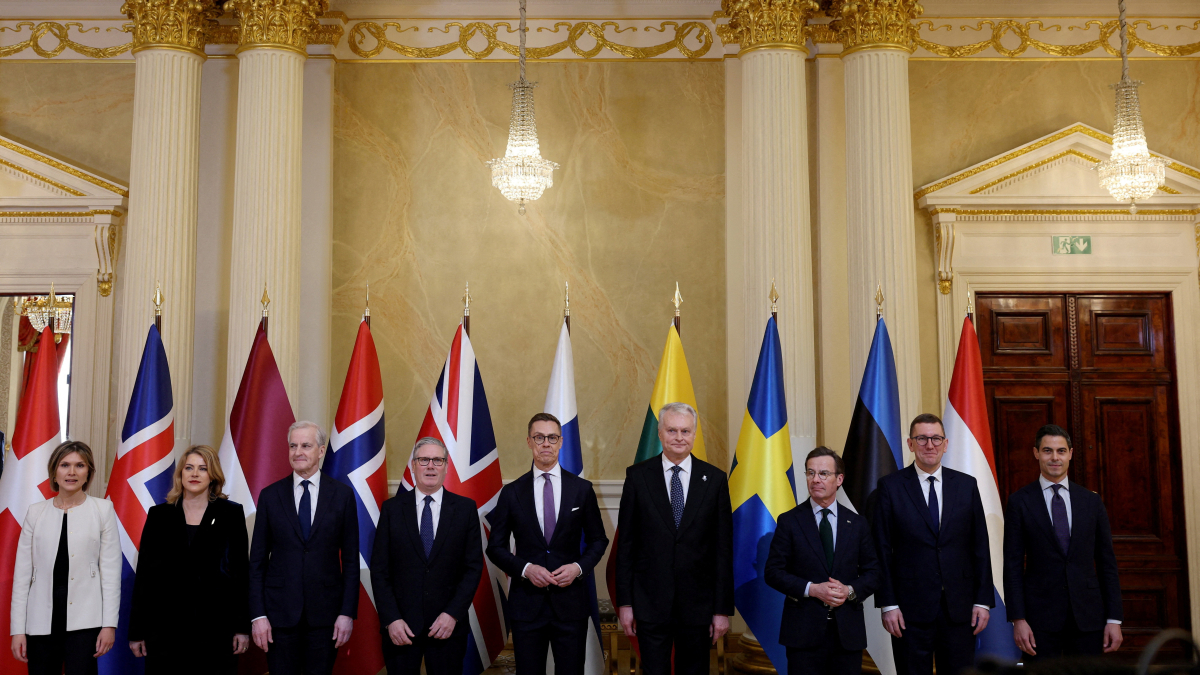
The UK-led Joint Expeditionary Force (JEF) met in Finland on Thursday (26 March) to discuss the Russia–Ukraine war, North Atlantic security and the coalition’s future.
The military partnership, comprising 10 northern European nations, has played a key role in protecting critical undersea infrastructure since Russia’s invasion of Ukraine in 2022.
Participating countries
The Joint Expeditionary Force (JEF) is a UK-led military partnership made up of Denmark, Estonia, Finland, Iceland, Latvia, Lithuania, the Netherlands, Norway, Sweden and the UK.
All members are also part of NATO. Their armed forces train together and respond jointly to threats in the North Atlantic and Baltic Sea regions. The JEF is designed to integrate into operations led by NATO, the UN and other security coalitions.
A rapid-response alliance
The JEF was conceived by the UK in the early 2010s as a way for allied nations to respond more quickly than larger organisations during crises.
In 2014, seven countries: the UK, Denmark, Estonia, Latvia, Lithuania, the Netherlands and Norway — signed an initial agreement to establish the partnership.
Finland and Sweden came on board in 2017 and the nine countries formally signed a Memorandum of Understanding establishing JEF a year later in 2018. Iceland, which does not maintain a standing army, joined in 2021.
JEF and NATO
JEF forces operate primarily in and around member states but can also respond to challenges further afield, including humanitarian crises. Any response would be aligned with NATO’s objectives.
Since its formation, JEF forces have been deployed across the Baltic Sea region and in Sweden, Latvia, Lithuania, Iceland and Denmark. Following Russia’s invasion of Ukraine in 2022, the partnership has stepped up deterrence missions, including protecting critical undersea cables in the Baltic Sea.
Recent missions
Lately, JEF nations have worked together to form a shared strategic understanding of the legal basis for countering Russia’s shadow fleet of tankers, which are used to bypass Western sanctions on oil exports.
From September, the military partnership will carry out three years of deployments and patrols in the Arctic and surrounding areas, including Iceland, the Danish Straits and Norway.














What is your opinion on this topic?
Leave the first comment