U.S. special envoy Steve Witkoff said talks between Russia and Ukraine in Geneva had brought “meaningful progress” towards ending the war.
Witkoff said efforts led by U.S. President Donald Trump had helped bring both sides to the table.
“Today, at President Trump’s direction, the United States moderated a third set of trilateral discussions with Ukraine and Russia,” Steve Witkoff wrote on X on Tuesday (17 February), thanking the Swiss Confederation for hosting the meetings.
He said the delegations had agreed to brief their respective leaders and continue working towards a deal.
His comments came after the first day of U.S.-mediated talks between Ukrainian and Russian representatives ended without a breakthrough, as mediators sought to narrow differences over territorial control and security guarantees.
Russian news agencies, citing a source familiar with the talks, described Tuesday’s discussions as strained.
“The talks were very tense,” the source said. “They lasted six hours. They agreed to continue tomorrow.”
Kremlin spokesperson Dmitry Peskov also cautioned against expecting major announcements and confirmed that talks would continue on Wednesday without media access.
The U.S. delegation was led by Witkoff and Trump’s son-in-law Jared Kushner. The pair joined the Ukraine discussions after earlier participating in indirect negotiations with Iranian representatives, mediated by Oman, focused on Tehran’s nuclear programme and sanctions relief.
What the talks are focusing on
The first day focused on what Kyiv described as practical issues and the mechanisms of possible solutions, signalling an emphasis on technical steps rather than broad political declarations.
Ukraine’s lead negotiator, Rustem Umerov, said discussions centred on workable measures and would resume for a second day. Russian news agencies, citing an unnamed source, described the six-hour session as very tense.
Territory remains the core point of disagreement. Russia is demanding that Ukraine cede the remaining part of the Donetsk region it does not control, a condition Kyiv rejects. Moscow currently occupies about 88% of the Donbas region and roughly 20% of Ukraine’s overall territory, including Crimea and areas seized before 2022.
Airstrikes continue
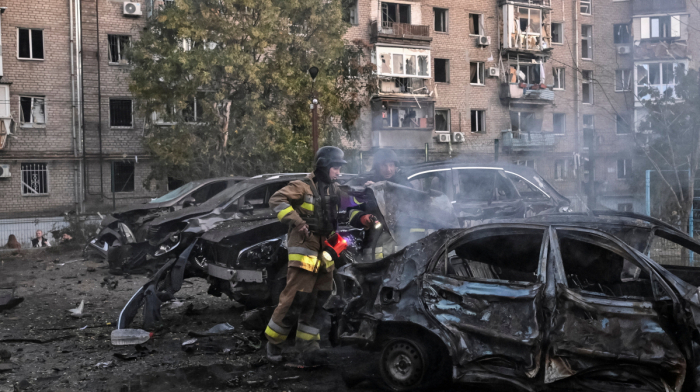
The negotiations unfolded against a backdrop of continued fighting. Russia carried out overnight air strikes across parts of Ukraine. In Odesa, damage to energy infrastructure left tens of thousands without heat and water, according to Ukrainian officials. Kyiv’s mayor said more than 1,000 residential buildings remain without heating following earlier strikes on a power facility.
Meanwhile, in an interview with Axios, Ukrainian President Volodymyr Zelenskyy said Trump was exerting undue pressure on him to move quickly towards a settlement. He described it as "not fair" that Ukraine, rather than Russia, was being publicly urged to make concessions, while expressing hope that the approach was tactical rather than final.
In his nightly address, Zelenskyy said, “All of these Russian missiles and drones used today contain thousands of components that Russia does not produce itself. Five Iskander-M missiles contain at least 75 critical foreign-made components. Three Kh-101 missiles contain nearly 160 components that Russia cannot replace on its own."
"Each Shahed drone contains hundreds of such components imported into Russia from other countries, and not only from Chinese companies, by the way, but also from Europe, America, and Japan," Zelenskyy said.
He urged the international community to pressurise Russia with sanctions.
"It is important not only for us in Ukraine but for global security overall that partners truly block the supply chains of critical components to Russia for weapons production. Companies themselves must also better monitor where their components end up. Without such connections to the world, Russia cannot function — it is not capable of being strong in complete isolation," he added
However, Trump has indicated that Ukraine must act swiftly for negotiations to succeed, telling reporters that Kyiv should come to the table fast.
Zelenskyy thanked Trump for his peacemaking efforts and said his discussions with Witkoff and Kushner had not involved the same degree of pressure. He added that Ukrainians would reject any proposal requiring them to give up territory not captured by Russia if such a plan were put to a referendum.
Instead, he called for positions to be frozen along the current front line, suggesting that such an arrangement could gain public support.
The Geneva round on Ukraine was held in a mix of bilateral and trilateral formats and ended without a breakthrough, although both sides agreed to keep the process going as they prepared for a second day of negotiations in Geneva.
Talks are expected to resume as mediators seek to narrow differences over territorial control and other outstanding issues. Officials have cautioned against expecting quick results, signalling that several more rounds may be needed before any broader settlement can take shape.











What is your opinion on this topic?
Leave the first comment