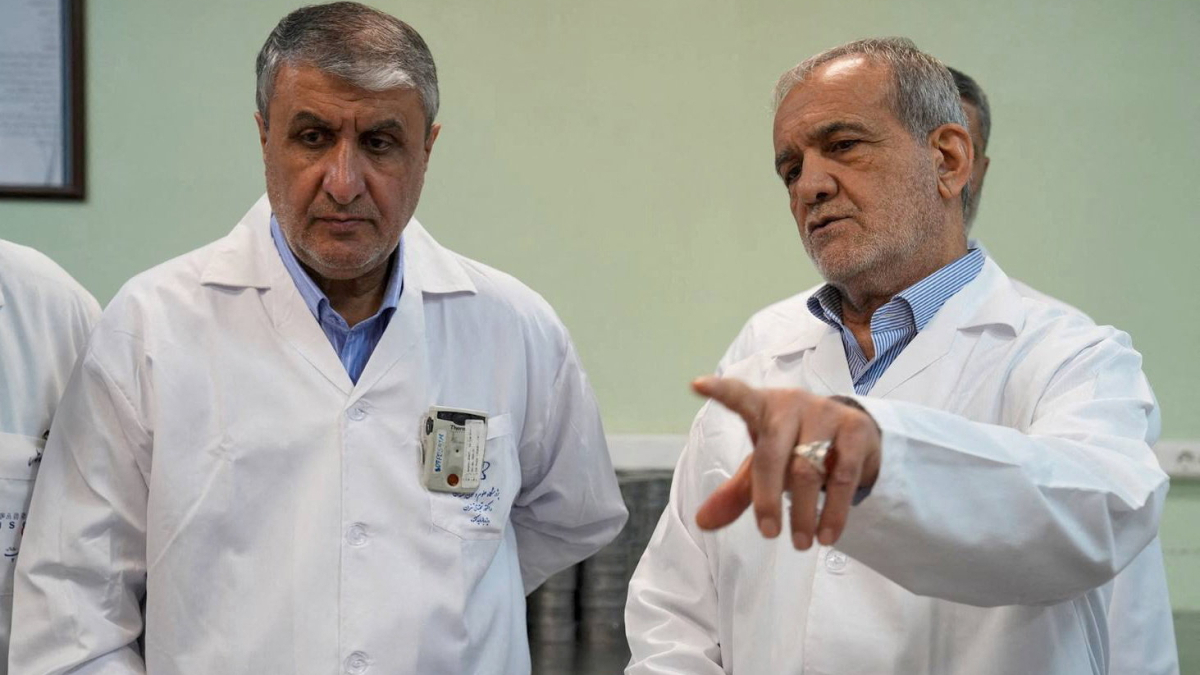
Iran’s nuclear agency chief Mohammad Eslami said on Saturday that nuclear weapons have “no place” in Iran’s military doctrine, insisting the country is fully capable of defending itself without possessing an atomic bomb.
Speaking in an interview with local media, Eslami said Iran does not seek nuclear weapons and already possesses sufficient deterrence to protect its national security.
His comments come amid heightened tensions with Washington, after U.S. President Donald Trump this week warned Tehran to abandon its nuclear ambitions or face possible military confrontation, while announcing that a large U.S. naval force was heading towards the region.
Eslami reiterated that Iran’s nuclear programme is peaceful, accusing the United Nations nuclear watchdog, the International Atomic Energy Agency (IAEA), of politicising Iran’s nuclear file. He also criticised IAEA Director General Rafael Grossi, accusing him of facilitating Israeli strikes on Iranian nuclear facilities during the 12-day conflict in June 2025.
He described Iran’s nuclear dossier as “political in nature” and said external pressure on the IAEA was likely to intensify rather than ease. While acknowledging years of negotiations that led to the 2015 Joint Comprehensive Plan of Action (JCPOA), Eslami said the agreement ultimately collapsed after the United States and European signatories — Britain, France and Germany — failed to uphold their commitments, triggering a snapback of sanctions late last year.
Eslami said the bombing of Iran’s nuclear sites during the June 2025 war was unprecedented and violated international law and the UN Charter. He stressed that all targeted facilities were registered with the IAEA and had been under its supervision at the time of the attacks.
Iran remains a signatory to the Nuclear Non-Proliferation Treaty, he said, and continues to comply with safeguards, though parliamentary legislation has suspended certain aspects of cooperation with the IAEA to protect nuclear facilities and personnel. Inspections at damaged sites have been halted, while monitoring of undamaged facilities continues.
Eslami accused the IAEA of failing to respond adequately to the attacks and called on the agency to act independently and professionally, including clarifying what measures would be taken if nuclear sites are targeted in future conflicts.
Looking ahead to the IAEA Board of Governors meeting in March, he said Iran expects increased pressure and warned of a possible referral of its case to the UN Security Council.
Addressing concerns over Iran’s uranium enrichment, Eslami said production of material enriched to 60% was intended for future civilian needs, including nuclear propulsion, arguing that lower enrichment levels were insufficient for such purposes.
During the June conflict, U.S. forces struck Iran’s nuclear facilities in Fordow, Natanz and Isfahan, after which President Trump claimed the programme had been “obliterated”. Iranian officials have neither confirmed nor denied that assessment.
Eslami reiterated that Iran does not seek nuclear weapons, citing a religious decree issued by Supreme Leader Ayatollah Ali Khamenei banning their development. However, debate within Iran has intensified in recent months, with some voices calling for a reassessment of the country’s non-nuclear doctrine amid escalating threats from the United States and Israel.










What is your opinion on this topic?
Leave the first comment