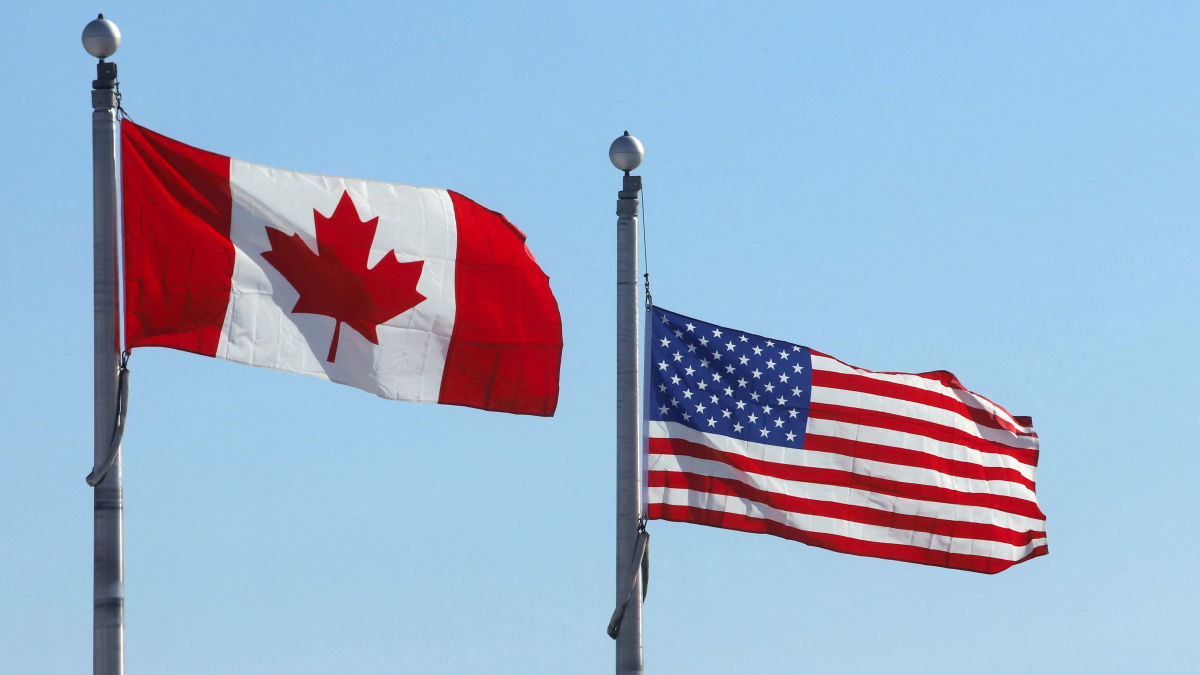
Canadian Prime Minister Mark Carney said on Sunday that his government has no intention of pursuing a free trade agreement with China, pushing back against claims by President Donald Trump, who has threatened to impose sweeping tariffs on Canadian goods if Ottawa deepens trade ties with Beijing.
Trump warned on Saturday that the United States would slap a 100% tariff on all imports from Canada if it went ahead with what he described as a trade deal with China, arguing that Beijing would “completely devour” Canada’s economy, businesses and way of life.
Carney said the claims misrepresented recent discussions with China, stressing that Canada had not entered into a free trade agreement and had no plans to do so.
“We have no intention of doing that with China or any other non-market economy,” Carney said. “What we have done with China is to rectify some issues that developed over the last couple of years.”
He added that under the United States–Mexico–Canada Agreement (USMCA), members are required to notify partners before pursuing free trade deals with non-market economies, a condition Canada has not breached.
Trump, however, dismissed Carney’s explanation in a series of social media posts, claiming China was “successfully and completely taking over” Canada and warning that Ottawa could become a conduit for Chinese goods entering the United States.
“If Prime Minister Carney thinks he is going to make Canada a ‘drop-off port’ for China to send goods into the United States, he is sorely mistaken,” Trump wrote, referring to the Canadian leader as “Governor Carney”, a term he has previously used while suggesting Canada should become the 51st U.S. state.
The dispute follows Carney’s visit to China earlier this month, where he sought to reset strained relations and reached a limited agreement reducing tariffs in specific sectors. Carney said the deal involved cutting tariffs on a small number of industries recently targeted by Chinese retaliation, rather than opening broad market access.
In 2024, Canada matched U.S. measures by imposing a 100% tariff on Chinese electric vehicles and a 25% levy on steel and aluminium. China responded with 100% tariffs on Canadian canola oil and meal, and 25% duties on pork and seafood.
Under the revised arrangement, Canada agreed to ease its tariff on Chinese electric vehicles in exchange for lower Chinese tariffs on Canadian agricultural products.
Carney said Chinese electric vehicle imports would initially be capped at 49,000 units a year at a tariff rate of 6.1%, rising to around 70,000 over five years.
He said the cap would represent about 3% of Canada’s annual vehicle sales and noted that China was expected to invest in Canada’s automotive sector within three years.
Trump seized on the issue by sharing a video featuring the head of the Canadian Vehicle Manufacturers’ Association, who warned that Canada’s auto industry depended heavily on access to the U.S. market and that domestic demand alone was insufficient to support large-scale manufacturing.
“A must watch,” Trump wrote. “The China deal is a disaster for them. Will go down as one of the worst deals in history.”
U.S. Treasury Secretary Scott Bessent echoed the criticism, saying Washington could not allow Canada to become an entry point for Chinese goods. He also questioned Carney’s motives ahead of a planned renegotiation of the USMCA this summer.
Relations between Trump and Carney have deteriorated sharply in recent days, particularly after Carney criticised Trump’s push to acquire Greenland, a move that has unsettled NATO allies. Speaking at the World Economic Forum in Davos, Carney argued that “middle powers” needed to work together to avoid coercion by larger states, warning that countries not “at the table” risked being “on the menu”.
Trump responded in his own Davos remarks by saying Canada “lives because of the United States”, a claim Carney later rejected.
“Canada doesn’t live because of the United States,” Carney said during a visit to Quebec. “Canada thrives because we are Canadian.”


















What is your opinion on this topic?
Leave the first comment