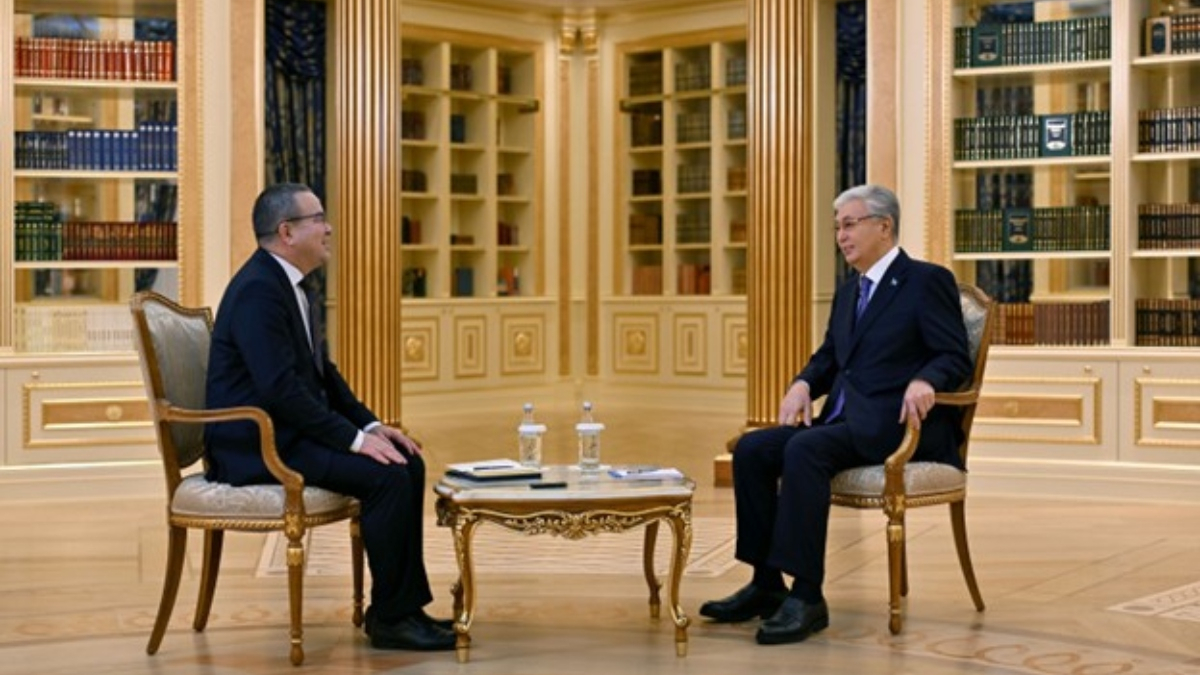
In his traditional New Year interview with the newspaper Turkistan, Kassym-Jomart Tokayev set out a broad assessment of Kazakhstan’s current position and future priorities, covering economic performance, global logistics, artificial intelligence, energy security and political reform.
The interview reflects an attempt to place recent achievements within a longer-term strategic framework, while openly acknowledging the risks emerging in an increasingly competitive and uncertain international environment.
Tokayev describes the past year as intense and fast-moving, pointing first to key macroeconomic indicators. Economic growth exceeded 6%, gross domestic product rose above $300 billion, and GDP per capita surpassed $15000. He characterises these figures as record highs not only for Kazakhstan but for the wider region. At the same time, the president warns against complacency, stressing that even favourable conditions can conceal dangers and that sustained growth requires constant discipline and adjustment.
From economic results, the interview turns to Kazakhstan’s transit and logistics potential, which Tokayev increasingly frames as a strategic asset. Despite being landlocked, the country is located at the centre of Eurasia, at the intersection of major transport routes linking China and Europe. This geographical position, he argues, offers significant advantages if supported by long-term infrastructure investment. By 2030, Kazakhstan plans to build and modernise 5000 kilometres of railways and to repair a further 11000 kilometres. Twelve international transport corridors already pass through the country, carrying up to 85% of overland freight traffic between China and Europe.
This infrastructure role has a clear foreign policy dimension. Tokayev points to Kazakhstan’s participation in the Belt and Road Initiative, the development of the North–South corridor, and efforts to strengthen the Trans-Caspian route, often referred to as the Middle Corridor. He also highlights growing interest in transport linkages connecting Russia, Kazakhstan, Turkmenistan and Iran. At the same time, he underlines that transport and logistics offer no easy income. Competition is intensifying, he says, and the sector has become closely intertwined with geopolitics.
The discussion then shifts to technology, with Tokayev announcing that 2026 will be declared the Year of Digitalisation and Artificial Intelligence in Kazakhstan. He frames this decision as a matter of national survival in a new technological era. Artificial intelligence, he argues, represents a dividing line between countries that manage to adapt and those that fall behind. Kazakhstan, in his view, must ensure it remains among those able to make this transition.
From digitalisation, Tokayev moves to the issue of energy, describing reliable electricity generation as a prerequisite for a new economic model based on supercomputing and large-scale data centres, which consume vast amounts of power. In this context, he defends plans to build several nuclear power plants. He calls this both a correction of what he terms a historical absurdity, being a global leader in uranium production without a single nuclear station, and an investment in prestige and in the formation of a new generation of technical specialists.
Another strategic priority highlighted in the interview is rare earth metals. Tokayev says global demand for critical materials is expected to double over the next five years, and Kazakhstan aims to position itself among the world’s leading countries in terms of reserves. To achieve this, the country is expanding cooperation with partners including the United States, China, Russia, South Korea, Japan and several European Union member states.
In the final part of the interview, the president turns to domestic politics and outlines what he sees as the defining priorities of the year ahead. These include large-scale political transformation, the continuation of economic reforms, and a referendum on constitutional reform. Tokayev says the scale of the proposed amendments would be comparable to adopting a new constitution, noting that work is already under way with a group of experts reviewing changes to the Basic Law.
Describing the period ahead as decisive, Tokayev says the coming year will be fateful for Kazakhstan, with events that will shape the country’s development for decades. At the same time, when asked about a future transfer of power, he says it is too early to discuss the issue and emphasises that several years of intensive work still lie ahead.











What is your opinion on this topic?
Leave the first comment