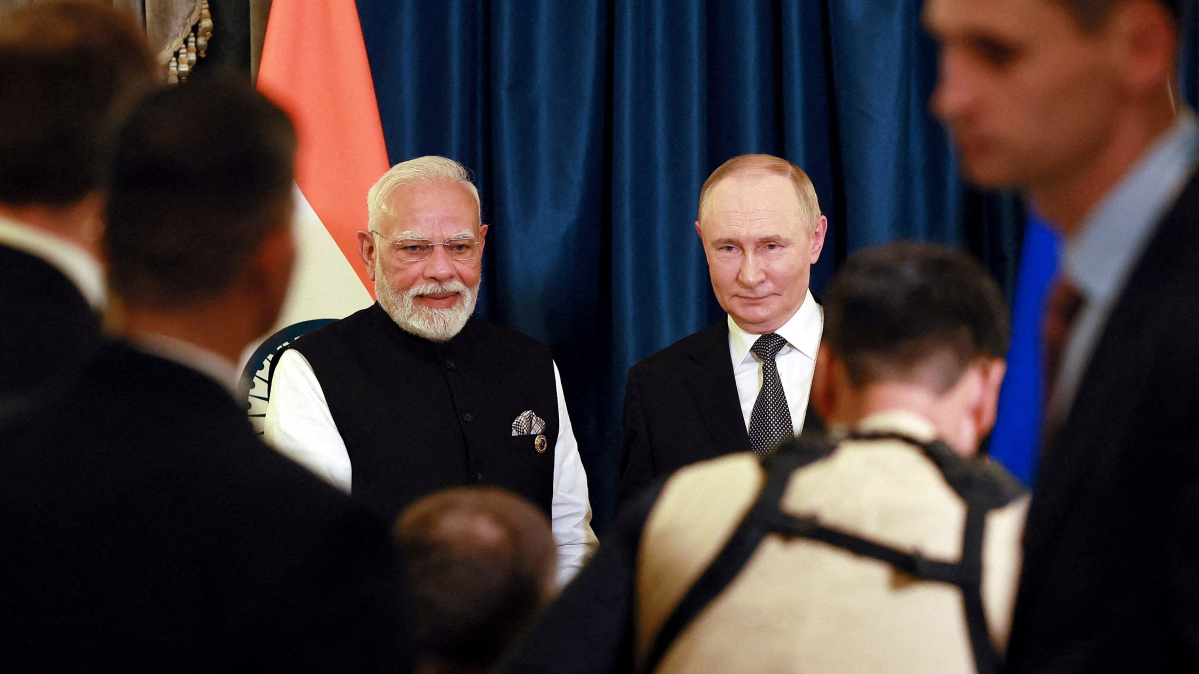
Facing mounting economic pressure and a shifting geopolitical landscape, Russian President Vladimir Putin is set to touch down in New Delhi on Thursday for a critical two-day summit.
The visit marks a significant diplomatic push by the Kremlin to reinvigorate a decades-old strategic partnership that has recently frayed under the weight of Western sanctions and aggressive US trade policies.
For President Putin, this trip—his first to the Indian capital in four years, is not merely ceremonial. It represents a determined effort to reverse a decline in energy and defence cooperation, sectors that have historically bound the two nations together but have suffered as India navigates the crosscurrents of global diplomacy.
The summit comes at a delicate moment for Prime Minister Narendra Modi. While New Delhi has maintained its "strategic autonomy" by refusing to condemn Moscow formally for the 2022 invasion of Ukraine, the economic realities of 2025 are testing this neutrality.
Following the invasion, India emerged as a vital economic lifeline for Moscow, becoming the top buyer of seaborne Russian oil.
However, that trend is reversing. Indian crude imports from Russia are on track to hit a three-year low this month.
This sharp decline coincides with a tightening of sanctions and a pragmatic pivot by New Delhi toward increasing purchases of US oil and gas to placate Washington.
Accompanied by Defence Minister Andrei Belousov and a high-powered delegation of business leaders, Putin’s primary objective is to arrest this slide.
The Russian delegation includes the chief executives of Sberbank and Rosoboronexport, alongside heads of sanctioned energy giants Rosneft and GazpromNeft, signalling a keen intent to secure concrete deals rather than mere diplomatic pleasantries.
"Putin's visit offers an opportunity for Delhi to reassert the strength of its special relationship with Moscow, despite recent developments, and make headway in new arms deals," noted Michael Kugelman, a senior South Asia fellow at the Atlantic Council.
"India-Russia summits are never solely optics-driven affairs, given the substance of the relationship."
The Trump Factor
Looming large over the summit is the shadow of US President Donald Trump. Indian officials are acutely aware that deepening ties with Moscow risks provoking further economic retaliation from Washington.
In August, the Trump administration doubled tariffs on Indian goods to 50%—a punitive measure explicitly linked to New Delhi's continued consumption of Russian crude.
This economic coercion has complicated matters. While officials from India and Russia have been engaged in preparatory talks regarding defence, shipping, and a potential free trade deal with the Eurasian Economic Union, the threat of US secondary sanctions remains a potent deterrent.
According to industry sources, Moscow is expected to request India’s assistance in procuring spare parts and technical equipment for its oil infrastructure, which has been degraded by years of Western technology bans.
Additionally, India is likely to push for the restoration of ONGC Videsh Ltd’s 20% stake in the Sakhalin-1 project in Russia’s Far East.
However, the path forward is fraught with difficulty. Most major Indian refiners have ceased buying Russian oil to avoid US ire, though widening discounts are tempting some state-run refiners back into the market.
Indian Oil Corp and Bharat Petroleum Corp have reportedly placed orders for December and January, utilising non-sanctioned Russian entities to bypass restrictions.
Defence: The Enduring Pillar
While energy trade fluctuates, defence remains the bedrock of the Russia-India relationship. Unlike oil, which can be sourced elsewhere, India’s military infrastructure remains heavily dependent on Russian hardware.
"Unlike crude, India does not plan to freeze defence ties with Moscow anytime soon as it requires continued support for the many Russian systems it operates," said Defence Secretary Rajesh Kumar Singh.
The Indian Air Force relies on Russian Sukhoi-30 jets for the majority of its fighter squadrons. To maintain operational readiness, India needs a steady flow of spares.
Furthermore, Moscow is eager to upsell New Delhi on its most advanced fighter, the Su-57, and secure orders for additional S-400 air defence systems—a platform that has previously drawn threats of sanctions from Washington.










What is your opinion on this topic?
Leave the first comment