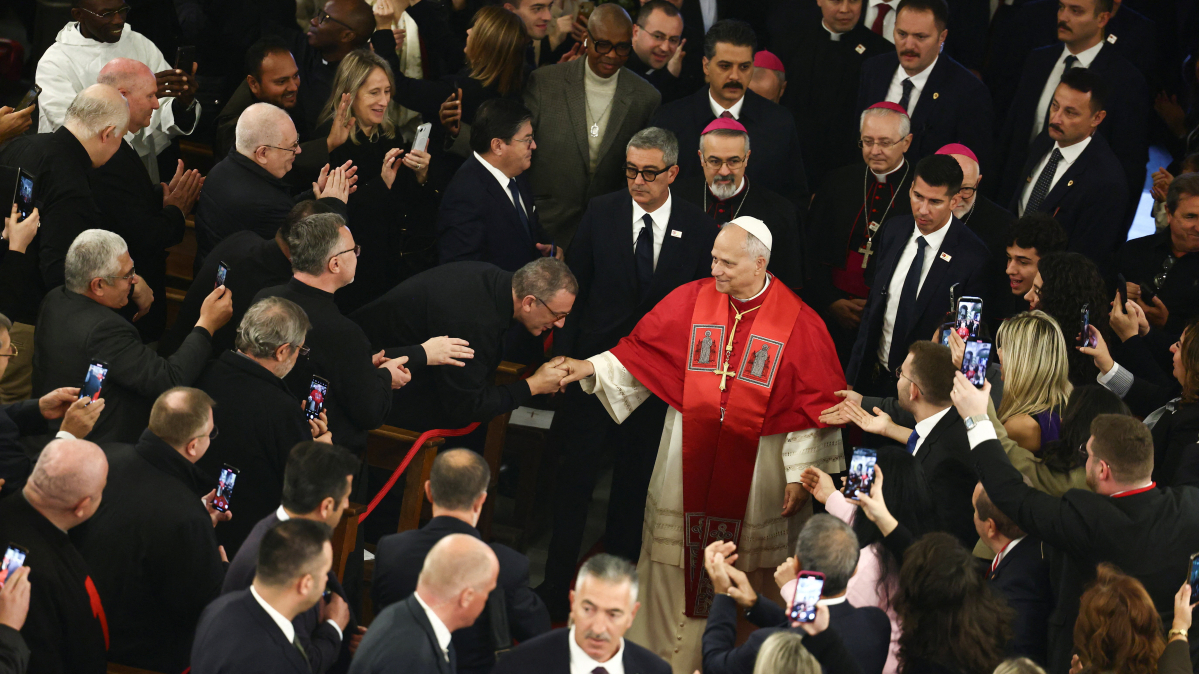
Pope Leo condemned violence in the name of religion on Friday at a landmark event with Christian leaders from across the Middle East, urging them to overcome centuries of heated divisions.
At a celebration of the 1,700th anniversary of a major Church council with senior clerics from countries including Türkiye, Egypt, Syria and Israel, Leo called it a scandal that the world's 2.6 billion Christians were not more united.
"Today, the whole of humanity, afflicted by violence and conflict, is crying out for reconciliation," Leo said at a ceremony in the Turkish town of Iznik, once known as Nicaea, where early churchmen created the Nicene Creed still used by most Christians today.
"We must strongly reject the use of religion for justifying war, violence, or any form of fundamentalism or fanaticism," said Leo, the first U.S. pope. "The paths to follow are those of fraternal encounter, dialogue and cooperation."
Friday's ceremony, at which the Church leaders prayed in English, Greek and Arabic and lit candles near the underwater ruins of a fourth-century basilica, is the main reason for Leo's four-day visit to predominantly Muslim Türkiye.
Leo, a relative unknown on the world stage before becoming pope in May, is being closely watched as he makes his first speeches overseas and interacts for the first time with people outside mainly Catholic Italy.
'MESSAGE OF PEACE AND UNIVERSAL FRATERNITY'
Christians were largely united during their first millennium, but began dividing into different denominations with the East-West Schism of 1054, when the Orthodox and Catholic communities split from one another.
Other divisions roiled Christianity in later centuries, including the Protestant Reformation, which sparked a series of bloody wars across Europe.
Leo told the clerics on Friday that if Christians could overcome their differences it would offer "a message of peace and universal fraternity that transcends the boundaries of our communities and nations".
Hundreds of excited onlookers gathered at the lakeside site where the event took place.
Beatrix Cervantes, 75, a French woman living in Türkiye, said the pope's visit was "very important".
"Whether we are Muslim, Catholic, Orthodox, or any other religion, the essential thing is that we live together peacefully," she told Reuters.
Also attending the ceremony at Iznik, 140 km (90 miles) southeast of Istanbul, was Ecumenical Patriarch Bartholomew, spiritual leader of the world's 260 million Orthodox Christians.
In his welcoming remarks, Istanbul-based Bartholomew urged Christian leaders not only to remember the past but to "move forward" together.
In an illustration of the divisions that Leo lamented, the Russian Orthodox Church, which is closely allied to President Vladimir Putin, did not attend Friday's celebration. The Moscow Patriarchate severed ties with Bartholomew in 2018 over his recognition of an independent Ukrainian Orthodox Church.
Arriving in Türkiye on Thursday, Leo held talks with President Tayyip Erdogan and lamented that the world was racked by an unusual number of bloody conflicts.
Türkiye has only about 33,000 Catholics in a population of some 85 million, Vatican statistics show, but it was once home to important early Christian saints such as the apostles Philip, Paul and John.
Leo met some of Türkiye's Catholics on Friday morning at Istanbul's Holy Spirit Cathedral.
Amid shouts of "Viva il papa" (Long live the pope), he urged them not to seek political influence but to focus on helping migrants in Turkey, home to nearly 4 million foreigners. Some 2.4 million of them are Syrian, while many others are from Afghanistan, Iran and Iraq.
Leo has made care for migrants a key priority of his six-month papacy, frequently criticising the anti-immigration policies of U.S. President Donald Trump.
Crowded itinerary in Türkiye, Lebanon
Leo, 70 and in good health, has a crowded itinerary during his six-day overseas trip, which also includes Lebanon.
In Türkiye, he will visit Istanbul's Blue Mosque on Saturday, his first visit as pontiff to a Muslim place of worship, and will celebrate a Catholic Mass at the city's Volkswagen Arena.
Peace is expected to be a key theme of Leo's visit to Lebanon, which starts on Sunday.
Lebanon, which has the largest share of Christians in the Middle East, has been rocked by the spillover of the Gaza conflict, as Israel and the Lebanese Shi'ite Muslim militant group Hezbollah went to war, culminating in a devastating Israeli offensive.
Leaders in Lebanon, which hosts 1 million Syrian and Palestinian refugees and is also struggling to recover from years of economic crisis, are worried Israel will dramatically escalate its strikes in coming months and hope the papal visit might bring global attention to the country.










What is your opinion on this topic?
Leave the first comment