Several countries and international organisations have welcomed the ceasefire agreement between Afghanistan and Pakistan, describing it as a vital step towards easing tensions and fostering regional stability.
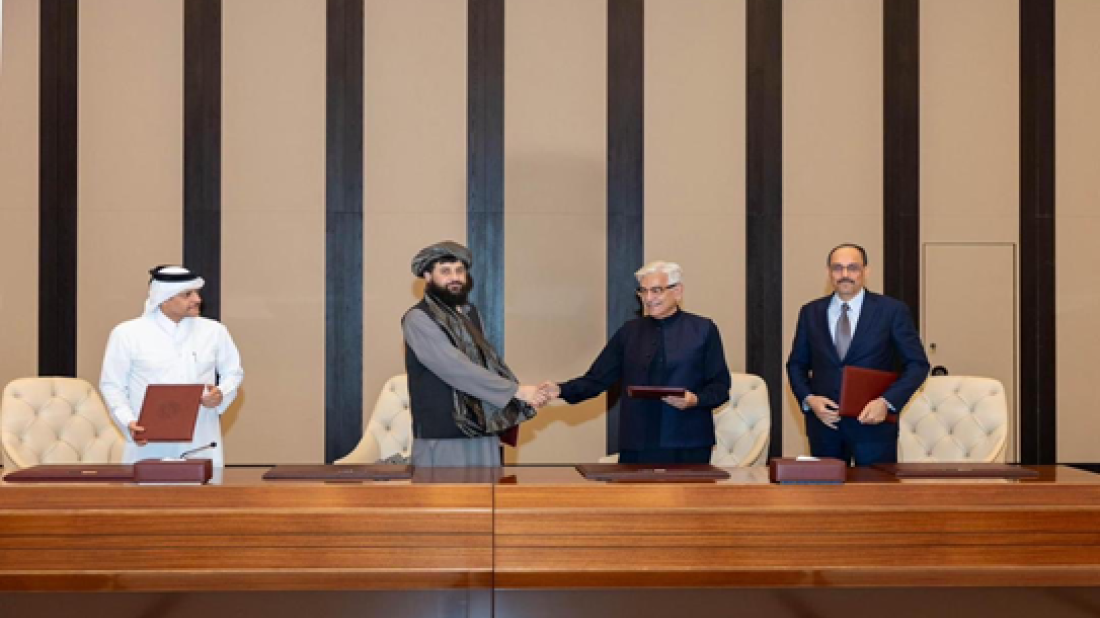
Afghanistan and Pakistan signed the ceasefire agreement in Doha over the weekend, with Qatar and Türkiye acting as mediators, following a week of clashes between both countries’ security forces.
Clashes between the security forces of the two countries erupted after the Afghan Ministry of Defence accused Pakistan of violating its airspace and conducting air strikes inside Afghanistan.
Islamabad, which accuses Kabul of sheltering militant groups did not confirm nor deny the allegations.
The Afghan and Pakistani governments have reported that the ceasefire signed in Doha also includes establishing a mechanism to enhance security and cooperation between the neighbouring countries.
The next round of negotiations between Afghanistan and Pakistan is expected in Istanbul on 25 October.
The ceasefire between Afghanistan and Pakistan has garnered widespread international support from several countries and international organisations.
The Ministry of Foreign Affairs of Saudi Arabia has praised the signing of the ceasefire agreement and reaffirmed its commitment to ensuring stability and prosperity for the “brotherly peoples of Pakistan and Afghanistan.”
In a statement, the ministry expressed appreciation for Qatar and Türkiye’s mediation roles, saying Riyadh hopes this positive step will help end tensions between Kabul and Islamabad.
The Organisation of Islamic Cooperation (OIC) and the Muslim World League (MWL) also issued statements supporting the ceasefire.
Both organisations described the move as a significant development that could restore coordination, enhance cooperation, and strengthen good-neighbourly relations across the region.
China also welcomed the ceasefire. In a statement, the Chinese Foreign Ministry praised Türkiye and Qatar for their peace efforts and for securing the ceasefire.
China reaffirmed its commitment to maintaining its constructive role in strengthening and developing relations between Pakistan and Afghanistan.
From Moscow, the Russian Foreign Ministry also welcomed the agreement. In a statement, the spokeswoman of the Russian Foreign Ministry, Maria Zakharova, said, “The commitment of the Islamic Emirate of Afghanistan and the Islamic Republic of Pakistan to dialogue and to resolving differences by political and diplomatic means serves as the foundation for maintaining peace between these two countries, which are friendly to us, and as an important factor in ensuring regional security.”
The spokesperson of the Iranian Foreign Ministry, Esmail Baghaei, also praised the ceasefire agreement between the two countries.
Esmail Baghaei emphasised that regional developments in Afghanistan and Pakistan affect the regional countries. He said, “Tehran welcomes the signing of the ceasefire agreement between the two sides.”
The Jordanian Foreign Ministry and the State of Kuwait also welcomed the agreement and expressed hope that it would permanently end tensions between Afghanistan and Pakistan. Both sides praised Qatar and Türkiye for their constructive role and support in mediating and hosting the negotiations.
Meanwhile, at the United Nations, spokesperson Stéphane Dujarric stated that Secretary-General António Guterres hopes the ceasefire will be maintained, urging both sides to settle disagreements through diplomacy.
Observers say the ceasefire and new peace measures could mark a turning point in Afghanistan–Pakistan relations, paving the way for ongoing dialogue, regional collaboration, and decreased border tensions.













What is your opinion on this topic?
Leave the first comment