France and Saudi Arabia will convene dozens of world leaders on Monday to rally support for a two-state solution, with several of them expected to formally recognise a Palestinian state - a move that could draw harsh Israeli and U.S. responses.
Israel and the United States will boycott the summit, said Israel’s U.N. Ambassador Danny Danon, describing the event as a “circus.” “We don't think it's helpful. We think it's actually rewarding terrorism,” he told reporters on Thursday.
Israel is considering annexing part of the occupied West Bank as a possible response as well as specific bilateral measures against Paris, Israeli officials have said.
The U.S. administration has also warned of possible consequences for those who take measures against Israel, including against France, whose president, Emmanuel Macron, is hosting the New York summit.
The summit, ahead of this week's United Nations General Assembly, follows Israel's launch of a long-threatened ground assault on Gaza City and amid few prospects for a ceasefire two years after Palestinian Islamist militants Hamas attacked Israel, triggering the war in the Strip.
Amid Israel's intensified Gaza offensive and escalating violence by Israeli settlers in the West Bank, there is a growing sense of urgency to act now before the idea of a two-state solution vanishes forever.
The General Assembly endorsed a seven-page declaration this month outlining "tangible, timebound, and irreversible steps" towards a two-state solution, while also condemning Hamas and calling it to surrender and disarm.
Those efforts drew immediate rebukes from Israel and the United States, calling them harmful and a publicity stunt.
"The New York Declaration is not a vague promise for the distant future, but rather a roadmap that begins with the top priorities: a ceasefire, the release of hostages, and the unimpeded entry of humanitarian aid into Gaza," France's Foreign Minister Jean-Noel Barrot told reporters on Thursday.
"Once the ceasefire and release of hostages are achieved, the next step is a plan for the day after, which will be on the agenda for Monday’s discussions."
France has driven the move, hoping that Macron's announcement in July that he would recognise a Palestinian state would give greater momentum to a movement hitherto dominated by smaller nations that are generally more critical of Israel.
Britain, Canada, Australia and Portugal all recognised a Palestinian state on Sunday. France and five other states are expected to also formally recognise a Palestinian state on Monday.
Some have said there would be conditions and others have said normalisation of diplomatic ties would be phased and dependent on how the Palestinian Authority advances in its promises to reform.
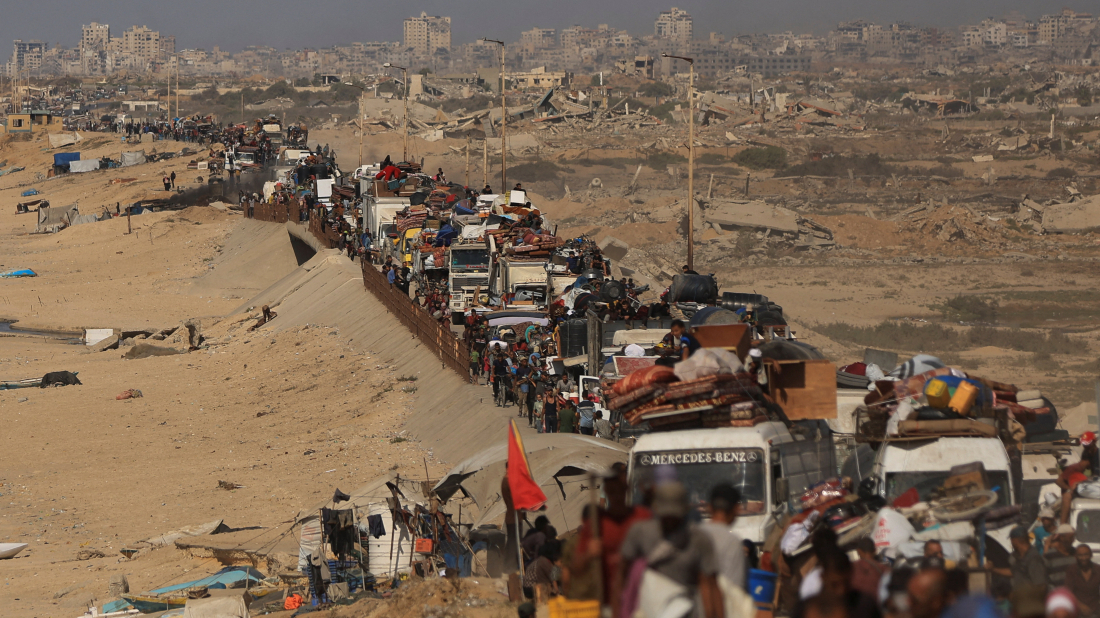
In Gaza, Palestinians were fleeing Israeli attacks on Gaza City on Sunday.
Displaced Palestinian Nabeel Jaber expressed doubts that recognition of a Palestinian state would bring tangible progress because no countries will push Israel enough to agree to a two-state solution.
“Even if countries such as Australia, Canada, and France —who are now among those initiating this recognition — acknowledge Palestine, I believe there will still be no serious pressure on Israel to grant the Palestinians their rights," he said.
"I also hope that diplomatically, this recognition by major world powers with global influence will serve as a tool to pressure, strong enough to push for a complete ceasefire and an end to the war.”
Residents of the Israeli-occupied West Bank, where Palestinians want to establish a homeland, appeared more optimistic.
"It is a victory for the historic rights of the Palestinians," said Mohammed Abu Al Fahim.
In Tel Aviv, Israelis, still angered by the October 2023 Hamas attack on Israel, said the Palestinians turned down many chances to establish a state in the past.
"We've offered them peace about five times. They could have agreed to any one of those, and they never, ever chose peace. So why do we need to choose peace with people who want to kidnap, murder, rape our people? I don't think we need to do that," said film student Tamara Raveh, 25.
Israel has said it is opposed to the move and has no confidence in the 89-year-old Palestinian President Mahmoud Abbas keeping pledges to reform and modernise as outlined in a letter to Macron earlier this year.
Abbas and dozens of Palestinian officials will not be there in person. The U.S., a staunch Israeli ally, refused to issue visas and Abbas is due to appear via video.
Saudi Crown Prince Mohammed bin Salman is not attending despite co-hosting the event. The General Assembly agreed on Friday - by consensus, without a vote - that he could appear via video at Monday's meeting.
"The world is saying out loud a Palestinian state and we need to materialise it. Now they need to show what these measures are," Palestinian Foreign Minister Varsen Aghabekian Shahin told reporters on Sunday.













What is your opinion on this topic?
Leave the first comment