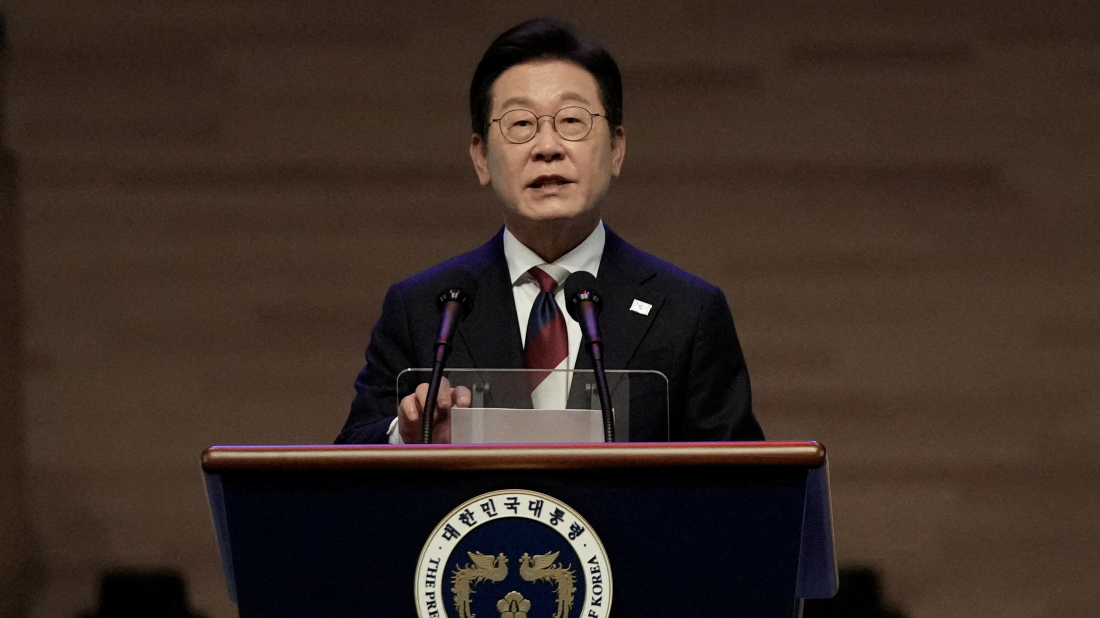
South Korea's new president, Lee Jae Myung, will face a pivotal moment on Monday when he meets U.S. President Donald Trump in Washington for their first summit on Monday (25 August), as the countries' decades-old alliance strains to confront rapid geopolitical changes.
Much is riding on the meeting for Lee, who took office in June after a snap election called after his conservative predecessor, President Yoon Suk Yeol, - feted in Washington for his hard line on North Korea - was removed for attempting to impose martial law.
South Korea's economy relies heavily on the U.S., with Washington underwriting its security with troops and nuclear deterrence. Lee hopes to chart a balanced path of cooperation with the U.S., while not antagonising top trade partner China.
As he headed to the U.S., Lee sent a special delegation to Beijing, which delivered a message calling for normalised relations with China that have been strained in recent years.
South Korea has long come under targeted criticism from Trump, who has called it a "money machine" that takes advantage of American military protection.
Lee will seek to make a good impression, connect personally with Trump, and above all, avoid any unpleasant surprises, analysts said.
"For Lee, a no-news summit I think would be good," said Victor Cha of the Center for Strategic and International Studies.
As part of his preparations for the summit, Lee told reporters during his flight to Washington that he had read 'Trump: The Art of the Deal'.
Trade and investments
Under heavy pressure from Trump's administration, South Korean negotiators secured a last-minute deal last month to avoid the harshest of new U.S. tariffs, but they must still hammer out details of billions of dollars in promised investments in the United States.
South Korean officials say they hope such working-level trade negotiations will largely be left for other meetings.
"There are many major topics in the security field," Lee's top policy aide, Kim Yong-beom, said last week.
"Our position is that trade was already finalised last time. We hope that specific implementation plans for trade won't be included in the summit at all, or at least should be kept simple if discussed," he said.
Several top officials, including the foreign minister, rushed to Washington over the weekend to try to iron out final details.
Lee, who arrived in Washington on Sunday, will highlight some of South Korea's expected investments when he visits a shipyard in Philadelphia owned by the country's Hanwha Group after the summit. Cooperation to help the ailing U.S. shipbuilding sector is part of the broad tariff agreement reached between the countries.
Engaging North Korea
Trump is expected to pressure Lee to commit to more spending on defence, including potentially billions of dollars more toward the upkeep of 28,500 American troops stationed in South Korea.
Wi Sung-lac, Lee's top security adviser, said South Korea was in talks with Washington over defence spending, taking as a reference NATO's agreement on a big new defence spending target. Wi added that the government was also looking into a plan for the purchase of American weapons.
While focusing on increasing military spending, Lee will likely seek to avoid conversations about a potential reduction of U.S. troops or using them for a wider range of operations, or details on modernising the alliance, said Duyeon Kim, from the Center for a New American Security.
Lee told reporters it would be difficult for Seoul to accept the demand by the U.S. to adopt "flexibility" in operating the U.S. military stationed in South Korea.
"They should leave those topics for working-level officials to hash out," Kim said. "Ambition could backfire."
Trump and Lee may also discuss efforts to persuade North Korea to freeze and eventually abandon its nuclear weapons programme. Both leaders support engaging Pyongyang, and Lee has called for a phased approach to denuclearisation.
North Korean leader Kim Jong Un says South Korea and the U.S. remain hostile to his country and he will never give up his nuclear arsenal. Over the weekend Kim supervised test firing of new air defence systems.
Lee's visit to Japan
Before Lee meets Trump, the South Korean leader travelled to Tokyo to meet Japanese Prime Minister Shigeru Ishiba on Saturday to underscore the importance of cooperation between South Korea, Japan and the U.S.
A commentary carried by North Korea's state media on Monday criticised Lee's "despicable" trip to Tokyo as a "begging message towards the master of the White House" by highlighting trilateral military cooperation.
Lee and Ishiba discussed relations with Washington and U.S. tariff issues and the Japanese leader shared his experience with Trump, which for Seoul was useful information before Lee's first meeting with Trump, said Wi, the South Korean security adviser.











What is your opinion on this topic?
Leave the first comment