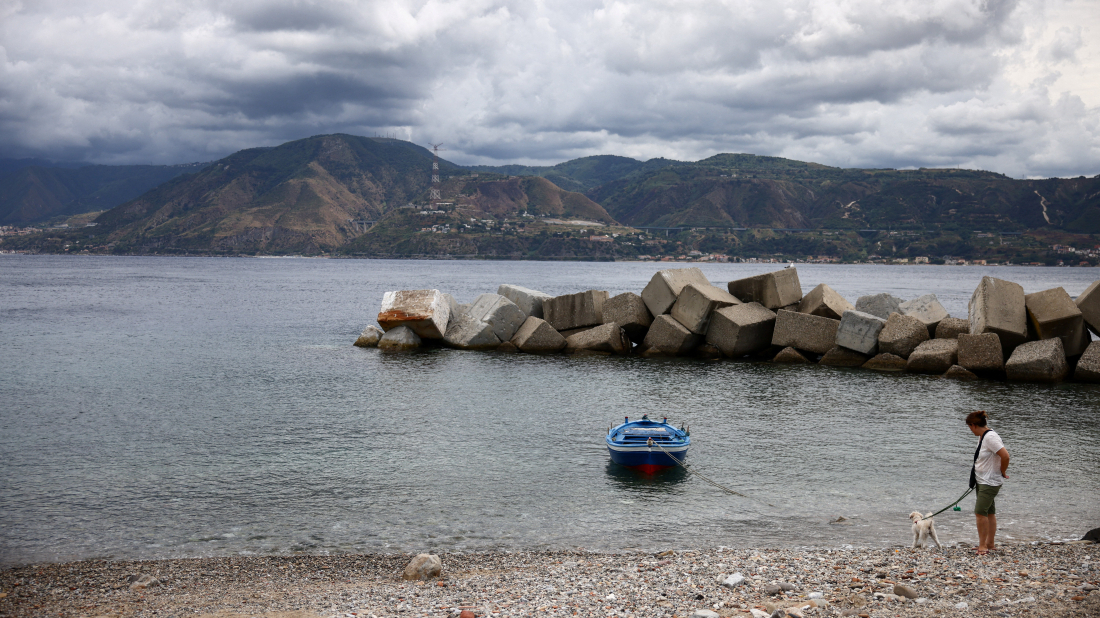
Italy’s government gave final approval on Wednesday for the construction of a long-planned suspension bridge linking Sicily to the mainland, a project touted as the world’s longest single-span bridge despite decades of environmental, financial and logistical concerns.
The 3.7-km Strait of Messina bridge has been under discussion since the late 1960s as part of efforts to boost economic development in Italy’s underdeveloped south.
The right-wing government of Prime Minister Giorgia Meloni has made the project a priority, allocating €13.5 billion ($15.63 billion) over the next ten years for construction and surrounding infrastructure.
The Interministerial Committee for Economic Planning and Sustainable Development (CIPESS) approved the plan at a meeting in Rome, the League party of Deputy Prime Minister and Transport Minister Matteo Salvini said.
According to the Messina Strait Company overseeing the project, the bridge is expected to be completed by 2032.
The project has long faced strong opposition from environmentalists, economists, and some local communities who argue that building such a massive structure in a seismically active area poses significant risks.
Concerns have also been raised about potential cost overruns, environmental degradation, and the risk of mafia infiltration in the construction process.
Some citizens' groups argue the bridge is unnecessary, while environmental organisations this week filed a complaint with the European Union citing serious environmental risks.
Supporters, however, say the bridge will deliver critical infrastructure to Sicily and improve connectivity between the island and the mainland, replacing the existing ferry system with faster road and rail transport. Advocates see the project as key to revitalising the economy in southern Italy.
The contract for the bridge was awarded to the Eurolink consortium following an international tender. The group is led by Italy’s largest construction firm, Webuild, and includes Spanish firm Sacyr and Japan’s IHI.
The Messina Strait Company said Wednesday’s approval clears the way for preliminary works to begin, including archaeological and geological surveys. Land expropriations will also be authorised.
Last week, Salvini told reporters that a review by the national audit court would still be required before the CIPESS decision can take effect. A source familiar with the matter said the process may take several weeks.
Webuild, which has ongoing projects around the world including in Saudi Arabia’s NEOM mega-development, has estimated the bridge construction could create more than 100,000 jobs. Sacyr previously participated in the Panama Canal expansion, and IHI has contributed to major suspension bridges in Japan and Türkiye’s.



















What is your opinion on this topic?
Leave the first comment