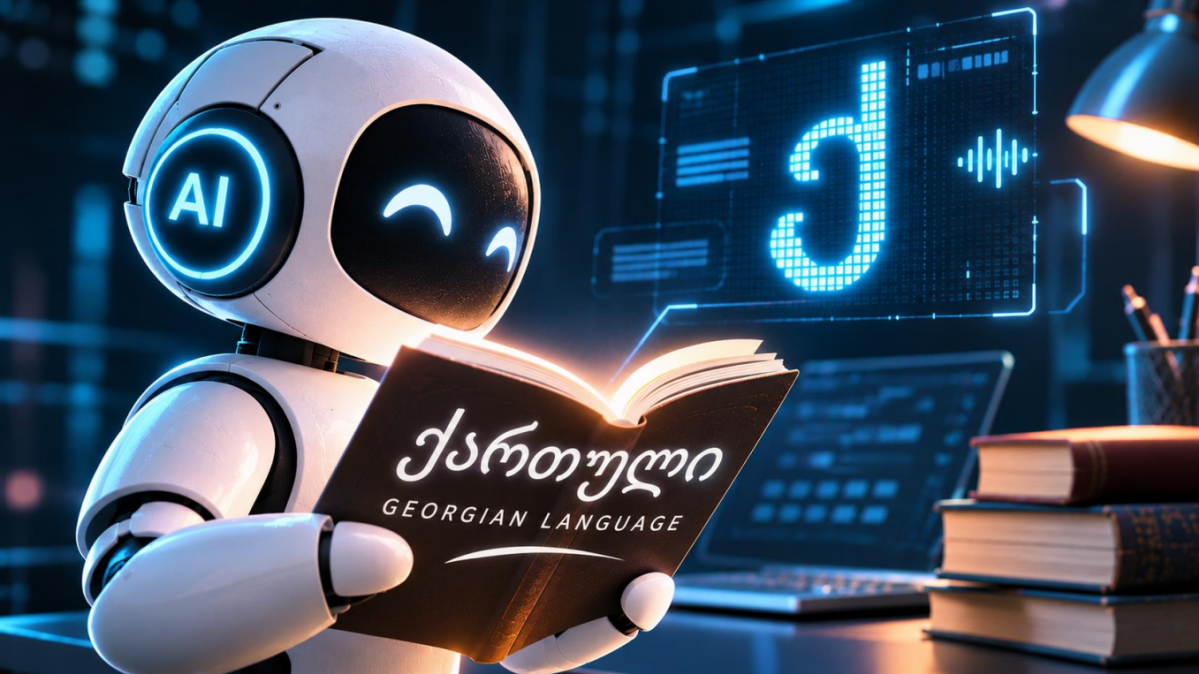
As artificial intelligence (AI) becomes part of everyday life, languages with smaller speaker communities risk being left behind. Georgian, spoken by around four million people worldwide, is facing a digital challenge: making sure it is understood by the machines shaping how the world communicates.
This is not necessarily because AI cannot process Georgian. The problem is that it has considerably less high-quality language material to learn from than it does for English, Spanish or Chinese.
In the world of artificial intelligence, the amount and quality of available data can make a significant difference. Georgian is particularly challenging. It belongs to the Kartvelian language family and has a complex grammatical structure, including extensive verb conjugations, grammatical cases and flexible sentence construction.
A single verb can carry information about several elements of an action, making it difficult for systems trained predominantly on other languages to reproduce Georgian naturally. Now, a new Georgian-language resource aims to help address that gap.
New dataset aims to help researchers
The Business and Technology University (BTU) in Tbilisi announced on 9 November that it had prepared an expanded dataset containing approximately 150 million tokens, alongside more than six million primary language records, grammatical examples and learning tasks.
The resource is intended to help researchers and developers train, test and improve AI systems working with Georgian. A token is a unit of text processed by an AI model. It can represent an entire word or just part of one.
More importantly, the new material is not simply a collection of sentences. It includes different grammatical structures, word forms, contextual examples and language exercises designed to help machines recognise how Georgian works.
The project was developed with support from Palitra Group, which provided a large collection of Georgian-language texts. The resource is publicly accessible through GitHub, although its published licence allows non-commercial use with attribution - commercial use requires separate permission. More data, better Georgian?
Other resources filling the gap
The initiative is part of a wider effort to address the shortage of resources for Georgian language technology. And it is not happening in isolation. Researchers at Tbilisi State University have developed GeoLogicQA, a Georgian-language benchmark designed to test whether AI models can do more than recognise words and produce fluent sentences.
It examines logical reasoning, reading comprehension, common-sense questions and mathematical problems. In initial tests of several major AI models, including Gemini, DeepSeek, Grok and GPT-4o, researchers recorded accuracy ranging from 64 per cent to 83 per cent. While the results demonstrated that models could perform reasonably well, the study also identified difficulties with more complicated reasoning and multi-step questions.
There are also efforts to improve AI's ability to recognise spoken Georgian. Mozilla's Common Voice, an international open-source speech initiative, has collected hundreds of hours of Georgian recordings for speech-recognition research.
Its September 2026 Georgian dataset contains approximately 494 hours of recorded speech, with more than 262 hours validated. These projects address different parts of the same problem: AI needs to understand not only how Georgian is written, but also how it is spoken, interpreted and used in everyday situations.
The gap is bigger than chatbots The consequences of limited language resources extend beyond awkward translations or unnatural chatbot responses. As AI becomes increasingly integrated into education, public services, healthcare, business and information platforms, the quality of language support will influence who can access these technologies comfortably and effectively.
Benefits of better language models
For Georgian users, better language models could eventually mean more accurate translations, educational tools that explain complicated subjects in Georgian, improved voice recognition and digital services that communicate naturally with citizens. But publishing a dataset does not automatically make existing AI platforms better.
It must first be incorporated into training or evaluation processes, and its effectiveness needs to be tested independently. The quality of the material, its diversity and the accuracy of its grammatical annotations matter just as much as its size. There is also a question of what is still missing. Written language resources alone cannot capture the full richness of Georgian.
Regional speech, dialects, informal conversations, cultural references and specialised terminology all require attention. Building reliable AI systems means continuously collecting, reviewing and updating this material. BTU's announcement is an additional step in that direction, rather than a finished solution.
Its publicly documented earlier dataset, for example, contains approximately 12 million tokens and more than 645,000 structured records, illustrating the development of the project over successive releases.
The expanded 150-million-token figure announced by the university will need to be reflected in accessible documentation and independently assessed as the new version becomes available.
For a language spoken by millions but represented less extensively in the global technology industry, the challenge is not simply teaching machines to produce Georgian sentences. It is making sure Georgian remains a language in which people can learn, work, communicate and participate in an increasingly AI-driven world. And that may prove just as important as teaching AI to speak it.
Read more from Georgia:










What is your opinion on this topic?
Leave the first comment