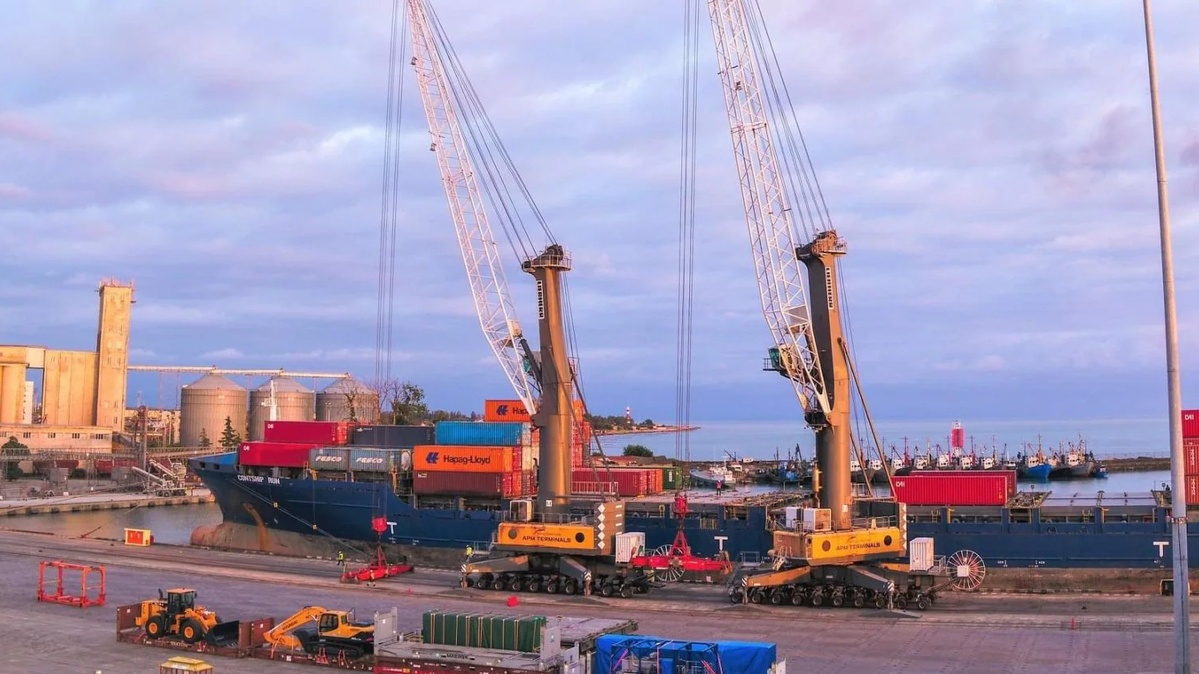
Georgia’s busiest sea gateway has reached its capacity limit, adding urgency to plans for a major expansion of Poti port as the country seeks to strengthen its role in the Middle Corridor trade route between Asia and Europe.
Zviad Chkhartishvili, head of the Poti Sea Port Administration, said the port is operating at the limit of its throughput capacity, making its long-discussed expansion increasingly urgent.
Privately financed expansion
Chkhartishvili said the Poti Port Expansion Project would be privately financed, with the state acting as a partner. The development would therefore not draw on taxpayers’ money.
The arrangement means responsibility for expanding Georgia’s key Black Sea port will fall on private investors rather than the public purse.
Higher volumes could ease tariffs
Chkhartishvili also highlighted the pressures on the port’s cost structure, with relatively modest cargo volumes and high operating costs contributing to higher tariffs.
He said increasing throughput and reducing costs should allow tariff policy to improve, potentially making Poti more competitive.
Expansion is therefore not only aimed at allowing the port to handle more containers, but also at creating the conditions for more competitive rates.
Competition across the Caspian
Poti faces growing regional competition. Ports in Aktau, Turkmenbashi and Baku have attracted significant investment in recent years, strengthening their positions along the Middle Corridor, which connects China and Europe through Central Asia and the South Caucasus.
Chkhartishvili said Georgia needs an “adequate infrastructural response” to keep pace with its Caspian neighbours.
Roads, railways and customs
The expansion of Poti alone will not be enough, according to Chkhartishvili, who said wider infrastructure improvements must progress alongside the project.
These include development of the East–West highway, modernisation of the railway network and digitalisation of customs procedures.
Together, he said, the projects form a unified strategy that will help determine whether Georgia can establish itself as a key link in the Middle Corridor rather than become a bottleneck along the route.
Boosting existing capacity
While negotiations over the larger expansion continue, APM Terminals, which operates the port, is already taking steps to handle rising cargo volumes.
Additional land has been acquired near the port to support future growth, while a new crane is expected to increase throughput capacity by 50,000 twenty-foot equivalent units (TEU).
The additional capacity is expected to support both Poti and the wider Middle Corridor.
Chkhartishvili expects the upgrades to increase the port’s total throughput capacity to 650,000 TEU by the end of the year.
Expansion talks continue
Negotiations between the Poti Sea Port Administration and Georgia’s Ministry of Economy and Sustainable Development are continuing, with both sides expected to hold further talks before the end of the year to finalise details of the large-scale expansion.
The project could strengthen Georgia’s position as a transit hub connecting Asia and Europe at a time when infrastructure investment elsewhere along the Middle Corridor is increasing.
With Poti already operating at its capacity limit, the expansion has become increasingly pressing as Georgia seeks to keep pace with growing regional competition.















What is your opinion on this topic?
Leave the first comment