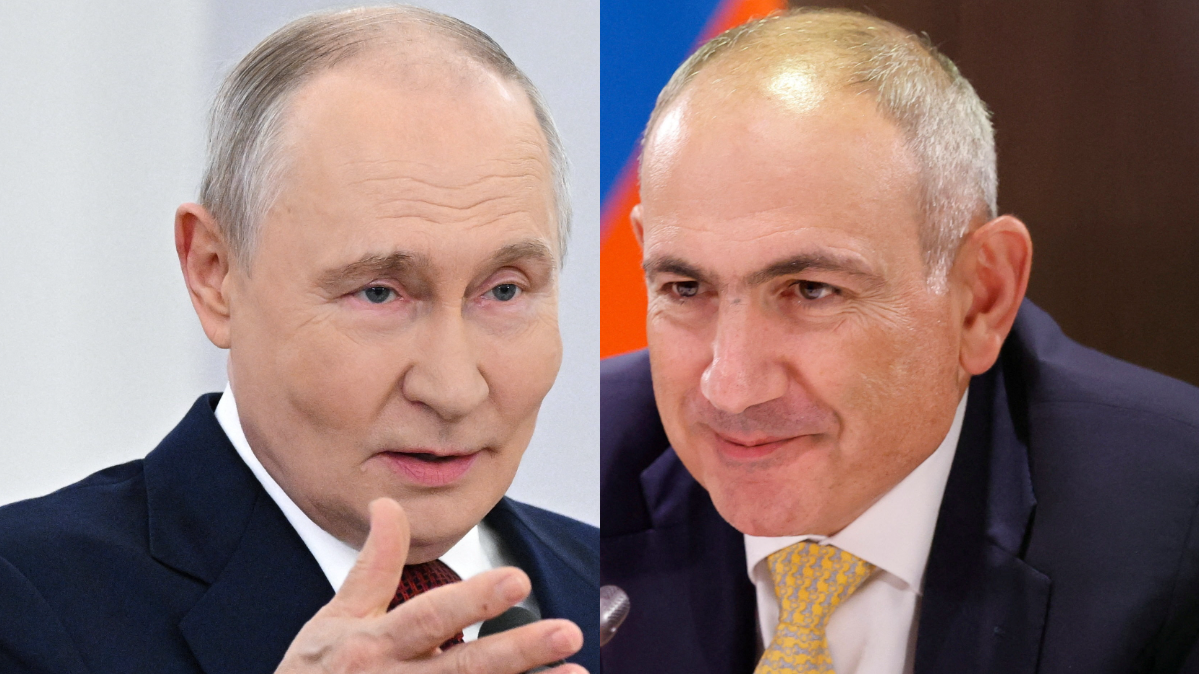
Armenian Prime Minister Nikol Pashinyan has urged Russian President Vladimir Putin to resolve a dispute over trade restrictions imposed by Moscow, Yerevan's government said on Monday.
Pashinyan, who has said Armenia wants to join the European Union (EU) despite its alliance with Russia, told Putin that import bans introduced by Moscow on Armenian products breached the rules of the Eurasian Economic Union (EAEU), of which both countries are members.
"He asked to take measures to resolve these issues," Pashinyan's office said, adding that Armenia remained ready to address outstanding disputes through dialogue.
The Kremlin said Putin told Pashinyan that the Armenian leader's proposal to seek EU membership should be put to a referendum "as soon as possible".
Since April, Russia has imposed trade restrictions on a growing list of Armenian products, including mineral water, vegetables, flowers and fish.
Moscow's food safety regulator has cited hygiene and sanitary violations for the bans and denied the restrictions are politically motivated.
European Union's response
However, European Commission President Ursula von der Leyen has accused Russia of trying to apply economic pressure on Armenia to punish the country for its pivot towards the EU.
In June, she described Moscow's trade restrictions as "nothing short of economic coercion" and "unacceptable".
"By extending export restrictions on Armenian products, Moscow is weaponising economic relations for political pressure," she said.
The EU has pledged financial assistance to Yerevan worth more than €50 million (U.S.$56 million) and eased trade for some Armenian products to help the country deal with the economic impact of the restrictions.
Impact of restrictions on Armenia
Armenia's central bank has estimated that the import bans introduced by Russia affect roughly two per cent of GDP, with redirected oversupply potentially lowering domestic prices by about 0.6 per cent.
Moscow has warned that Armenia could be suspended from the EAEU if it continues pursuing EU membership.
Armenia remains heavily dependent on Russia for energy supplies, while Russia accounted for about 35 per cent of Armenia's foreign trade last year.
Read more from Armenia:











What is your opinion on this topic?
Leave the first comment