India's delivery of guided Pinaka rockets to Armenia is drawing renewed attention as analysts assess the military and strategic significance of one of New Delhi's most prominent defence export deals.
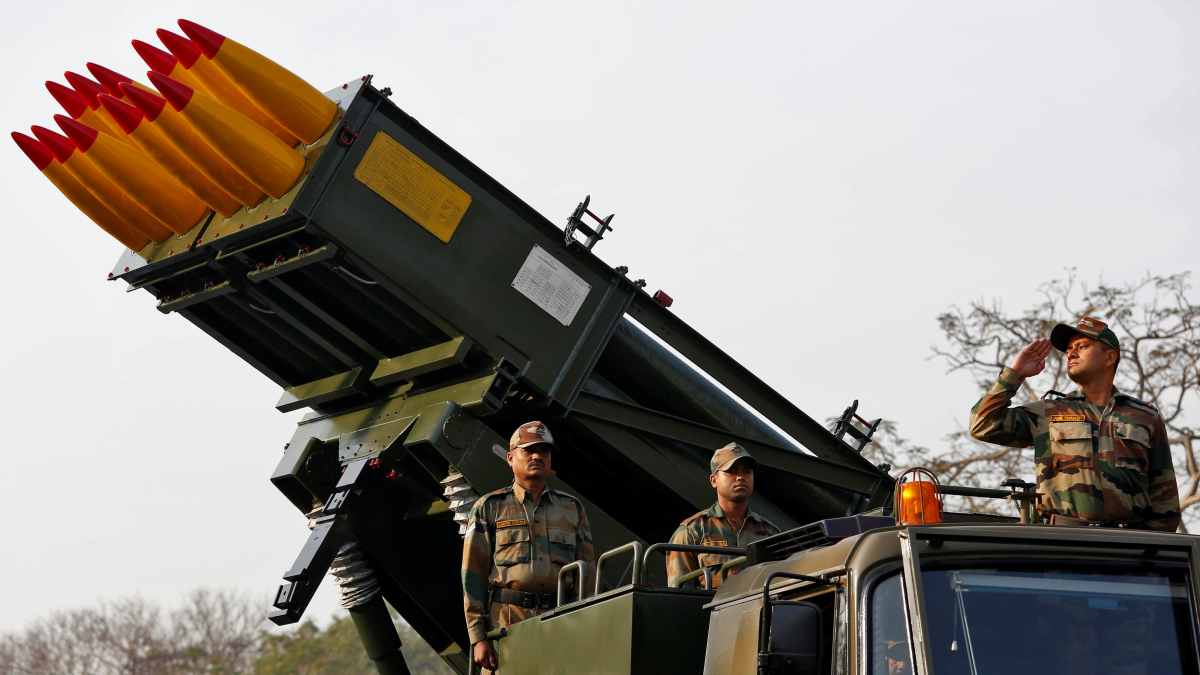
The shipment, which was flagged off by Indian Defence Minister Rajnath Singh at Solar Defence and Aerospace Limited (SDAL)'s facility in Nagpur on January 18, 2026, forms part of a wider artillery package previously ordered by Armenia. The transfer included an initial batch of 1,000 Guided Pinaka rockets, intended to support the operation of Armenia's Pinaka multiple launch rocket systems.
The export represents more than a simple ammunition delivery. It reflects India's broader ambition to establish itself as a major defence supplier while helping Armenia diversify military procurement beyond traditional sources.
Part of a larger defence package
The guided rockets are linked to an agreement reportedly valued at approximately 2,000 crore rupees (around US$240-250 million), covering four Pinaka batteries, ammunition and supporting equipment.
The Pinaka system was originally developed by India's Defence Research and Development Organisation (DRDO) as an indigenous multiple-launch rocket system for the Indian Army. Over the years, the system has evolved through several upgrades designed to improve range, accuracy and operational flexibility.
Reports indicate launcher and unguided ammunition deliveries occurred between 2023 and 2024, meaning the guided rocket shipment builds on equipment already delivered to Armenian forces rather than representing the start of a new acquisition programme. According to an analysis by Defence Security Asia, the latest deliveries are best understood as a continuation of an existing force-modernisation effort rather than a newly announced arms package.
Precision firepower and operational questions
Guided Pinaka rockets are reported to have an effective engagement range of approximately 75 to 80 kilometres, providing a significantly longer and more precise strike capability than standard unguided artillery rockets.
Military analysts note that such systems could allow Armenian commanders to engage targets at greater distances while reducing reliance on combat aircraft for some strike missions.
However, experts caution that possessing guided munitions does not automatically translate into battlefield effectiveness.
According to Defence Security Asia, the key military question is not simply how many rockets have been delivered, but how effectively Armenia can integrate them with reconnaissance systems, targeting networks, communications infrastructure, command structures and logistics support.
A precision-guided rocket remains dependent on accurate targeting information. Even highly accurate munitions can become ineffective if intelligence is incomplete, communications are disrupted, or targets relocate before impact.
Stock depth versus combat endurance
The reported figure of 1,000 guided rockets suggests a substantial ammunition reserve.
A standard Pinaka battery is generally configured with six launchers. Depending on ammunition type, a launcher may carry between eight and twelve rockets, creating significant short-term firepower.
If Armenia operates all four ordered batteries in a typical configuration, the inventory could provide several complete reload cycles beyond an initial deployment.
Analysts stress, however, that stockpile size should not be confused with sustained battlefield endurance.
The actual military value of the inventory depends on training, maintenance, replenishment capacity, launcher survivability and the availability of crews, spare parts and support vehicles. Ammunition reserves must also be distributed, protected and replenished under combat conditions.
As Defence Security Asia notes, launcher mobility and precision guidance cannot eliminate vulnerabilities to surveillance, electronic warfare, logistics disruption or counter-battery strikes.
Strategic significance
The strongest conclusion emerging from the delivery is that it deepens a growing defence relationship between India and Armenia while strengthening the material basis of Armenia's artillery force.
Yet military specialists argue that the real measure of success will not be the number of rockets exported, but whether Armenia can sustain precision-fire operations over time through effective training, logistics, survivability and replenishment.
Read more:

















What is your opinion on this topic?
Leave the first comment